

Key Takeaways
Why Drivers Delay - and What It Costs Them
Dashboard warning lights have a reputation problem. Because many drivers have seen a check engine light glow for months without the car visibly breaking down, the instinct to wait-and-see feels rational. It rarely is.
The underlying issue is that most warning systems are designed to alert early - before a small fault becomes structural damage. Delay compresses the window between a manageable repair and a catastrophic one. According to AAA's annual vehicle research, unplanned repairs are consistently among the largest out-of-pocket costs drivers face, and deferred maintenance is a primary driver of that figure.
Understanding what each light actually signals - and what ignoring it typically sets in motion - is one of the most direct ways to protect your vehicle budget. For a broader look at why maintenance costs escalate, see why your car costs more to maintain than it should.
Check Engine Light
The check engine light (CEL) is the most misunderstood indicator on any dashboard. It covers an enormous range of fault codes - from a loose gas cap to misfiring cylinders to a failing catalytic converter.
Typical escalation path: A loose gas cap or failing oxygen sensor might cost $20-$175 to address. Left undiagnosed, a misfiring engine can destroy a catalytic converter (often $1,000-$2,500 to replace) within weeks. A faulty oxygen sensor ignored long enough will skew fuel trims, reducing fuel economy and accelerating wear on downstream components.
First step: A basic OBD-II code reader (available at most auto parts stores for under $30, or read for free at many chain locations) will retrieve the stored fault code. That code narrows the diagnosis significantly before you see a mechanic.
A $30 code reader can prevent a $2,000 catalytic converter replacement - read the code first.
Oil Pressure Warning
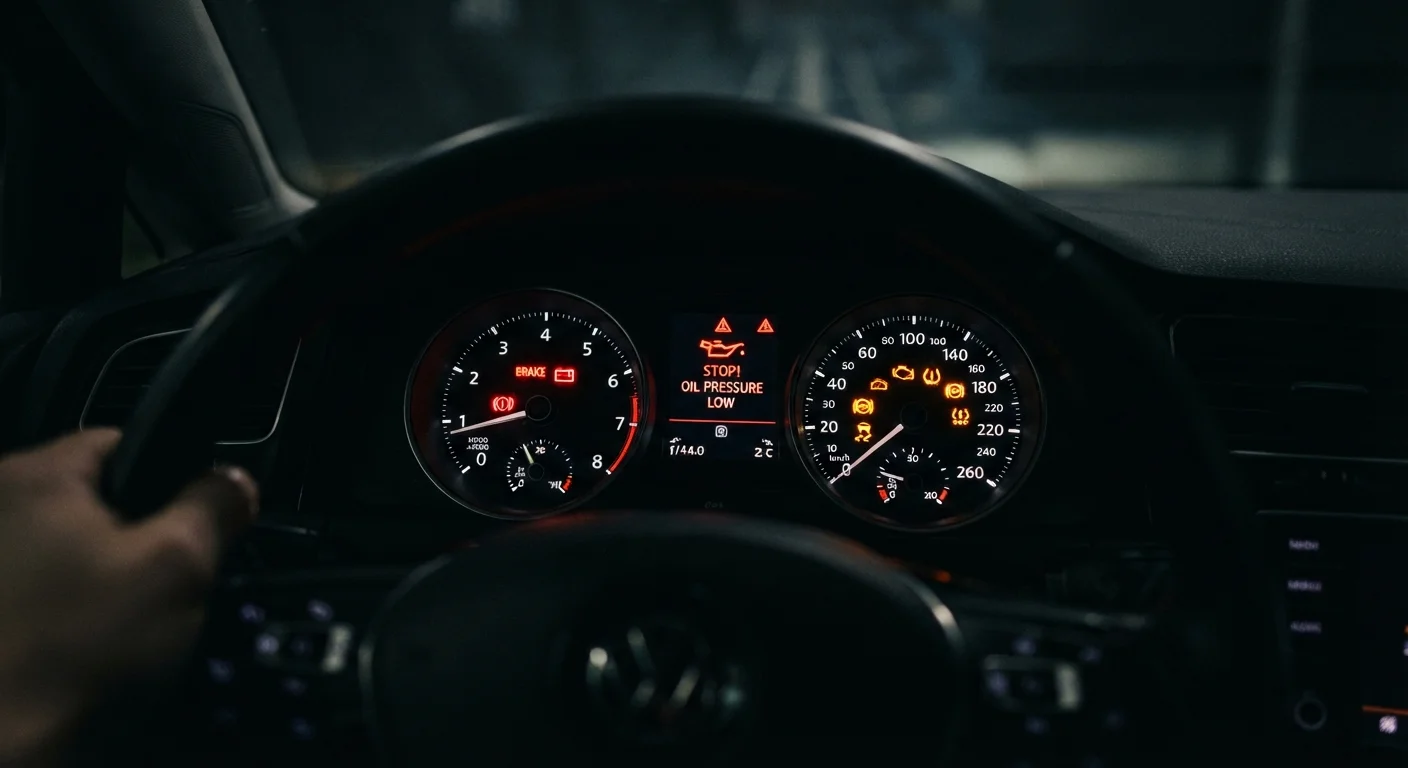
The oil pressure light - typically a red oil can symbol - is one of the few alerts that demands you pull over immediately. Low oil pressure means engine components are not being adequately lubricated. Metal surfaces are contacting metal surfaces.
Typical escalation path: Driving even a short distance with critically low oil pressure can score bearing surfaces, warp crankshafts, and cause rod failure. Engine replacement or rebuild costs commonly range from $3,000 to $10,000 depending on vehicle type. The cause might be as simple as low oil level (a $30-$60 fix with an oil top-up) or as serious as a failing oil pump.
First step: Stop driving, check oil level, and do not restart the vehicle until the cause is identified by a qualified mechanic.
Oil pressure warnings are stop-immediately alerts - continued driving risks total engine failure.
Coolant Temperature Warning
When the temperature gauge climbs into the red or a coolant warning light illuminates, the engine is approaching or reaching unsafe operating temperatures. Overheating is a leading cause of catastrophic engine damage.
Typical escalation path: A blown head gasket - one of the most common results of sustained overheating - can cost $1,500-$3,000 to repair. Warped cylinder heads add another $500-$1,500 in machine work. The original cause is often a $15 coolant leak from a hose or a $120 thermostat failure.
First step: Pull over safely, turn off the engine, and allow it to cool before checking coolant level. Never open a hot radiator cap. Have the cooling system pressure-tested before further driving.
A $120 thermostat fix ignored can become a $3,000 head gasket repair within miles.
Brake System Warning
Brake warning lights cover several distinct scenarios: low brake fluid, worn brake pads (on vehicles with electronic wear sensors), or an ABS fault. Each has a different urgency level, but none should be deferred.
Typical escalation path: Worn pads allowed to wear through to bare metal will score brake rotors, turning a $200 pad replacement into a $600-$900 pad-and-rotor job. More critically, ignored brake fluid warnings can indicate a hydraulic leak - a safety failure, not just a cost issue.
First step: If the light is red and the pedal feels soft or travel has increased, treat it as an emergency. For a yellow ABS light with normal pedal feel, schedule an inspection within days, not weeks.
Brake warnings are safety-critical; a $200 repair today can prevent brake failure tomorrow.
Transmission Temperature Warning
Less common than the others but equally costly when ignored, a transmission temperature warning indicates the transmission fluid is overheating - often from towing beyond capacity, stop-and-go driving, or low fluid level.
Typical escalation path: Transmission fluid that runs too hot breaks down chemically, loses its lubricating properties, and degrades clutch material. A fluid change and filter service might cost $150-$250 when caught early. A burnt or failed automatic transmission commonly runs $2,500-$5,000 or more to rebuild or replace.
First step: Reduce load or stop driving, check transmission fluid level and condition (if dipstick-accessible), and have the cooling circuit inspected. Dark or burnt-smelling fluid warrants immediate service.
Overheated transmission fluid costs $150 to address; a failed transmission costs ten times more.
Battery / Charging System Warning
A battery warning light typically signals that the charging system - the alternator, battery, or associated wiring - is not maintaining the correct voltage. The vehicle is running on stored battery power alone.
Typical escalation path: A failing alternator will drain the battery completely, often leaving the driver stranded. A new alternator runs $300-$700 installed. If the failing alternator also overcharges the battery during its death cycle, it can damage the battery and, in modern vehicles, sensitive electronic control modules - pushing total repair costs significantly higher.
First step: Reduce electrical load (AC, rear defroster, non-essential accessories), drive directly to a shop, and avoid turning the engine off until diagnosed. Most auto parts stores will test battery and alternator output for free.
A failing alternator that strands you will cost far more than catching it at the first warning.
Acting Early Is Always the Cheaper Option
Every warning light on this list follows the same economic logic: the repair cost at first alert is a fraction of the repair cost after the underlying problem is allowed to propagate. A $150 diagnostic visit and sensor replacement becomes a $4,000 engine overhaul. A $200 brake pad replacement becomes a $900 rotor and caliper job.
Triage by Color, Not Just Symbol
Most vehicles use a consistent color logic for warning lights: red means stop or seek immediate attention, yellow or amber means investigate soon, and green or blue signals an active system (like high beams). When in doubt about a symbol's meaning, your owner's manual is the definitive reference - it takes less than two minutes to look up and can reframe the urgency level accurately.
This is the core argument behind preventive maintenance - costs are most manageable when problems are caught at their smallest. The logic behind preventive maintenance explores this cost curve in detail.
If you're working within a tight budget and weighing which alerts to prioritize, safety-critical lights - brakes, oil pressure, temperature - should always come first. Others can be triaged by urgency, but none should be permanently dismissed. Drivers who underestimate these compounding costs often share the same blind spots covered in common ownership cost myths.
This article provides general educational information about vehicle maintenance. Specific repair costs vary by vehicle make, model, age, and geographic market. Consult a qualified mechanic for diagnosis and repair decisions specific to your vehicle.