

Key Takeaways
Start here
Why the Label Structure Matters
Next
Serving Size and Servings Per Container
Then
Nutrients, Amounts, and % Daily Value
Dig deeper
Other Ingredients and What They Signal
Apply it
Putting It All Together Before You Buy
Why the Label Structure Matters
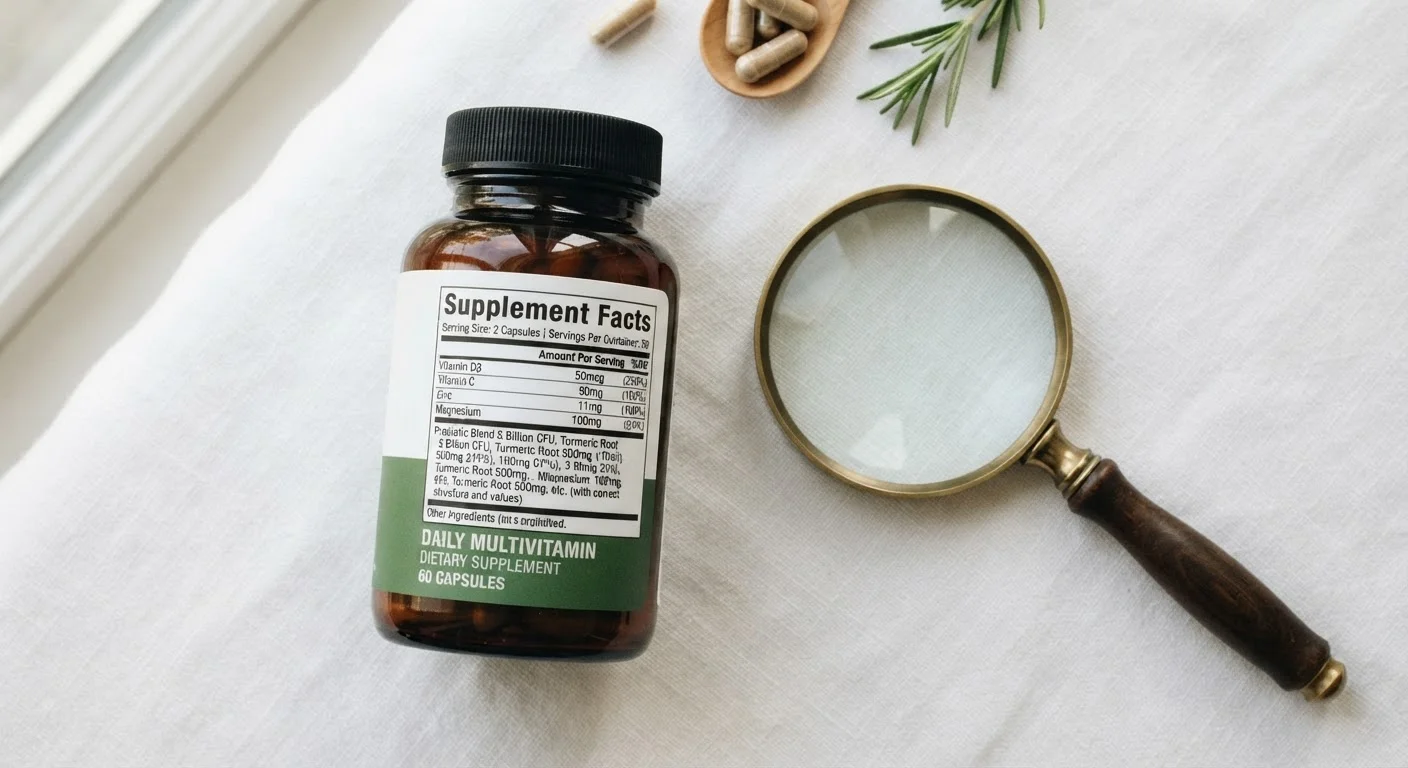
In the United States, the Food and Drug Administration (FDA) requires all dietary supplements to carry a Supplement Facts panel - a standardized information block modeled loosely on the Nutrition Facts panel found on food. That standardization is good news for consumers: once you know how the panel is structured, you can decode any supplement on the shelf using the same mental checklist.
What the label cannot tell you, however, is whether the claimed amounts are accurate. Unlike pharmaceutical drugs, dietary supplements are not reviewed or approved by the FDA before sale. Manufacturers bear responsibility for what goes on the label. That gap is why third-party certification seals carry real weight - they provide independent verification the regulatory framework does not automatically supply.
Supplement Facts panel
The standardized information block required by the FDA on all dietary supplement labels, showing serving size, ingredient amounts, and % Daily Values.
% Daily Value (% DV)
A percentage showing how much of a nutrient one serving provides relative to a government-established daily reference amount, based on a 2,000-calorie diet.
Proprietary blend
A group of ingredients listed together under a single combined weight on a label, without revealing the individual amount of each ingredient.
Other Ingredients
A mandatory label section listing non-dietary components such as binders, fillers, colorants, and capsule materials included in the product.
Dagger symbol (†)
A label notation indicating that no Daily Value has been established by the FDA for a particular ingredient, common with herbs and botanical extracts.
Price per serving
The total product cost divided by the number of servings in the container - the most reliable metric for comparing supplement costs across different products.
Serving Size and Servings Per Container
The serving size line sits at the very top of the panel for a reason: every number below it is expressed per serving, not per capsule, per gram, or per bottle. If a product lists two capsules as one serving, a consumer taking one capsule is getting half the stated amounts of every ingredient.
Directly below serving size is servings per container. Multiply serving size by servings per container to understand the total supply in the bottle. A 90-capsule bottle with a two-capsule serving size yields 45 servings - meaning a 45-day supply, not 90. This figure is the foundation of an honest price-per-serving calculation, which is the most reliable way to compare costs across products.
Calculate Price Per Serving Before Comparing
Before comparing two products side by side, divide the retail price of each by its servings per container. A larger bottle with a higher sticker price often works out cheaper per serving than a smaller, more attractively priced competitor. This single calculation strips out packaging and marketing variables to show you true relative value.
Nutrients, Amounts, and % Daily Value
The main table lists each dietary ingredient, the amount per serving (in milligrams, micrograms, IU, or another unit), and the % Daily Value (% DV). The % DV is calculated against reference intakes established by the FDA for a 2,000-calorie diet - a useful benchmark, but not a prescription for any individual. Needs vary by age, sex, health status, and other factors; a healthcare professional is the right resource for personalized guidance.
When no Daily Value has been set for an ingredient - common with botanicals, amino acids, and many herbal extracts - you will see a dagger symbol (†) instead of a percentage. The absence of a % DV is not a red flag; it simply reflects that regulators have not established a standard reference intake for that compound.
Watch for proprietary blends: a group of ingredients listed together under a single total weight. Inside a proprietary blend, individual ingredient amounts are not disclosed. This can make it genuinely difficult to judge whether any one ingredient is present at an amount supported by available research. For an accessible explanation of ingredient terminology, the supplement terms glossary covers commonly encountered words on packaging.
Other Ingredients and What They Signal
Below the main table, a section labeled Other Ingredients lists everything in the product that is not a dietary ingredient - binders that hold tablets together, flow agents that aid manufacturing, capsule materials, colorants, and preservatives. These are not inherently harmful, but the list is worth reviewing for two reasons.
First, allergens: common culprits such as soy, gluten, dairy derivatives, and shellfish-sourced compounds can appear here. If you have food sensitivities, this section is non-negotiable reading. Second, the length and composition of the list can reflect formulation philosophy - a shorter list with recognizable ingredients generally indicates a simpler product.
Manufacturers sometimes include language such as "manufactured in a facility that also processes tree nuts" as a separate allergen advisory. This is distinct from the Other Ingredients list itself and signals shared-equipment cross-contact risk rather than intentional inclusion.
Putting It All Together Before You Buy
Reading a Supplement Facts panel is a three-step process: confirm the serving size first, evaluate the main table with % DV in context, then scan Other Ingredients for anything relevant to your health situation. Apply those steps consistently and you will quickly spot the difference between a product with transparent labeling and one that obscures meaningful information behind proprietary blends or inflated serving counts.
For cost-conscious shoppers, the core metric is price per serving: total price divided by servings per container. That single number cuts through packaging size and marketing language to reveal actual value. Pair it with a look at whether the product carries any independent testing certification and you have a practical framework for smarter purchasing decisions.
Label reading is general health literacy - it tells you what a manufacturer claims is in a product and in what amounts. It does not substitute for a conversation with a qualified healthcare professional about whether a particular supplement is appropriate for your individual circumstances.
This article is for general informational purposes only and does not constitute medical or dietary advice. Consult a licensed healthcare professional before starting, stopping, or changing any supplement regimen.