

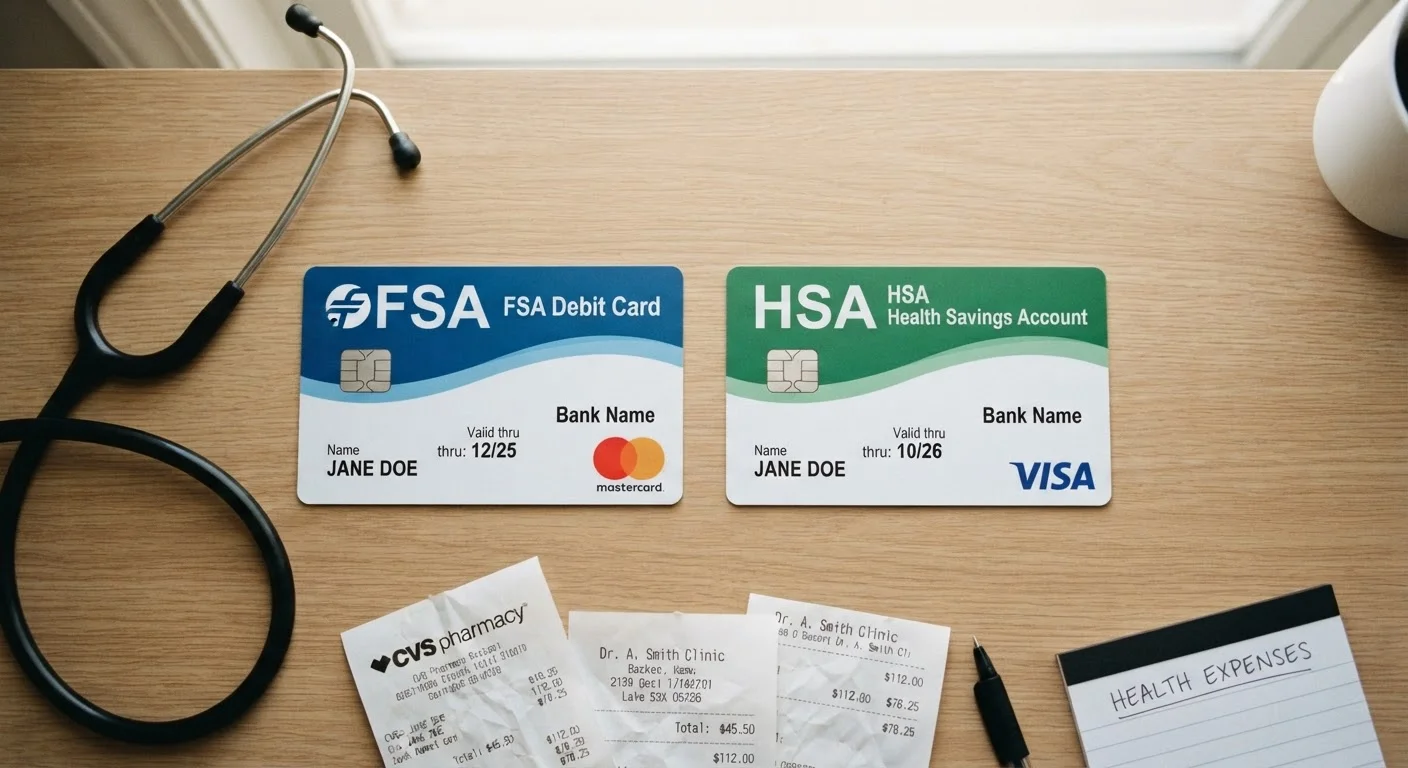
Key Takeaways
Option A
Flexible Spending Account (FSA)
The widely accessible option tied to employer benefits.
Best for: Employees with employer-sponsored health plans who want immediate access to pre-tax healthcare dollars.
Option B
Health Savings Account (HSA)
The triple-tax-advantaged account built for the long game.
Best for: Individuals enrolled in a qualifying high-deductible health plan who want to save and invest healthcare dollars over time.
If you're enrolled in a High-Deductible Health Plan
Health Savings Account (HSA)
HSA eligibility is tied directly to HDHP enrollment, and the triple tax advantage - contributions, growth, and qualified withdrawals - makes it the stronger option for HDHP participants.
If you have predictable, near-term medical expenses each year
Flexible Spending Account (FSA)
FSAs grant immediate access to the full elected amount on day one of the plan year, making them practical for known upcoming costs like scheduled procedures or recurring prescriptions.
If you want to build long-term healthcare savings or invest
Health Savings Account (HSA)
Unused HSA funds roll over every year without limit and can be invested in mutual funds or other vehicles, functioning as a supplemental retirement account for healthcare costs.
If your employer doesn't offer an HDHP option
Flexible Spending Account (FSA)
FSAs are accessible through most employer benefit packages regardless of health plan type, making them the practical choice when an HDHP isn't available to you.
How FSAs and HSAs Actually Work
Both Flexible Spending Accounts and Health Savings Accounts let you set aside pre-tax dollars to pay for qualified medical expenses - reducing your taxable income in the process. But they operate under distinct rules that make them suited to different situations.
An FSA is offered through an employer and allows you to elect a contribution amount at the start of the plan year. That full elected amount is available immediately, even before you've contributed it through payroll. The catch: most FSA funds are subject to a "use it or lose it" rule. Employers may offer a grace period of up to 2.5 months into the following year, or allow a limited rollover amount (set by the IRS annually), but unused balances beyond those provisions are forfeited.
An HSA works differently at its foundation. You can only open and contribute to one if you're enrolled in an IRS-qualifying High-Deductible Health Plan (HDHP). Unlike an FSA, your HSA balance is yours permanently - it rolls over every year without cap. Many HSA providers also let you invest your balance in funds once it reaches a threshold, allowing it to grow tax-free over time.
Limited Purpose FSAs: A Hybrid Option
If you have an HSA, you may still access a Limited Purpose FSA (LP-FSA) through your employer. LP-FSAs are restricted to dental and vision expenses, which preserves your HSA eligibility. This combination can help you stretch pre-tax dollars across more expense categories. Check with your benefits administrator to see if your employer offers this option.
This article is for general informational purposes only and does not constitute financial, tax, or medical advice. Consult a qualified professional before making decisions about your benefits enrollment or healthcare spending strategy.
Eligibility, Contribution Limits, and Key Rules
Understanding the eligibility requirements and annual limits is essential before choosing between these two accounts.
| Criterion | FSA | HSA |
|---|---|---|
| Health plan requirement | None (most employer plans) | Must be enrolled in qualifying HDHP |
| Who can open one | Employees with employer offering FSA | HDHP enrollees; self-employed may qualify |
| Contribution limit (individual, approximate) | ~$3,200/year (IRS-set, varies by year) | ~$4,150 self-only; ~$8,300 family (IRS-set) |
| Rollover of unused funds | Limited or none (employer option) | Full rollover, no annual cap |
| Investment of balance | Not permitted | Permitted above provider threshold |
| Funds available immediately | Full election available day one | Only contributed amount available |
| Portability if you leave employer | Generally forfeited or limited | Fully portable - yours to keep |
| Tax treatment | Pre-tax contributions only | Pre-tax contributions, tax-free growth, tax-free qualified withdrawals |
For FSA eligibility, you generally need to be employed by a company that offers the benefit - self-employed individuals typically cannot participate. Your health plan type usually doesn't matter, though a Limited Purpose FSA exists for those with an HSA.
For HSA eligibility, the IRS requires that you are enrolled in a qualifying HDHP, have no other disqualifying health coverage, and are not claimed as a dependent on someone else's tax return. The IRS updates HDHP minimum deductible thresholds and out-of-pocket maximums annually - verify current figures at IRS.gov before enrolling.
Both account types have annual contribution limits set by the IRS that adjust periodically for inflation. HSAs have separate limits for self-only versus family coverage, and individuals aged 55 and older may make additional catch-up contributions. FSA limits apply per employee, not per household.
The Rollover Difference: Why It Matters
The rollover rules represent one of the sharpest practical differences between FSAs and HSAs - and they significantly affect how you should plan your contributions.
~$3,200
Annual FSA contribution limit (approximate)
The IRS sets and periodically adjusts the FSA contribution cap; verify the current figure at IRS.gov before your enrollment period.
$8,300
Annual HSA family contribution limit (approximate)
IRS Publication 969 outlines current HSA limits, including catch-up contributions for those 55 and older.
Triple
Tax advantages offered by an HSA
HSA contributions, investment growth, and qualified withdrawals are all tax-advantaged - a combination not available with an FSA.
With an FSA, unspent funds are generally lost at year-end unless your employer has adopted an IRS-permitted grace period or rollover provision. This means you need to estimate your qualified expenses accurately each open enrollment period. Overestimating is a real financial risk. Eligible expenses include co-pays, deductibles, dental, vision, and many over-the-counter items - the IRS maintains a current eligible expense list that's worth reviewing.
HSAs carry no such pressure. Because balances roll over indefinitely, you can contribute consistently, spend only what's needed now, and let the rest accumulate - potentially for decades. After age 65, HSA funds can be withdrawn for any purpose (not just medical expenses) without penalty, though non-medical withdrawals are taxed as ordinary income at that point, similar to a traditional IRA.
For consumers focused on long-term saving strategies, the HSA's rollover feature and investment potential make it a compelling vehicle - provided you qualify.
Which Account Makes Sense for Your Situation
The choice between an FSA and an HSA isn't always within your control - your health plan options at enrollment largely determine eligibility. But where you do have a choice, the decision comes down to a few key factors.
If your employer offers an HDHP alongside a traditional plan, compare the total cost of each option: premiums, expected out-of-pocket expenses, and the value of HSA contributions (including any employer contributions to your HSA, which some employers provide). Lower premiums on an HDHP can offset higher deductibles, especially if you're healthy and don't anticipate significant medical costs.
If you're managing predictable recurring expenses - orthodontia, a planned surgery, regular specialist visits - the FSA's front-loaded availability can be advantageous. You can access your full annual election immediately and reimburse yourself as costs occur, then repay the account through payroll over the year.
It's also worth noting that these accounts serve only human healthcare costs. If you're exploring similar savings strategies for pets, the IRS does not permit FSA or HSA funds to be used for veterinary expenses. The pet health savings hub outlines separate approaches designed specifically for managing animal care costs.
Ultimately, benefits decisions are individual. A licensed benefits advisor, HR department, or certified financial planner can help you model both options against your actual expected healthcare usage and tax situation before open enrollment closes.