

Key Takeaways
Why Sticker Price Misleads Almost Everyone
A 30 lb bag of kibble priced at $60 looks expensive next to a 15 lb bag at $28. But if the 30 lb bag has higher calorie density - meaning your dog needs fewer grams to meet daily energy needs - it may cost significantly less per day. Sticker price tells you nothing without the portion equation attached to it.
The same problem runs in every direction. A smaller, pricier bag formulated for a concentrated daily portion can undercut a seemingly budget-friendly large bag when daily use is compared. And wet food's per-ounce price almost always looks alarming until you account for moisture content and the corresponding portion difference.
Understanding what drives these prices in the first place is useful background - the forces pushing pet food costs higher affect every format differently. But once you know the daily cost calculation, you have a reliable filter that cuts through packaging claims and marketing.
What you will need
This method works across dry, wet, raw, and fresh formats. It doesn't require a spreadsheet, just a few minutes and the right numbers from the label.
What You'll Need Before You Start
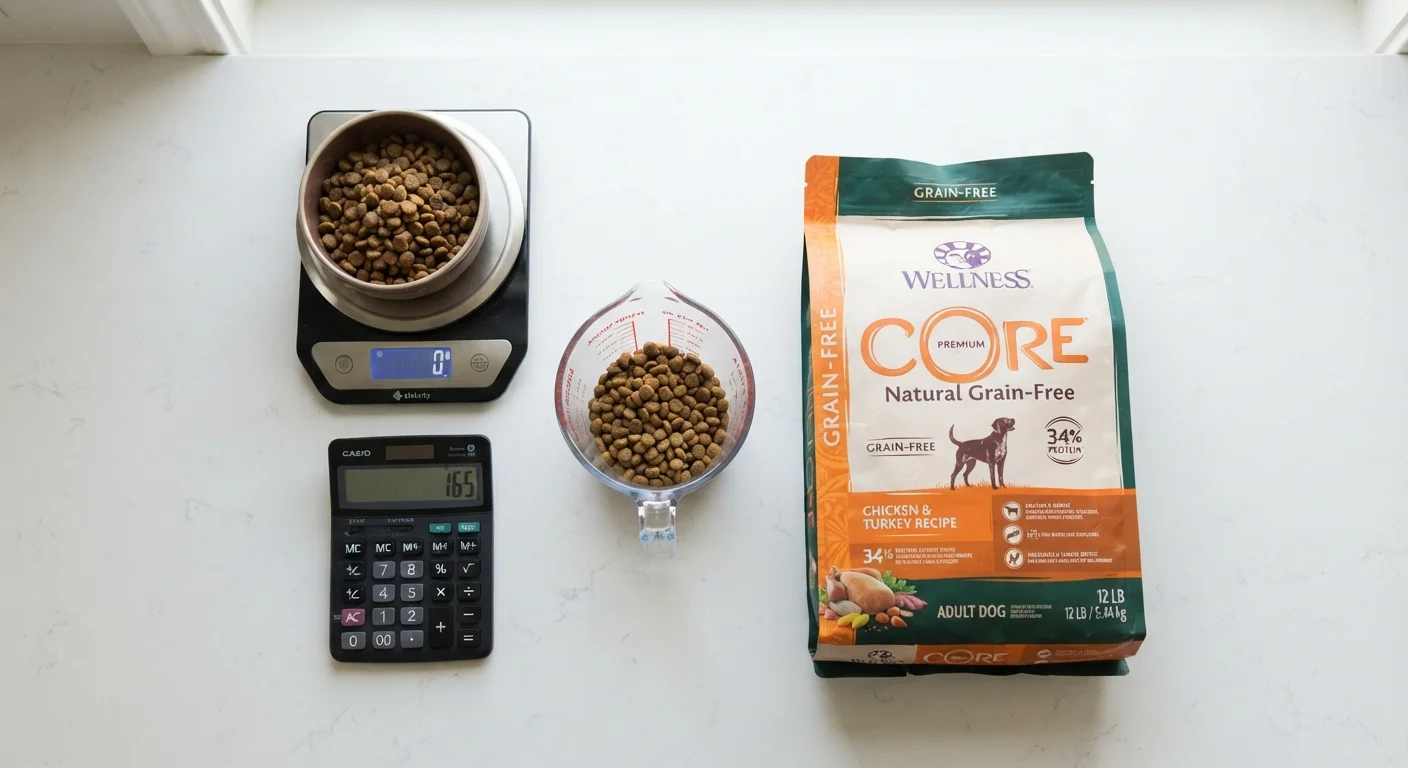
Kitchen scale (digital)
Measures actual portion weight so your calculation matches what your pet is eating, not what you estimate.
Calculator or spreadsheet
Runs the cost-per-day formula and stores results side by side for easy comparison across foods.
Pet food label or manufacturer website
Provides the feeding guideline (grams or kcal per day) and calorie content (kcal per kg or per cup) needed for accurate math.
A kitchen scale is worth emphasizing. Research on pet feeding accuracy consistently shows that volume-based scooping leads to significant overfeeding, which inflates both your food costs and, potentially, your pet's weight. Weighing portions once to calibrate your scoop takes two minutes and pays for itself quickly. For a broader look at how to evaluate what you're actually getting for your money across pet purchases, the value factors beyond price tags article covers the same principle in other product categories.
Step-by-Step: Calculate Your Pet's True Daily Food Cost
Find the calorie content and feeding guideline on the label
Every pet food sold in the US is required to list a guaranteed analysis and feeding guidelines. Look for the metabolizable energy statement - typically expressed as kcal per kilogram and kcal per cup (dry) or kcal per can (wet). This number is your anchor.
The feeding guideline will show a daily amount - usually in cups, grams, or ounces - keyed to your pet's body weight. Find the row that matches your animal's current weight. If your pet falls between two ranges, use the midpoint or the higher end for a conservative estimate.
Convert the daily portion to a consistent unit
To compare foods accurately, you need a consistent unit of measure across all options. Grams work best because they don't compress or settle the way cups do. If the guideline is in cups, weigh a level cup of that food on your kitchen scale to get grams per cup, then multiply by the recommended number of cups.
For wet food sold in cans or pouches, check whether the guideline refers to the full container weight or a net weight after liquid. Use the net fed weight - the solid content your pet actually consumes.
Calculate the cost per gram (or ounce) of the food
Divide the total price of the package by its total weight in the same unit you chose in Step 2.
Cost per gram = Package price ÷ Package weight in grams
Example: A 15 lb (6,804 g) bag priced at $42 gives you $42 ÷ 6,804 = $0.00617 per gram.
Do this for every food you're comparing. Write the results down - this is the figure that strips away packaging and marketing and lets you compare like-for-like.
Multiply cost per gram by your pet's daily portion
Now combine the two numbers:
Daily cost = Cost per gram × Daily portion in grams
Continuing the example: if your dog needs 220 g per day, then $0.00617 × 220 = $1.36 per day.
Multiply by 30 to get a monthly figure, or by 365 for an annual one. Annual figures make the real difference between foods immediately visible - a $0.50/day gap is $182.50 over a year.
Adjust for activity level and life stage
Feeding guidelines are built around a moderately active, healthy adult animal. Your pet may need more or less. Common adjustments include:
- Puppies and kittens: typically require 1.5-2× the adult maintenance amount per unit of body weight
- Seniors or low-activity pets: may need 10-20% less than the guideline
- Working, nursing, or highly active animals: may need significantly more
Apply the appropriate multiplier to your Step 4 result to get a more realistic daily cost. Your veterinarian is the appropriate resource for guidance on how much your specific pet should eat - this calculation gives you the financial picture once that portion is established.
Compare the daily cost across all candidate foods
Repeat Steps 1-5 for each food you're evaluating. Record results in a simple table:
| Food | Format | Cost/gram | Daily portion (g) | Daily cost | Annual cost |
|---|---|---|---|---|---|
| Food A | Dry | $0.006 | 220 g | $1.36 | $496 |
| Food B | Wet | $0.018 | 340 g | $6.12 | $2,234 |
| Food C | Fresh | $0.028 | 280 g | $7.84 | $2,862 |
This side-by-side view makes the annual cost gap between formats concrete rather than abstract. For a broader breakdown of how formats compare on price and nutrition, see the full format cost comparison.
Putting the Number to Work
Once you have a reliable daily cost figure, it becomes a practical decision tool rather than just an academic exercise. A few ways to use it:
- Set a monthly food budget: Multiply daily cost by 30. This gives you a real figure to plan around rather than guessing at the register.
- Evaluate subscription or bulk discounts accurately: Apply the same formula to the discounted price to confirm the saving is real, not just a lower package count at the same per-gram rate.
- Track cost drift over time: If your food's price increases or the bag size quietly shrinks, recalculating exposes the change immediately. Package size reductions without a price drop are common and easy to miss.
- Weigh cost against vet-recommended nutritional criteria: Daily cost is one variable. Your veterinarian's guidance on what your specific pet needs nutritionally is a separate - and more important - input. The goal is finding foods that satisfy both, not trading one off against the other.
For questions about your pet's overall health budget, including veterinary care costs, the pet health savings hub covers the broader picture of keeping pet care affordable.
This article provides general information for educational purposes. It is not veterinary or nutritional advice. Consult a licensed veterinarian to determine the appropriate diet and portion sizes for your specific pet.