

Shop Smarter

Before You Click 'Buy': A Pre-Purchase Savings Checklist

Share
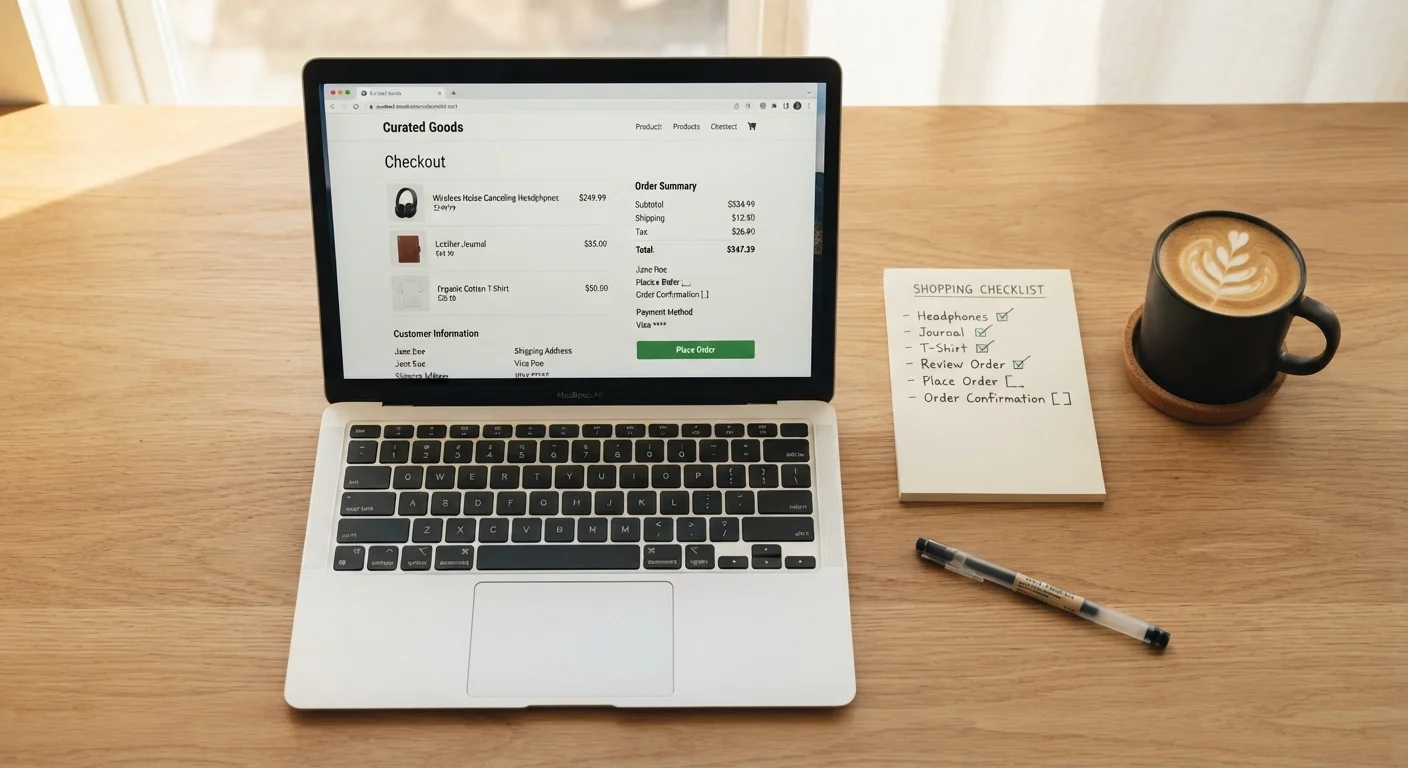
Laptop displaying an online shopping checkout page next to a handwritten checklist on a notepad

Key Takeaways

Running a consistent pre-purchase routine helps you avoid leaving savings on the table at checkout.
Price history tools can reveal whether a listed price is genuinely lower than usual.
Cashback portals and browser extensions can stack with other discounts on many purchases.
Comparing return policies and total costs — including shipping — prevents surprise expenses after buying.
Waiting 24–48 hours before purchasing non-urgent items can reduce impulse-driven overspending.
10–20 min

Summary

18 items · 10–20 minutes

Why a Checklist Works Better Than Instinct

Most overspending online doesn't happen because shoppers are careless — it happens because the checkout process is designed to move fast. A product lands in your cart, a countdown timer appears, and before you've verified anything, you've confirmed the order. A repeatable checklist interrupts that momentum.

This checklist applies to any product category, from electronics and clothing to household goods and subscriptions. Work through it in order before every non-trivial purchase. For travel-specific buying, see our pre-purchase checklist for cheap flight shoppers or the hotel booking checklist — the principles overlap but the details differ significantly.

If you're new to deal-finding in general, our first-timer's roadmap to online savings covers the foundational habits that make this kind of checklist sustainable over time.

Required

Price history tracker

Displays historical price data for a product so you can judge whether the current price is genuinely lower than typical.

Optional

Coupon code browser extension

Automatically tests available promo codes at checkout to apply any valid discount without manual searching.

Required

Cashback portal account

Earns a percentage back on qualifying purchases when you navigate to a retailer through the portal before buying.

Optional

Note-taking app or bookmarked checklist

Keeps this checklist accessible at checkout so you can run through it consistently without relying on memory.

The Pre-Purchase Savings Checklist

Work through each group below before confirming any purchase. You don't need to complete every item on every order — use judgment based on the order value and product type — but aim to make the high-priority checks automatic.

Price Verification

Check the item's price history using a dedicated tool to determine whether the current price is actually lower than its typical range. Must
Search at least two other retailers for the same item or a direct equivalent to confirm you're seeing a competitive price. Must
Verify that any 'sale' price reflects a genuine reduction from a stable baseline, not an inflated 'original' price. Must
Check whether a refurbished, open-box, or certified pre-owned version is available at a meaningful discount if condition is not critical. Should

Coupons and Promo Codes

Search for active coupon codes specific to the retailer before reaching the payment screen. Must
Check whether a browser extension that auto-applies codes is installed and active for this retailer. Should
Look for a newsletter sign-up discount or first-purchase offer if this is your first order with the retailer. Should
Check whether any membership programs (warehouse clubs, loyalty accounts) you already belong to offer a better price. Nice to have

Cashback and Rewards

Activate a cashback portal before navigating to the retailer's site to ensure your session qualifies for cashback. Must
Check whether your credit or debit card offers purchase-specific cashback or points multipliers for this retailer or category. Should
Confirm that cashback from different sources can be stacked — some portals exclude transactions initiated through certain browser extensions. Should

Total Cost and Terms

Add up the full landed cost — product price, shipping, taxes, and any mandatory fees — before comparing with alternatives. Must
Read the return and refund policy for this specific item, particularly if it's a final-sale, large, or fragile product. Must
Verify the expected delivery timeline and confirm it meets your actual need date, especially if urgency influenced your choice of retailer. Should
Check whether a price-match guarantee applies and note the window for requesting a match after purchase. Nice to have

Purchase Readiness

Confirm you actually need this item now rather than in the future — pausing non-urgent purchases for 24–48 hours often reduces impulse decisions. Must
Check whether you already own something that serves the same purpose adequately. Should
Consider whether buying in bulk or bundling with another needed purchase would lower the per-unit cost or qualify for free shipping. Nice to have

Cashback Sessions Can Be Invalidated

Cashback portals typically require that you navigate to a retailer's site directly from their tracking link in a single, uninterrupted session. Opening the retailer in a separate tab first, using a coupon extension simultaneously, or clearing your cookies mid-session can void the cashback entirely. Always activate the portal link last, immediately before shopping, and check the portal's specific terms — they vary by retailer.

Making This a Habit

The checklist only pays off if you actually run it. The simplest way to build the habit: bookmark this page and open it whenever you reach a checkout screen. After a few dozen purchases, most of these steps will become automatic — you'll instinctively check price history before adding something to your cart, or open a cashback portal before navigating to a retailer.

Pairing this routine with honest self-assessment also matters. If you're consistently finding reasons to justify a purchase rather than reasons to make it, that's useful information. Our guide on buyer's remorse explains what that hesitation is often signaling. And for a broader audit of your purchasing patterns, the shopping habit audit checklist is worth running periodically alongside this one.

For more structured approaches to keeping more of what you earn, explore the Saving Strategies hub and the Smart Buying Habits hub — both offer frameworks that complement this checklist at a broader level.

This article is for general informational purposes only and does not constitute financial advice. Savings outcomes vary by retailer, product, and individual circumstances.

Shop Smarter Editorial Team is the collective byline for our editorial team and contributor network. Articles published under this byline or an editorial pen name are researched, written, and reviewed according to our editorial standards for clarity, consistency, and independence before publication.

View all articles by Shop Smarter Editorial Team →
Disclaimer: The content provided on our blog site traverses numerous categories, offering readers valuable and practical information. Readers can use the editorial team’s research and data to gain more insights into their topics of interest. However, they are requested not to treat the articles as conclusive. The website team cannot be held responsible for differences in data or inaccuracies found across other platforms. Please also note that the site might also miss out on various schemes and offers available that the readers may find more beneficial than the ones we cover.