

Key Takeaways
How retailers shape the decisions you think you're making freely
Retail environments — physical and digital — are not neutral spaces. They're designed by teams whose job is to maximize average order value, reduce cart abandonment, and increase purchase frequency. The techniques they use aren't secret; many are grounded in well-documented behavioral science. What gives them their edge is that most shoppers encounter them without recognizing them in the moment.
Understanding these tactics doesn't require cynicism about retailers. It simply requires knowing that your decision-making environment has been shaped before you arrived. The goal here isn't to make you suspicious of every price tag — it's to help you make purchase decisions that actually reflect your priorities. As research into impulse buying shows, even experienced shoppers are susceptible when they're unprepared.
This is general consumer information
This article describes documented techniques studied in behavioral economics and consumer psychology research. It is intended as general education, not personalized financial advice. Individual responses to these tactics vary, and awareness is one tool among many for managing spending decisions.
Seven tactics worth knowing by name
Anchor pricing skews your sense of value
When a product is displayed next to a higher-priced alternative — or shown with a crossed-out "original" price — your brain uses that first number as a reference point. This is called the anchoring effect, a well-studied cognitive bias in behavioral economics. The result: a $60 item feels like a bargain next to a $120 item, even if $60 is above the fair market rate. To counter this, look up the item's price history across multiple sources before assuming a deal is real. The reference price a retailer sets is a starting point for their argument, not yours.
The reference price a retailer sets is their argument — not yours.
Artificial urgency compresses your decision time
Countdown timers, low-stock alerts, and "only 3 left" messages are designed to trigger loss aversion — the discomfort of potentially missing out. Research in consumer psychology consistently shows that time pressure degrades decision quality. When you feel rushed, you're less likely to compare options, check your budget, or ask whether you genuinely need the item. A practical rule: if a deadline feels arbitrary or unverifiable, treat it as a prompt to pause, not to purchase. Most "limited" offers recycle regularly.
Time pressure degrades decision quality — when rushed, pause rather than purchase.
Store layout controls what you encounter first
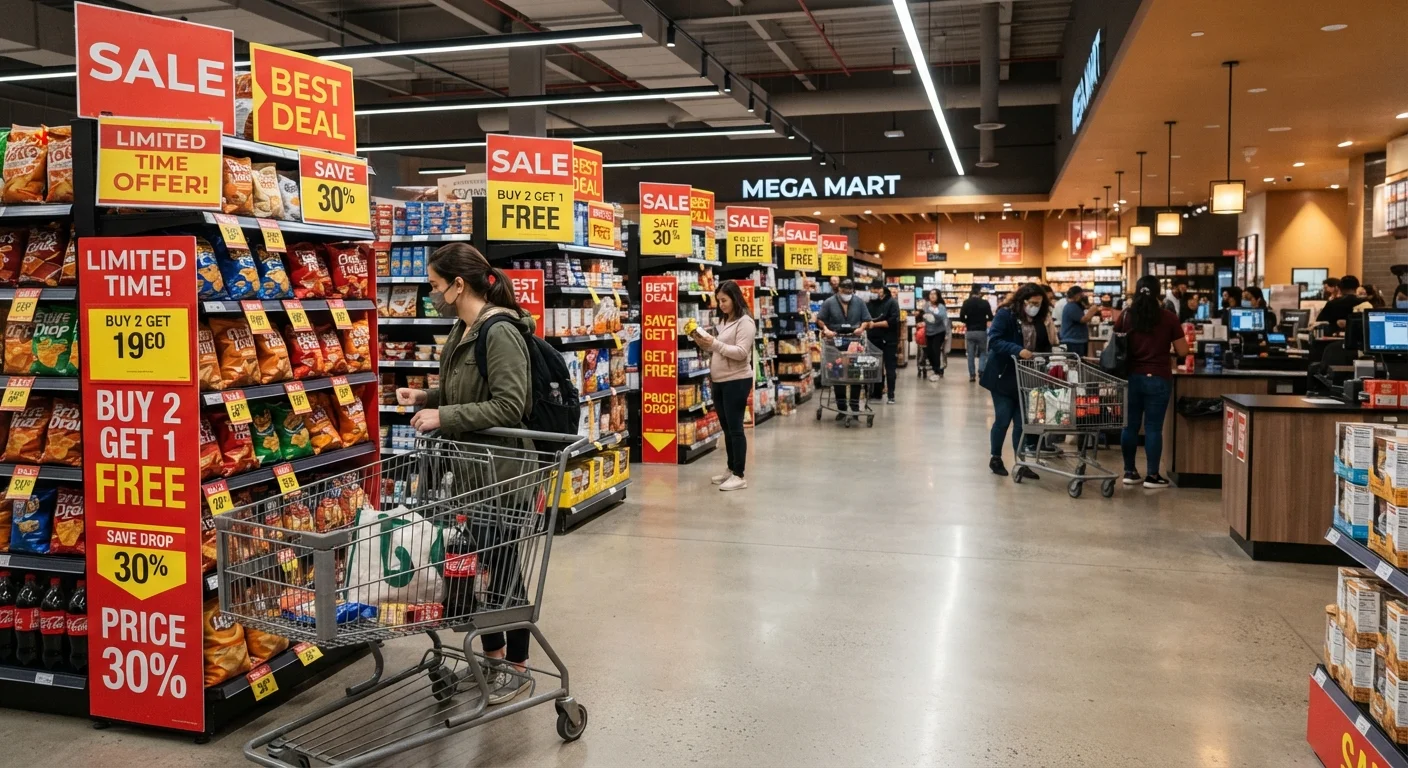
Physical retailers position high-margin or impulse items at eye level, near checkout queues, and at the ends of aisles (known as endcaps) — all locations that receive disproportionate shopper attention. Essential items like staples and basics are often placed at the back, requiring you to walk through more of the store. Online, the same principle applies through homepage placement, sponsored search results, and default sort orders. Shopping with a list — and sticking to it — sidesteps layout manipulation in both environments.
Shopping with a list sidesteps layout manipulation in stores and online alike.
Bundling obscures per-unit cost comparisons
Retailers often bundle products in ways that make the total feel economical without making individual value easy to evaluate. A multi-pack or combo offer requires you to do mental math that most shoppers skip. This isn't inherently manipulative — bundles can offer genuine value — but they can also obscure whether you're paying more per unit than you would buying items separately or choosing a competing product. When evaluating bundles, calculate the per-unit cost explicitly. If that calculation is difficult to perform, that's usually intentional.
If the per-unit math is hard to do, that difficulty is usually by design.
Sensory and environmental design lowers your guard
Lighting, music tempo, scent, and temperature in physical retail environments are actively managed to affect your mood and pace. Slower music correlates with longer shopping durations; pleasant ambient scents can increase dwell time and purchase likelihood, according to environmental psychology research. Online equivalents include visual design choices — warmer colors, clean layouts, and frictionless checkout flows — that reduce hesitation. Being aware of the environment you're shopping in, and the mood it's engineered to induce, is a useful moment to recheck your list and intent.
Retail environments are engineered to influence mood — checking your intent is the countermeasure.
Free shipping thresholds create artificial spending targets
Free shipping minimums — say, "Free shipping on orders over $50" — are deliberately set to sit just above the average cart value of a given customer segment. The result is that shoppers add items not because they want them, but to unlock a threshold. Before adding a filler item to qualify, compare the cost of what you're adding to the actual shipping fee. In many cases, paying shipping is cheaper than buying something you don't need to avoid it.
Compare the shipping fee to the cost of qualifying items — paying shipping often wins.
Default selections and pre-ticked options add cost quietly
At checkout — both online and in-store — you're frequently presented with pre-selected add-ons: extended warranties, donation round-ups, subscription upgrades, or protection plans. These defaults exploit the tendency to accept rather than actively opt out. Because opting in feels like the path of least resistance, many shoppers pay for additions they neither researched nor truly wanted. Review every checkout screen item-by-item, treating unchecking a pre-selected box as a routine part of the process rather than an exception.
Treat unchecking pre-selected boxes as a routine checkout step, not an exception.
Build a pre-shopping routine
Before opening a retailer's app or walking into a store, write down exactly what you intend to buy and a rough budget for each item. This 60-second habit creates a concrete reference point that makes deviation more deliberate and visible. Pairing this with a habit stacking approach can make the routine easier to sustain long-term.
Turning awareness into lasting habit
Recognizing a tactic in the moment is genuinely useful — but the window between recognition and action is short, especially under engineered time pressure. The more durable approach is building pre-shopping routines that reduce your exposure to these influences before they can land.
For instance, timing purchases deliberately removes urgency as a variable entirely. And if you're noticing patterns in where your budget quietly leaks, the habits that quietly erode a budget are worth examining alongside retail tactics — they often work in tandem. For a category-level view, the categories where people most consistently overpay can help you focus your attention where the return is highest.
The goal isn't a perfectly optimized shopping session every time. It's enough friction — self-imposed and deliberate — to ensure that what ends up in your cart is actually what you intended to buy.