

Key Takeaways
Option A
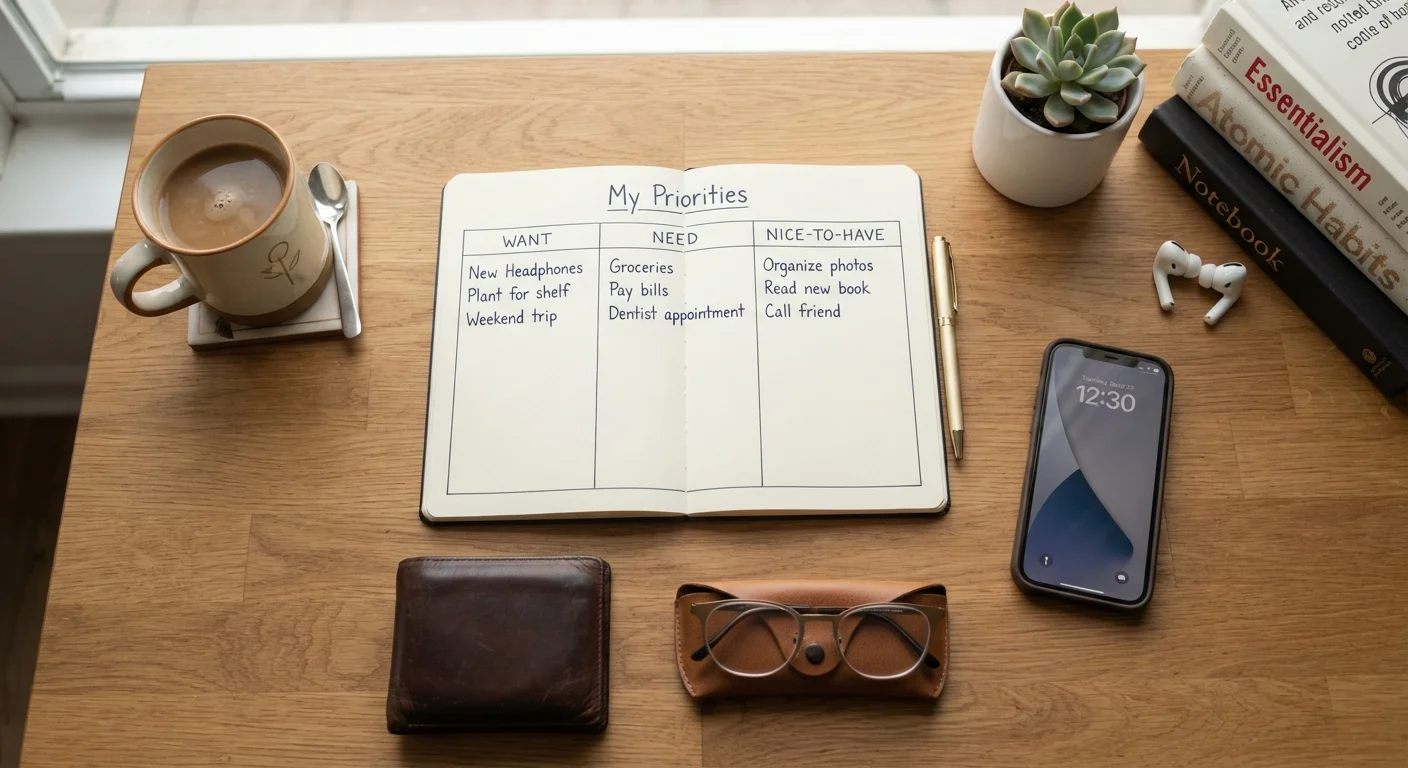
Need
The non-negotiable baseline for function or safety.
Best for: Purchases where going without creates a genuine problem — health, safety, or core daily function.
Option B
Want vs. Nice-to-Have
Desire-driven purchases that differ only in intensity and justifiability.
Best for: Distinguishing conscious discretionary spending from impulsive upgrades you'll regret within a week.
If you're trying to stop rationalizing impulse purchases
Need framework
Forcing yourself to articulate the consequence of not buying something cuts through emotional justification quickly and effectively.
If you frequently experience buyer's remorse on discretionary items
Want vs. Nice-to-Have distinction
Separating genuine wants from fleeting upgrade appeals helps you identify which purchases actually align with your priorities.
If you're building a long-term spending decision habit
All three categories used together
The full framework works as a repeatable pre-purchase filter that removes guesswork and makes decisions feel less arbitrary over time.
Why the Categories Feel Obvious but Aren't
Most people believe they know a need when they see one. In practice, the lines dissolve fast — especially when a product is well-marketed, urgently promoted, or emotionally appealing. A replacement winter coat feels like a need. So does the premium version of the replacement winter coat you already own. Neither instinct is wrong; the problem is treating both the same way.
The three-category system — Need, Want, Nice-to-Have — is only useful if you apply a consistent definition to each, not one that shifts based on your mood or how long you've been looking at the item. Building a personal spending decision framework before you shop gives these categories real structure rather than loose intuition.
| Criterion | Need | Want / Nice-to-Have |
|---|---|---|
| Defining question | What happens without it? | Why do I want it? |
| Consequence of skipping | Functional or safety problem | Disappointment or missed upgrade |
| Budget priority | Non-negotiable allocation | Discretionary — subject to trade-offs |
| Emotional driver | Low (practical necessity) | High (desire, comparison, aspiration) |
| Risk of misclassification | Rare but costly when it happens | Very common — especially with upgrade appeals |
| Decision urgency | Often genuine | Usually manufactured or inflated |
Defining Each Category With Precision
Need
A need passes one test: what is the concrete, practical consequence of going without it? If the answer involves a genuine problem — you can't get to work, you're unsafe, an existing item is broken beyond function — it's a need. Comfort, habit, and preference do not qualify. Replacing a broken laptop used for remote work is a need. Upgrading a working one to a newer model is not, regardless of how much better the new one is.
Want
Wants are intentional desires that reflect real priorities. You've thought about it, it aligns with something you value, and you can make a case for it beyond 'I'd enjoy it.' Wanting a higher-quality kitchen knife because you cook daily and the current one is frustrating — that's a want grounded in use. Wants aren't bad spending. Unexamined wants are.
Nice-to-Have
Nice-to-haves are wants with weaker justifications. They often arrive as upgrade appeals: slightly bigger, slightly faster, slightly more stylish. They're the features you didn't know you wanted until the product page told you to. Our companion piece on features you're paying for but probably don't need maps this pattern in detail.
~52%
Shoppers reporting frequent buyer's remorse
A CreditCards.com survey found roughly half of US adults have experienced buyer's remorse on a recent purchase, with impulse decisions being the leading cause.
72 hrs
Cooling-off period that filters impulse buys
Consumer behavior researchers broadly suggest a 48–72 hour delay before non-essential purchases significantly reduces impulsive spending decisions.
The Categorization Test You Can Apply in Real Time
When you're about to make a non-essential purchase, run through these three questions in order:
- What happens if I don't buy this? A specific, concrete problem = need. Mild inconvenience or disappointment = move to the next question.
- Does this align with a priority I've already identified? Yes, and I can explain how = want. Vague yes or 'it'd be nice' = nice-to-have.
- Would I still want this in 72 hours if the price were 30% higher? Sustained yes = legitimate want. Fading interest = nice-to-have or impulse.
This isn't about denying yourself discretionary purchases. It's about making them with full awareness. Use the pre-purchase checklist to build this into a habit rather than a one-off exercise.
How Context Shifts the Category
The same purchase can move between categories based on circumstances. A gym membership is a want for most people, a need for someone recovering from a condition under medical guidance, and a nice-to-have for someone who already exercises at home and is considering a second option. Before defaulting to a category label, anchor it to your current situation — not a generalized version of your life.
Timing matters too. A new phone is often a want or nice-to-have when your current one works. It becomes a need when yours is genuinely beyond repair. Retailers know that urgency and comparison pressure blur this shift — which is exactly why applying the test consistently matters more when you're being rushed.
If you want a structured approach to evaluating your priorities before you ever reach the product page, building a personal evaluation framework before you shop lays out a practical method for doing exactly that. And once you've identified your categories, ensuring you're comparing the right things helps prevent misleading conclusions from affecting your final decision.