

Key Takeaways
Option A
The 50/30/20 Rule
The percentage-based, hands-off framework for broad financial balance.
Best for: People who want a simple structure without tracking every dollar category-by-category.
Option B
Envelope Budgeting
The tactile, category-by-category method built on hard spending limits.
Best for: People who overspend in specific categories and need a physical or visual boundary to stop it.
If you want a low-maintenance starting framework
The 50/30/20 Rule
Its broad buckets require minimal setup and work well for people whose spending is roughly on track but lacks structure.
If you consistently overspend in specific categories like groceries or dining
Envelope Budgeting
Hard per-category limits make it immediately clear when you've hit your ceiling, stopping overspend before it compounds.
If you're new to budgeting and want to build a habit gradually
The 50/30/20 Rule
The simple three-bucket structure is easy to understand and apply without overwhelming detail from day one.
If you've tried percentage-based budgets but still lose track of the details
Envelope Budgeting
Envelopes enforce accountability at the category level, which percentage rules often leave too vague to act on.
If you want a flexible framework that adapts to variable income
The 50/30/20 Rule
Percentage targets scale automatically with income fluctuations, making recalculation straightforward each pay period.
How Each Framework Actually Works
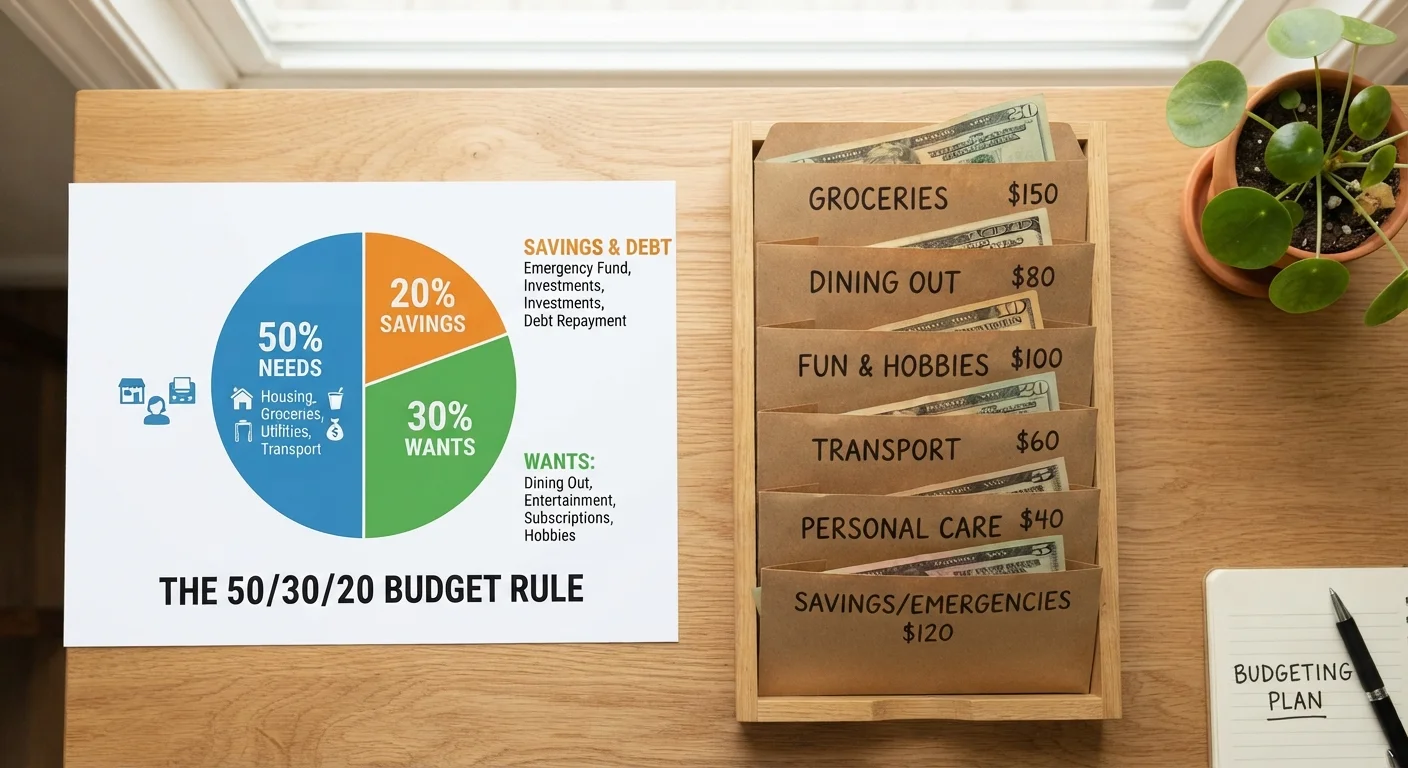
The 50/30/20 rule allocates your after-tax income into three broad buckets: 50% toward needs (housing, utilities, groceries, transportation), 30% toward wants (dining, entertainment, subscriptions), and 20% toward savings and debt repayment. You track overall spending against those thresholds — not individual line items. For a deeper look at how the percentages translate to real monthly cash flow, see what the 50/30/20 rule actually means for your monthly budget.
Envelope budgeting works differently at a structural level. Before the month starts, you divide your income into named spending categories — groceries, gas, dining, clothing, entertainment, and so on — and assign a fixed dollar amount to each. Traditionally, you'd place physical cash in labeled envelopes. When an envelope is empty, spending in that category stops. Digital apps now replicate the same logic without cash.
The core difference: the 50/30/20 rule sets percentage ceilings across broad zones; envelope budgeting sets dollar ceilings within granular categories. One is a compass, the other is a fence.
| Criterion | 50/30/20 Rule | Envelope Budgeting |
|---|---|---|
| Structure | 3 broad percentage buckets | Multiple fixed-dollar categories |
| Setup time | Low — one calculation | High — allocate each category |
| Ongoing maintenance | Minimal monthly tracking | Regular category monitoring |
| Spending control | Broad zone limits | Hard per-category limits |
| Flexibility | High — scales with income | Moderate — requires reallocation |
| Best for variable income | Yes — percentages auto-adjust | Harder — dollar amounts shift |
| Granularity of insight | Low — broad category view | High — line-item visibility |
| Learning curve | Very low | Moderate to high |
Strengths and Limitations of Each Approach
The 50/30/20 rule's primary strength is accessibility. There are only three numbers to manage, the math is fast, and the framework scales with income changes automatically — a meaningful advantage for people with variable or freelance earnings. Its limitation is precision: a 30% wants bucket on a $5,000 monthly income is $1,500, which is a wide lane. It's easy to technically stay within bounds while still making poor individual spending choices.
Envelope budgeting's strength is exactly that granularity. When you have $200 in a grocery envelope and $180 is gone by week three, the feedback is immediate and concrete. Research on mental accounting — the psychological tendency to treat money differently based on how it's categorized — suggests that designated spending pools reduce impulsive allocation. Cash budgeting in a digital world explores the psychological advantages and practical trade-offs in more depth.
Its limitation is maintenance. Setting up 10–15 envelope categories each month takes time. Irregular expenses — car repairs, medical bills — can disrupt the system if you haven't built buffer envelopes. And if you make an error in the initial allocation, every downstream category is affected.
A Note on the 20% Savings Target
The 50/30/20 rule groups savings and debt repayment together in the 20% bucket. If you carry high-interest debt, prioritizing repayment within that 20% before building savings is generally considered a sound approach — but the right balance depends on your specific interest rates, emergency fund status, and financial goals. A licensed financial adviser can help you determine the right split for your situation.
Choosing the Right Fit — or Combining Both
The frameworks aren't mutually exclusive. Many budgeters use the 50/30/20 rule as a macro check — ensuring their overall income allocation is healthy — while using envelope-style sub-categories within the wants and needs buckets to prevent individual line-item drift. This hybrid approach captures broad structural balance and granular control simultaneously.
Your choice should reflect where your spending actually breaks down. If you regularly hit your overall percentage targets but still feel financially stretched, envelope budgeting within your spending categories will likely surface the specific problem. If you've never tracked spending at all, the 50/30/20 rule gives you a workable baseline without demanding detailed record-keeping on day one.
A few honest questions help narrow the decision: Do you tend to overspend in specific categories, or across the board? How much time are you willing to spend managing your budget monthly? Do you respond better to broad goals or hard limits? If these questions surface uncertainty about foundational assumptions, it may help to first address budgeting myths that keep people stuck.
Once you've chosen a framework and run it for a month, the monthly budget review checklist is a practical tool for evaluating what worked and what needs adjustment before you reset.
This article is for general informational and educational purposes only and does not constitute personalised financial advice. For guidance tailored to your individual circumstances, consult a qualified financial professional.