

Key Takeaways
Credit Utilisation
Credit utilisation is the percentage of your available revolving credit that you're currently using. It's calculated by dividing your total credit card balances by your total credit limits, then multiplying by 100. For example, if you owe $2,000 across cards with a combined $10,000 limit, your utilisation is 20%. Lenders use this figure to gauge how reliant you are on borrowed money.
Scoring models such as FICO and VantageScore evaluate utilisation both across all revolving accounts combined (aggregate utilisation) and on each individual card (per-card utilisation). Both dimensions affect your score independently.
Why Credit Utilisation Carries So Much Weight
When lenders pull your credit file, they're trying to answer one core question: how well does this person manage the credit they already have? Your utilisation ratio answers that question in a single number. According to FICO's published scoring framework, amounts owed — of which utilisation is the primary driver — accounts for approximately 30% of a FICO score. Only payment history weighs more.
The logic is straightforward: someone using 80% of their available credit looks financially stretched. Someone using 10% appears to have headroom. From a lender's perspective, high utilisation signals higher risk, which can mean higher interest rates, lower credit limits, or outright denials on new applications.
If you want a grounded starting point on how credit scores are structured overall, our foundational credit guide walks through every major scoring factor.
~30%
Weight of 'amounts owed' in FICO scoring
FICO's published scoring breakdown identifies amounts owed — including utilisation — as the second largest scoring factor, behind payment history.
<10%
Utilisation level common among highest scorers
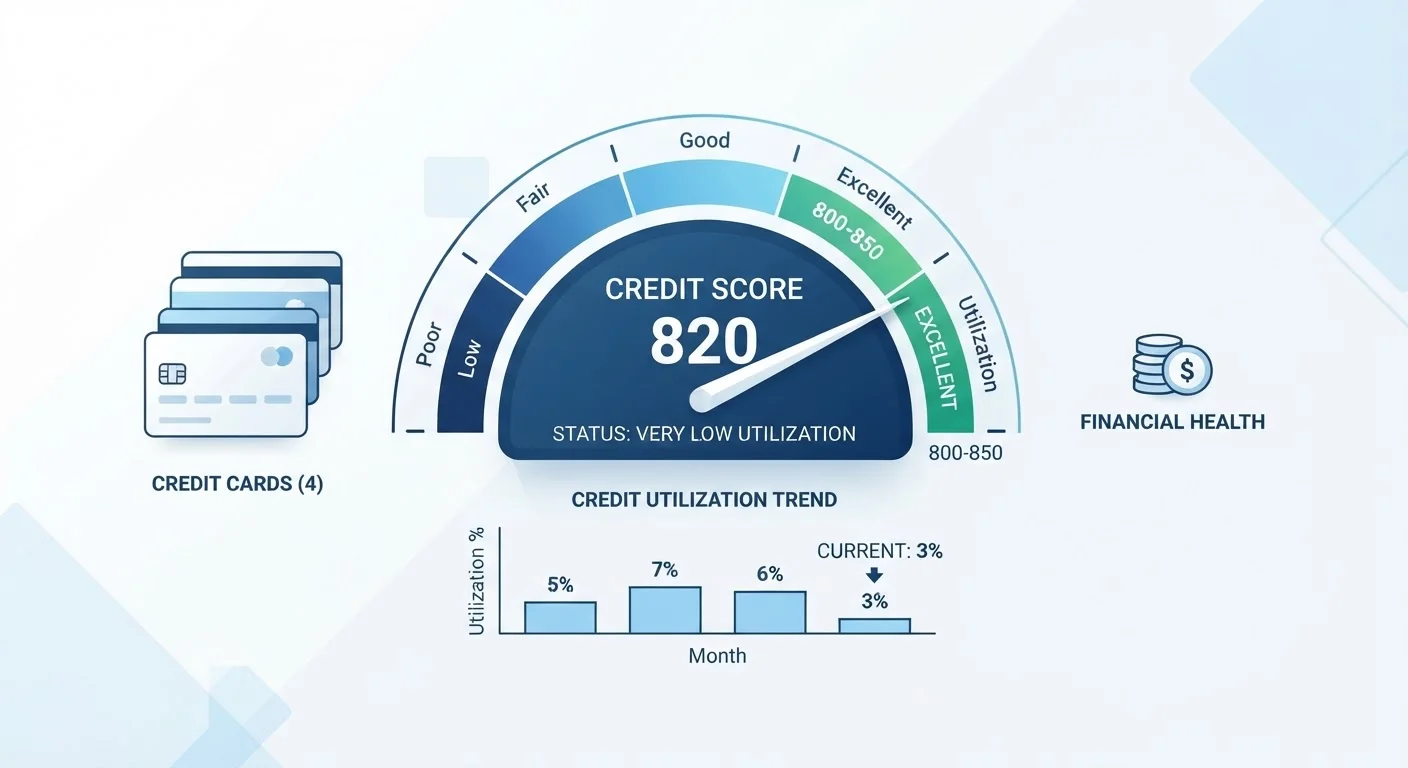
Consumers in the highest FICO score ranges typically maintain very low utilisation ratios, often in single digits, according to FICO's published score analysis data.
1–2
Billing cycles for utilisation changes to register
Because balances are reported monthly, paying down a significant balance can be reflected in your credit score within one to two statement cycles.
How the Calculation Actually Works
The aggregate formula is simple: add up all your revolving balances, divide by your combined credit limits, and multiply by 100. But aggregate utilisation is only half the story.
Scoring models also evaluate per-card utilisation — the ratio on each individual account. A card sitting at a 90% balance drags your score even if your overall utilisation looks reasonable. This is why spreading debt across multiple cards doesn't fully neutralise a high balance on one of them.
Another detail most people miss: the balance your issuer reports to the bureaus is typically your statement balance, not your real-time balance. If you charge $3,000 on a card with a $5,000 limit and pay it off in full each month, your reported utilisation is still 60% unless you pay it down before the statement closes. This is one of several credit score misconceptions worth correcting.
Practical Ways to Bring Your Ratio Down
There are two levers you can pull: reduce your balances or increase your available credit. Either move — or both together — will lower your ratio.
Time Payments to Your Statement Closing Date
Most card issuers report your balance to credit bureaus on your statement closing date — not your payment due date. If you want a lower utilisation figure to appear on your credit report, pay down the balance before that closing date, not just before the payment deadline. Check your card's online account or call the issuer to confirm your specific closing date.
- Pay before your statement closes. Identify each card's closing date and pay down the balance beforehand so the reported figure is lower.
- Make multiple payments per month. Splitting a large monthly payment into two smaller ones keeps your running balance — and your reported utilisation — lower throughout the cycle.
- Request a credit limit increase. If your account is in good standing, issuers will often grant a higher limit. Your balance stays the same, but your ratio drops. Be aware that some issuers run a hard inquiry for this request.
- Avoid closing old accounts unnecessarily. Keeping older cards open preserves your total available credit, supporting a lower ratio. Habits that quietly damage scores covers this and other non-obvious credit risks.
- Prioritise the most utilised card first. When paying down debt, targeting the card closest to its limit often delivers the fastest score improvement, even before the balance is fully cleared.
Spending discipline is the foundation beneath all of these tactics. A realistic monthly budget makes it easier to keep balances in check — budgeting basics is a useful companion resource for building that structure.
What 'Too Much' Really Looks Like
The 30% guideline is a useful rule of thumb, not a hard scoring cliff. Utilisation impacts your score on a continuum — each percentage point of reduction generally helps, and each point of increase generally hurts. Scoring models don't apply a single penalty at 30% and nothing below it.
That said, crossing into higher bands — particularly above 50% and then above 75% — tends to produce more noticeable score drops. A card reported at 95% utilisation is a more significant drag than one at 40%. The practical goal is to bring both per-card and aggregate utilisation as low as your current finances allow, even if you can't reach single digits right away. Incremental improvement still registers in your score.
For a plain-language reference on the vocabulary you'll encounter while working on your credit — including terms like revolving credit and hard inquiry — our debt and credit glossary is worth bookmarking.
This article is for general informational and educational purposes only and does not constitute personalised financial or credit advice. For guidance specific to your situation, consult a qualified financial professional.