

Key Takeaways
Why Accommodation Type Matters More Than Price Alone
A $25-per-night room in Southeast Asia and a $25-per-night room in Eastern Europe are not the same proposition. The category of accommodation shapes what you actually get — privacy level, meal inclusion, social environment, and cancellation flexibility. Budget travelers who understand the global landscape of lodging types consistently make sharper decisions than those who sort solely by nightly rate.
If you're newer to navigating accommodation options, our starting-point guide to budget lodging walks through how pricing structures work and what questions to ask before booking. For terminology you'll encounter during your search, this plain-language glossary of lodging terms covers the basics — from rack rate to half-board — so you can read listings without guesswork.
Below is a practical breakdown of the major budget accommodation types found around the world, what each typically offers, and who each suits best.
Hostels
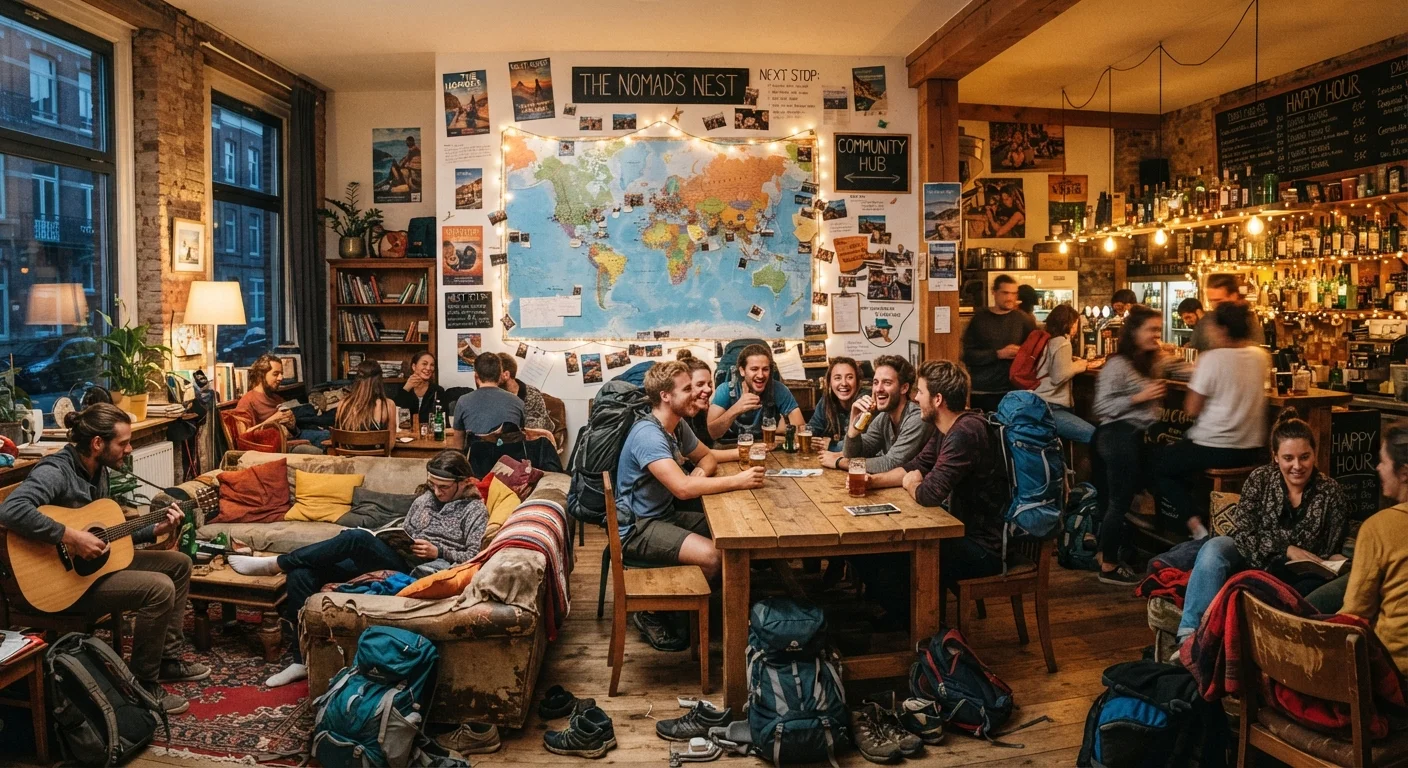
Found on every inhabited continent, hostels are the most internationally recognized form of budget accommodation. They typically offer dormitory-style bunk beds in shared rooms of four to twelve beds, with communal bathrooms, a lounge, and often a shared kitchen. Private rooms are frequently available at hostels too, at rates below comparable hotels.
What sets hostels apart is the social infrastructure: organized events, common areas designed for meeting other travelers, and staff who often function as informal local guides. This makes them particularly well-suited to solo travelers or anyone whose itinerary benefits from spontaneous collaboration with others.
Trade-offs include variable noise levels, shared bathroom queues during peak hours, and security that depends heavily on the individual property. Lockers are standard at reputable hostels — bring your own padlock as a backup.
Hostels work best for solo travelers who value social connection over guaranteed quiet.
Guesthouses and Pensiones
A guesthouse is a small, often family-operated property where guests stay in private rooms within or adjacent to the owner's home. In Spain and Latin America, the equivalent is often called a pensión; in France, a chambre d'hôte; in Greece, a domatio. The terminology varies but the structure is broadly similar: fewer than fifteen rooms, personal service, and rates that typically undercut comparable hotels.
Many guesthouses include breakfast in the nightly rate — a meaningful cost offset. The experience tends to be quieter and more intimate than a hostel, and owners frequently provide recommendations that go well beyond what any travel app surfaces. This category suits couples, older travelers, or anyone who values privacy without paying hotel prices.
Consistency is the main variable: quality is tied entirely to the individual operator, so reviewing recent guest feedback is especially important before booking.
Guesthouses often bundle breakfast into the rate, quietly reducing your daily food spend.
Ryokans and Minshuku (Japan)
Japan's traditional inn formats offer budget travelers a culturally immersive option that sits outside the standard hostel-or-hotel binary. A ryokan is a formal traditional inn featuring tatami mat rooms, futon bedding, communal baths (onsen where hot spring water is available), and multi-course meals. Even entry-level ryokans tend to deliver a high-service experience, though rates vary widely.
A minshuku is the more modest, family-run equivalent — essentially Japan's version of a bed-and-breakfast. Rooms are simpler, meals are home-cooked rather than formal, and prices are considerably lower. For travelers willing to follow house rules (set meal times, shared bath schedules), a minshuku delivers authentic domestic hospitality at rates that compete with mid-range hotels.
Both formats typically require advance booking and some flexibility around schedules, which suits methodical itinerary planners more than spontaneous travelers.
A minshuku offers a genuine window into Japanese domestic life at genuinely modest rates.
Backpacker Lodges
Backpacker lodges are concentrated in Southern Africa, East Africa, Australia, and New Zealand. Structurally similar to hostels, they tend to occupy larger properties — sometimes former farms or estates — and often include outdoor common areas, on-site bars or cafes, and activity booking desks. They typically cater to travelers on multi-week or multi-month journeys rather than short city stays.
What distinguishes a backpacker lodge from a standard hostel is often the setting and the amenity set: camping pitches alongside dormitory rooms, gear storage for trekking equipment, and proximity to trailheads or wildlife areas. They serve as operational bases for outdoor itineraries rather than just sleeping stops.
Rates often include access to shared kitchens, and some offer basic self-catering supplies. Travelers doing extended regional circuits — say, a southern Africa overland route — frequently string together backpacker lodges as their primary accommodation infrastructure.
Backpacker lodges double as activity hubs, often saving travelers a separate booking for tours or gear.
Capsule Hotels
Originating in Japan and now found across parts of East Asia and in select cities globally, capsule hotels provide individual sleeping pods — enclosed or semi-enclosed berths roughly the size of a large bunk, fitted with a mattress, lighting, and sometimes a small screen or storage shelf. Bathrooms and lounges are shared.
They offer more privacy than an open dormitory at a price point that frequently matches or beats hostel dorms in the same city. In Japan particularly, capsule hotels in major transit hubs are an efficient choice for travelers with early departures or late arrivals, since many operate around the clock.
The format suits light packers comfortable with compact spaces. It is less practical for travelers with large luggage, and the pod design is not suited to everyone's sleep preferences. Most properties have separate floors or sections for different genders.
Capsule hotels deliver more privacy than a hostel dorm for a comparable or lower nightly rate.
Homestays and Room Rentals
A homestay involves renting a room directly within a local resident's home, with the host present. This differs meaningfully from whole-property rentals, where no host is on-site. Homestays are common across Central America, Southeast Asia, Eastern Europe, and parts of Africa — often arranged through community tourism programs, language schools, or informal networks.
The practical benefits include a built-in local contact, often shared meals, and rates well below hotels. The social dynamic requires a degree of adaptability: house rules vary, privacy is limited, and schedules may need to align with the host family's routines. For language learners or travelers seeking depth over independence, this trade-off is frequently worth it.
Travelers who prefer more autonomy while still benefiting from local pricing can look at private room rentals — a single room in a resident's home where the host may or may not be present during the stay.
Homestays embed you in local daily life in a way no hotel category can replicate.
Matching the Right Type to Your Trip
No single accommodation category dominates every destination or travel style. A solo traveler doing a two-week circuit through Central America will get more value from hostels than a couple on a ten-day stay in rural Japan, where a family-run minshuku may offer comparable rates with added cultural depth.
Factor in What's Included, Not Just the Rate
When comparing options, list out what each property includes: breakfast, kitchen access, lockers, airport transfers, or activity discounts. A guesthouse at $45 per night with breakfast and a communal kitchen may cost less in practice than a $30 bare-bones room where every meal requires eating out. Building a simple daily-cost estimate rather than comparing nightly rates alone leads to more accurate decisions.
Before finalizing any booking, cross-reference the listed amenities against your actual needs. A dormitory bed saves money upfront but costs more in disrupted sleep if you're an early riser on a packed itinerary. Similarly, a guesthouse with breakfast included may undercut a bare-bones hotel once you factor in the cost of eating out every morning. Reading guest reviews strategically also helps surface the operational details — noise levels, security, reliability of hot water — that photos and star ratings rarely capture.
For travelers looking to sharpen their booking approach beyond simply choosing the right category, the strategies seasoned budget travelers use to book affordable rooms covers timing, flexibility tactics, and negotiation principles that work across all accommodation types.