

Key Takeaways
Vehicle Depreciation
Depreciation is the decline in a vehicle's market value over time. It begins the moment a new car is purchased and continues throughout its life, reducing what you could sell or trade in the vehicle for. Unlike a loan payment or insurance premium, depreciation isn't a bill you receive - it's a cost that quietly erodes your asset's worth.
Depreciation is calculated as the difference between a vehicle's purchase price and its residual (resale) value at any given point. It is recognized by the IRS as a deductible business expense for vehicles used commercially, based on published annual limits.
Why Depreciation Is the Cost Drivers Most Often Miss
Ask most drivers what their car costs them each month, and they'll cite their loan payment, insurance premium, and maybe a fuel estimate. Few will mention depreciation - yet for the average new-vehicle buyer, it represents the largest single annual expense of owning that car.
The reason it goes unnoticed is structural: depreciation doesn't arrive as an invoice. It accumulates silently as the gap between what you paid and what you could sell the car for today. According to AAA's annual Your Driving Costs study, depreciation accounts for roughly 35-40% of the total cost of owning a new vehicle when measured over five years. That figure regularly exceeds cumulative fuel, maintenance, and insurance costs combined.
For a broader view of where depreciation sits within the full ownership picture, see the true annual cost of car ownership.
15-25%
New car value lost in year one
AAA's Your Driving Costs research consistently shows first-year depreciation in this range for most new vehicles.
~37%
Share of 5-year ownership cost from depreciation
AAA estimates depreciation accounts for roughly 35-40% of total new vehicle ownership costs over a five-year period.
40-60%
Typical residual value after five years
Most vehicles retain between 40% and 60% of their original purchase price by the end of year five, depending on model and condition.
How Depreciation Actually Works
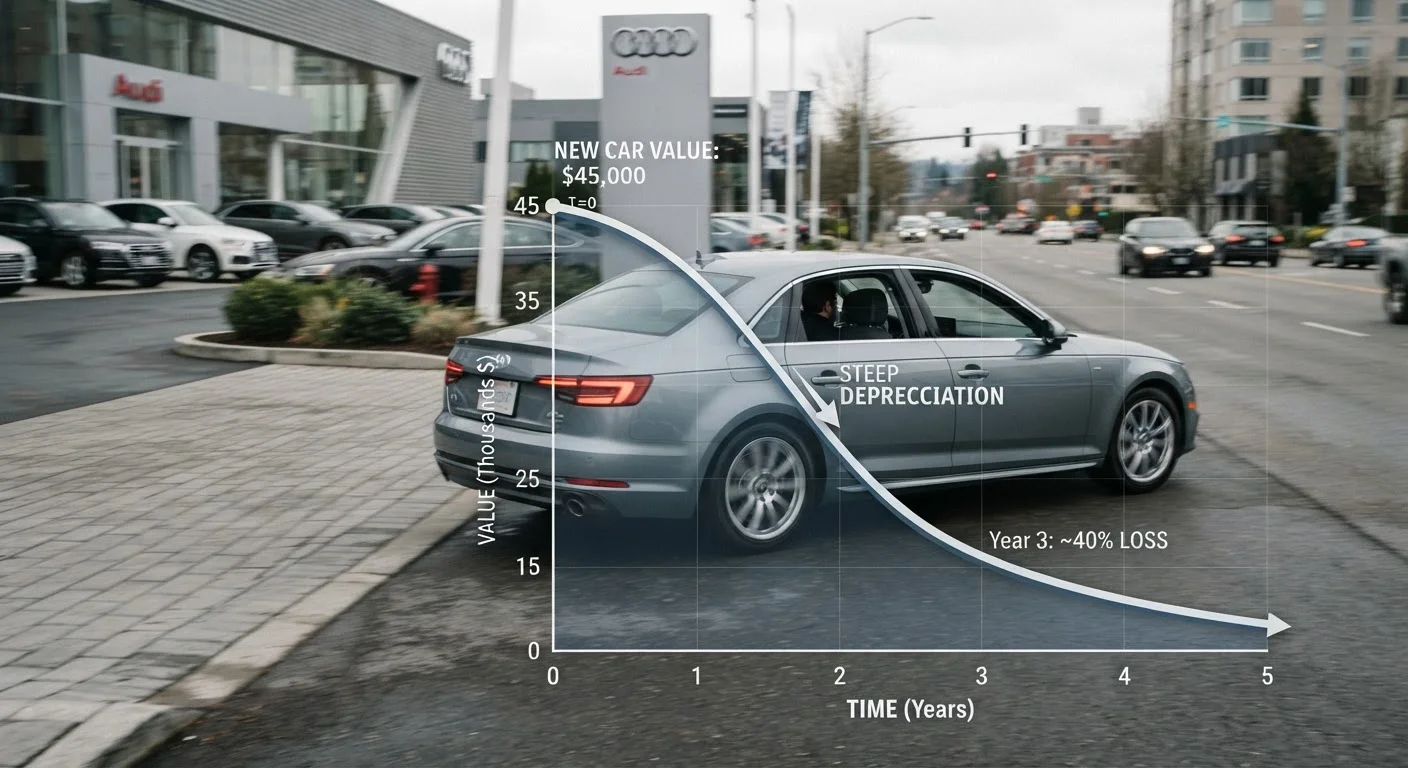
Depreciation follows a curve, not a straight line. The steepest drop occurs immediately - a new car is estimated to lose around 9-11% of its value the moment it leaves the dealership lot, simply because it transitions from new to used. By the end of year one, total depreciation typically reaches 15-25% of the purchase price.
Years two and three continue to see meaningful losses, though at a slower pace. By year five, a vehicle may have retained only 40-60% of its original value, depending on the model and market conditions. After that, the rate of decline generally flattens - which is one reason long-term owners sometimes find the economics improve the longer they hold a vehicle.
Several variables influence the pace of depreciation:
- Mileage: Higher annual mileage accelerates value loss.
- Condition and service history: Well-maintained vehicles with documented records retain more value.
- Model demand: Vehicles with strong resale reputations - often certain trucks and SUVs - depreciate more slowly than others.
- Market shifts: Fuel price changes, supply constraints, and technology trends can all affect how quickly specific segments lose value.
“For most Americans who buy new vehicles, depreciation is the dominant ownership cost - often larger than fuel, insurance, and maintenance put together over the first five years.”
— AAA, Annual Your Driving Costs Study
Depreciation and the Buy vs. Lease Decision
Understanding depreciation is essential to evaluating whether buying or leasing makes financial sense for your situation. When you lease, your monthly payments are essentially covering the vehicle's projected depreciation during the lease term, plus fees and interest. A model with a high residual value - meaning it's expected to retain more of its worth - will generally produce lower lease payments than one that depreciates steeply.
When you buy, you bear the full depreciation exposure. If you sell after two years, you absorb the steepest part of the depreciation curve. If you hold for eight or ten years, the annual depreciation cost per year decreases substantially - though other ownership costs such as maintenance may rise. The buying vs. leasing comparison is worth examining with depreciation as a central input, not an afterthought.
Practical Ways to Reduce Your Depreciation Exposure
While depreciation cannot be eliminated, informed purchase and ownership decisions can meaningfully reduce its financial impact.
Buy used, not new. Purchasing a vehicle that is two to three years old allows a prior owner to absorb the steepest part of the depreciation curve. You pay a lower price for a vehicle that will depreciate more slowly going forward. This is one of the most effective structural ways to reduce per-year depreciation cost.
Choose models with strong residual values. Some vehicle segments - particularly full-size pickup trucks and certain sport utility vehicles - have historically held their value better than average. Researching historical resale data before purchase is a useful exercise.
Maintain condition deliberately. Regular servicing, documented maintenance records, avoiding unnecessary cosmetic damage, and keeping mileage in check all support better resale value. For a broader framework on managing costs over the full ownership period, see keeping ownership costs in check over a vehicle's full life.
Time your sale strategically. Selling or trading in a vehicle before major depreciation milestones - such as when it crosses 60,000 miles or enters its fifth model year - can sometimes preserve more residual value, though market conditions always play a role.
Check Residual Value Before You Buy
Before purchasing or leasing a vehicle, look up historical resale data for that specific model using publicly available used-car market data. A vehicle with consistently strong resale performance will cost you less in depreciation over a typical ownership period, even if its sticker price is similar to a model that depreciates faster.
This article provides general financial education about vehicle depreciation. It is not personalized financial or investment advice. Consult a qualified financial professional for guidance specific to your situation.