

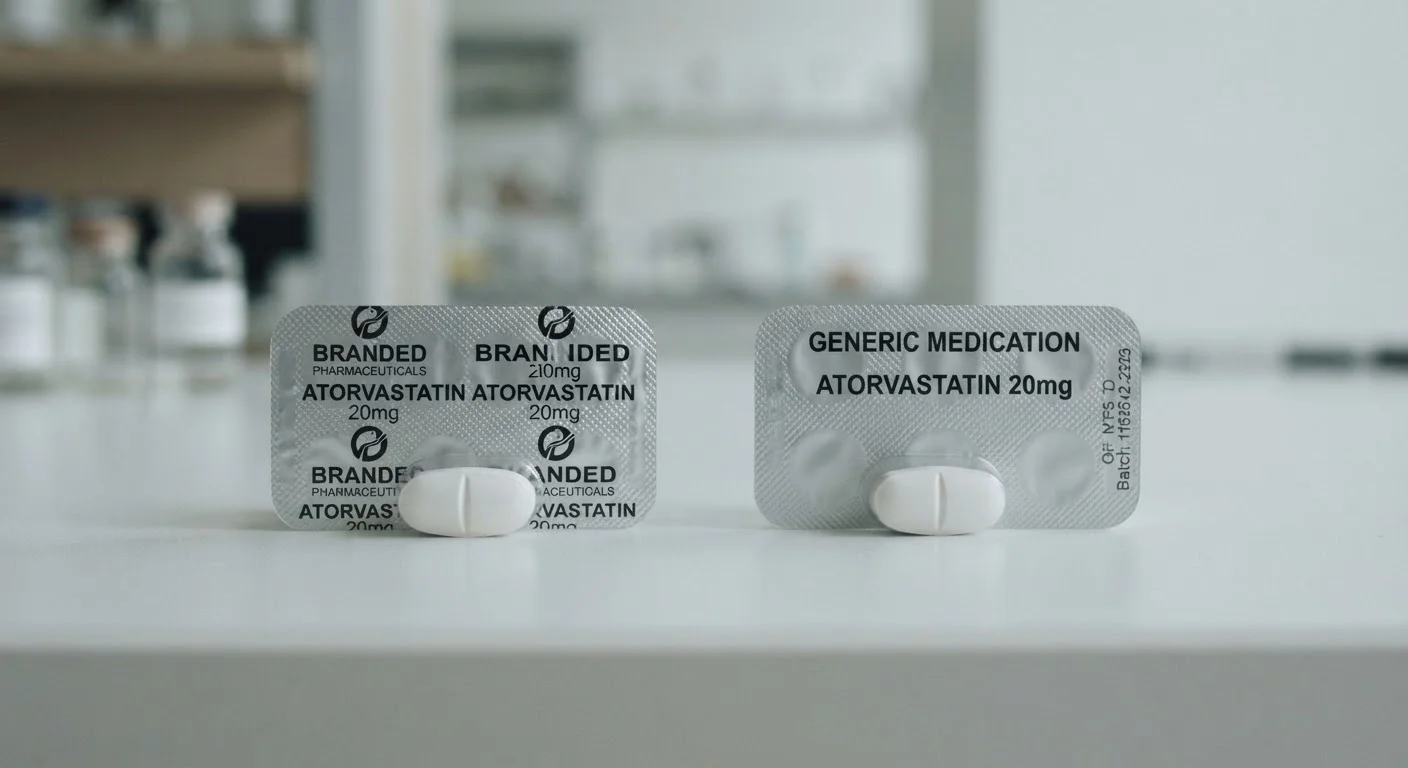
Key Takeaways
Option A
Brand-Name Medication
The original, patent-protected formulation.
Best for: Patients whose prescribers or pharmacists identify a clinically meaningful difference from available generics - or where no generic exists yet.
Option B
Generic Medication
The FDA-approved, bioequivalent alternative.
Best for: Cost-conscious patients seeking the same therapeutic effect at a significantly lower out-of-pocket cost.
If you are managing a stable, chronic condition with a widely available generic
Generic Medication
Regulatory bioequivalence standards mean the therapeutic outcome is expected to be the same, and the cost savings over time can be substantial.
If you take a narrow therapeutic index medication such as levothyroxine or warfarin
Consult your prescriber
Small differences in absorption between formulations can have meaningful clinical effects; your doctor should guide any switch decision.
If you have known allergies or sensitivities to dyes, fillers, or coatings
Review inactive ingredients with your pharmacist
Generics may use different inactive ingredients, and a pharmacist can compare formulations to identify potential concerns before you switch.
If no generic equivalent is currently available for your medication
Brand-Name Medication
Patent protection periods mean some newer drugs have no generic option; explore manufacturer assistance programs if cost is a concern.
What FDA Bioequivalence Actually Requires
The U.S. Food and Drug Administration (FDA) requires that a generic drug demonstrate bioequivalence to its brand-name reference before receiving approval. In practical terms, this means the generic must deliver the same active ingredient to the bloodstream at a rate and extent that falls within an accepted statistical range - typically 80-125% of the brand drug's measured absorption, assessed at the 90% confidence interval.
Generic manufacturers must also match the brand on active ingredient, strength, dosage form (tablet, capsule, liquid), and route of administration. What they are not required to replicate are inactive ingredients - the fillers, binders, dyes, and coatings that give a pill its shape, color, or flavor. For the vast majority of patients, these differences are clinically irrelevant. For a subset with documented allergies or sensitivities, they may matter. When in doubt, your pharmacist can look up the inactive ingredient list for any approved generic.
| Criterion | Brand-Name Medication | Generic Medication |
|---|---|---|
| Active ingredient | Original compound | Identical active ingredient |
| FDA approval required | Yes (NDA pathway) | Yes (ANDA pathway) |
| Bioequivalence standard | Sets the reference standard | Must meet 80-125% CI range |
| Inactive ingredients | Proprietary formulation | May differ; not required to match |
| Average cost | Significantly higher | ~80-85% less on average (FDA) |
| Insurance formulary tier | Typically higher tier | Typically lowest tier |
| NTI drug caution | Same caution applies | Discuss switches with prescriber |
This article provides general health information and is not a substitute for medical advice. Always consult a qualified healthcare professional before making changes to your medication regimen.
The Price Gap: How Big Is It and Why?
According to the FDA, generic drugs save U.S. consumers and the healthcare system hundreds of billions of dollars annually. The cost differential isn't subtle: FDA data indicates generics cost roughly 80-85% less than their brand-name equivalents on average. Once a brand drug's patent expires, multiple manufacturers can produce the same molecule, and competitive market pressure drives prices down quickly.
~80-85%
Average cost savings with generics
According to FDA data, generics cost significantly less than brand-name equivalents when a substitution is available.
90%+
Of U.S. prescriptions filled as generics
The FDA reports that the overwhelming majority of dispensed prescriptions in the United States are generic drugs.
$300B+
Annual savings from generic drugs
The Association for Accessible Medicines has reported annual savings in the hundreds of billions attributed to generic drug utilization in the U.S.
The savings don't stop at the pharmacy counter. Insurers typically place generics on lower formulary tiers, meaning your copay may be a fraction of what you'd pay for the brand. This is why understanding the generic status of your prescriptions is one of the more straightforward ways to reduce out-of-pocket healthcare spending - no negotiation required. For a broader look at why prices still vary so widely even within the generic category, see our article on prescription drug pricing and what drives it.
Where the Science Flags Caution
For most medications, switching to a generic is straightforward and clinically uneventful. However, a specific category called narrow therapeutic index (NTI) drugs deserves attention. NTI drugs are those where a relatively small difference in dose or blood concentration can lead to either under-treatment or adverse effects. Common examples include levothyroxine (thyroid hormone replacement), warfarin (an anticoagulant), lithium, and certain antiepileptic drugs.
Professional pharmacy and medical organizations have historically advised that patients stabilized on one NTI formulation - brand or generic - should ideally remain on the same manufacturer's product when possible, rather than switching between different generics or between generic and brand. This isn't a reason to avoid generics categorically; it's a reason to have an informed conversation with your prescriber and pharmacist when NTI drugs are involved.
Narrow Therapeutic Index Drugs: A Specific Caution
Drugs like warfarin, levothyroxine, and certain antiepileptics have a narrow margin between a therapeutic dose and one that causes harm or fails to work. The FDA has specific guidance on NTI drugs, and many clinical guidelines recommend consistency in manufacturer when possible. This does not mean generics are unsafe for these drugs - it means any transition should be medically supervised and followed by appropriate monitoring.
It's also worth noting that the comparison between drugs and supplements is a separate conversation. Vitamins and supplements are not subject to the same FDA approval pathway as prescription or OTC drugs. For context on how that plays out in retail choices, see our guide on store-brand vs. name-brand vitamins.
Making an Informed Switch
For most prescription medications, asking your pharmacist whether a generic is available is a low-effort, high-reward step. If a generic exists and your prescriber hasn't indicated "dispense as written" on the prescription, the pharmacy can generally substitute automatically depending on your state's substitution laws.
If you're managing a chronic condition and have been on a brand-name drug for years, it may still be worth revisiting whether a generic has become available - patents expire on a rolling basis, and the generic landscape changes continuously. Your pharmacist is an underused resource here: they can confirm what's available, compare inactive ingredients, and flag any interactions or concerns before a switch happens.
The Budget Health Products hub covers related decisions across vitamins and wellness products, where the regulatory picture is different but the comparison-shopping instinct is just as valuable. Understanding regulatory standards - whether for drugs or supplements - is what separates an informed purchase from one made on marketing alone.
This content is for general informational purposes only and does not constitute medical advice. Consult your prescriber or pharmacist before making any changes to your medications.