

Key Takeaways
Option A
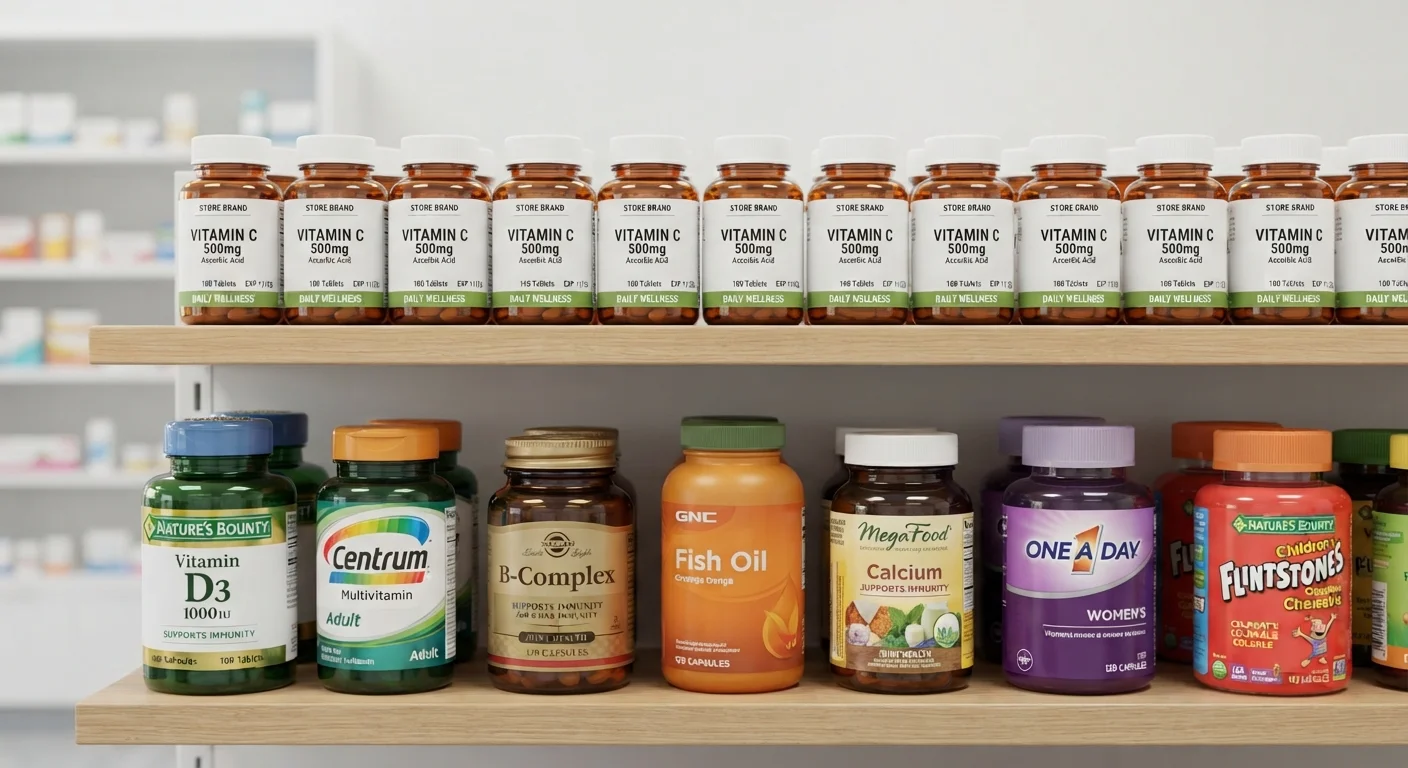
Store-Brand Vitamins
The lower-cost, often equivalent alternative.
Best for: Budget-conscious shoppers who want standard nutrient doses without paying for marketing overhead.
Option B
Name-Brand Vitamins
The established choice with higher formulation transparency.
Best for: Consumers who prioritize third-party certification, specialized forms of nutrients, or specific proprietary blends.
If you need a standard daily multivitamin with common nutrient forms
Store-Brand Vitamins
Basic multivitamins from reputable retailers often meet the same label claims as name-brand equivalents at significantly lower cost.
If you require a specific nutrient form such as methylfolate or magnesium glycinate
Name-Brand Vitamins
Specialty nutrient forms are more consistently found in name-brand products; store-brand lines may default to lower-cost chemical variants.
If third-party quality verification is a priority for you
Name-Brand Vitamins
More name-brand products carry USP, NSF International, or similar certifications, though some store brands are catching up in this area.
If you're managing a tight health budget and need routine vitamins like C or D3
Store-Brand Vitamins
Vitamins C and D3 have simple, well-established chemical forms where store-brand products are substantively equivalent and deliver real savings.
Why the Price Gap Exists (and What It Doesn't Tell You)
Store-brand vitamins typically cost 30-50% less than name-brand counterparts for one straightforward reason: retailers don't spend on national advertising, celebrity endorsements, or elaborate packaging. The manufacturing itself is often done by the same contract facilities that produce name-brand products - a fact that surprises many shoppers.
What the price gap doesn't tell you is whether the formulation inside the bottle is equivalent. That requires looking at three specific variables: the chemical form of each nutrient, the dose per serving, and whether the product has been independently verified for purity and potency. Price alone is a poor proxy for any of these.
For a broader look at how brand positioning inflates supplement costs, see our comparison of whole food vs. synthetic vitamins, which examines similar premium claims in a related category.
| Criterion | Store-Brand Vitamins | Name-Brand Vitamins |
|---|---|---|
| Typical price premium | 30-50% lower cost | Higher, reflects marketing spend |
| Active ingredient forms | Often basic/economy forms | More likely to offer specialty forms |
| Third-party certification | Growing but less common | More frequently certified |
| Manufacturing source | Often same contract facilities | Often same contract facilities |
| Label transparency | Varies by retailer | Generally more detailed |
| Dose accuracy (verified) | Depends on certification | Depends on certification |
Where Formulations Are Genuinely Identical
Certain vitamins have one dominant, well-established chemical form that all manufacturers use - meaning store-brand and name-brand products are substantively the same thing in the bottle.
- Vitamin C (ascorbic acid): There is one primary form. A 500 mg store-brand tablet delivers the same compound as a 500 mg name-brand tablet.
- Vitamin D3 (cholecalciferol): Widely standardized. Store-brand D3 softgels are chemically identical to name-brand versions at the same IU dose.
- Vitamin B12 as cyanocobalamin: The most common form across all price tiers. Unless a product specifies methylcobalamin, it's the same ingredient regardless of the label.
For these nutrients, the decision comes down to dose accuracy and manufacturing quality - both of which third-party certification addresses directly. The multivitamin self-assessment checklist can help you evaluate those specifics before purchasing.
~50%
Typical store-brand vitamin price savings
Consumer Reports analyses have consistently found store-brand supplements priced 30-50% below name-brand equivalents for comparable doses.
80%+
Supplements with label accuracy issues in spot tests
ConsumerLab has reported in multiple testing rounds that a notable share of supplements fail to meet label claims for potency or purity, underscoring why certification matters more than brand tier.
1
FDA pre-market approval steps for supplements
Unlike prescription drugs, dietary supplements in the US require no FDA pre-market approval for safety or efficacy - making independent third-party certification the primary quality signal available to consumers.
Where Real Differences Emerge
Not all nutrients are created equal across price tiers. Some have multiple chemical forms with meaningfully different properties - and name-brand products more often use the higher-quality (and higher-cost) variants.
- Folate: Store-brand products commonly use folic acid (synthetic). Name-brand and specialty products increasingly offer methylfolate (5-MTHF), which is the biologically active form. For individuals with certain genetic variants affecting folate metabolism, this distinction can matter. Consult a healthcare provider if you have questions about which form applies to you.
- Magnesium: Magnesium oxide is the least expensive form and has lower absorption rates compared to magnesium glycinate or citrate. Store-brand magnesium is more likely to be oxide; name-brand products vary widely, so label reading is essential.
- Iron: Ferrous sulfate (common in store brands) can cause more gastrointestinal side effects than ferrous bisglycinate (found in some name-brand products). Again, a healthcare professional can guide appropriate form selection.
Understanding these distinctions becomes easier with a working vocabulary. The plain-language supplement glossary defines terms like bioavailability and chelation that appear on packaging.
The Role of Third-Party Certification
Unlike prescription drugs, dietary supplements in the US are not required to prove safety or efficacy before reaching store shelves. The FDA regulates manufacturing practices under current Good Manufacturing Practices (cGMPs), but it does not pre-approve individual supplement products.
This regulatory gap means the most reliable quality signal - for both store-brand and name-brand vitamins - is independent third-party verification. Organizations such as USP (United States Pharmacopeia), NSF International, and ConsumerLab test supplements for label accuracy, contamination, and disintegration. A certification seal from one of these bodies indicates a product was verified against its label claims, regardless of whether it's store-brand or name-brand.
How to Check Certification Status
USP, NSF International, and ConsumerLab each maintain searchable online databases of verified products. Before purchasing any vitamin - store-brand or name-brand - a quick database check takes under a minute and confirms whether the specific product (not just the brand) currently holds active certification. Certification can lapse or apply only to select SKUs within a product line.
Historically, third-party certification has been more common among established name-brand products, but a growing number of retailer private-label lines now carry USP or NSF verification. Check the product label or the certifier's online database before assuming either way.
For context on how drug-style regulation differs from supplement oversight, the generic vs. brand-name medication comparison is a useful parallel read.
How to Make the Smarter Choice for Your Budget
The practical decision framework is simpler than the marketing landscape suggests. Start with the nutrient form: if what you need has one standard chemical form (vitamin C, D3, basic B12), a certified store-brand product is a sound choice. If the nutrient has meaningful form variations (folate, magnesium, iron), verify the specific form on the label - don't assume the store-brand version uses the more bioavailable option.
Next, look for a certification seal. A store-brand vitamin with a USP seal represents stronger quality assurance than an uncertified name-brand product at twice the price. Check the certifier's website to confirm current verification status, as certifications can lapse.
Finally, factor in delivery format - capsules, tablets, softgels, and powders each have different cost-per-dose profiles. Our guide to supplement delivery forms breaks down what each format means for value. If you're considering buying store-brand vitamins in larger quantities to extend your savings further, bulk supplement purchasing has a grounded look at when that strategy actually pays off.
This article is for general informational purposes only and does not constitute medical or dietary advice. Always consult a qualified healthcare professional before starting, stopping, or changing any supplement regimen.