

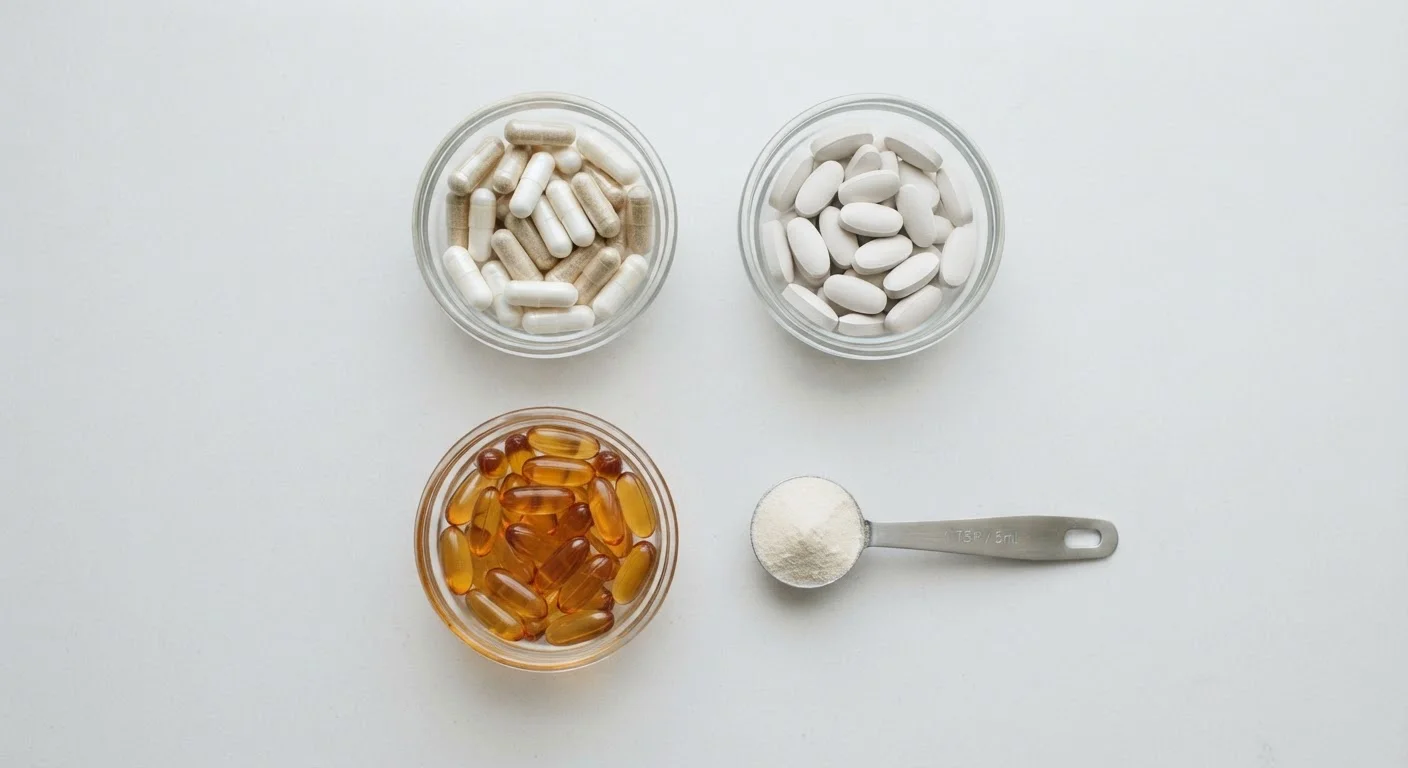
Key Takeaways
Our Verdict
No single supplement format is universally superior - the right choice depends on the specific nutrient, your digestive tolerance, and how much you're spending per effective dose. Tablets win on unit cost; powders win for high-dose or mixable nutrients; softgels suit fat-soluble vitamins; capsules suit those prioritizing minimal additives. Matching format to nutrient type is the fastest way to avoid paying more for less.
| Best for | Recommended |
|---|---|
| Budget-focused shoppers buying everyday vitamins | Tablets |
| Those taking fat-soluble vitamins like D, E, or K | Softgels |
| High-dose nutrients such as magnesium, collagen, or creatine | Powders |
| People with sensitivities to fillers and binders | Capsules |
Why Delivery Form Is a Value Decision, Not Just a Preference
When comparing supplements, most shoppers look at the ingredient label and price. Few look at the delivery format - yet format drives manufacturing cost, absorption efficiency, and shelf stability all at once. Understanding these trade-offs helps you avoid paying a premium for a format that offers no real benefit for the specific nutrient you're taking.
For a grounding in the terminology you'll encounter on labels - including terms like bioavailability and chelated minerals - see the plain-language supplement glossary before diving deeper.
| Tablets | Capsules | Softgels | Powders | |
|---|---|---|---|---|
| Typical cost per dose | Lowest | Low to moderate | Moderate to high | Lowest for high doses |
| Dissolution speed | Slowest (varies by binders) | Faster than tablets | Fast with food | Immediate (no shell) |
| Best nutrient fit | Water-soluble vitamins | Probiotics, herbs, B vitamins | Fat-soluble vitamins, omega-3s | High-dose minerals, protein, collagen |
| Additive load (fillers/binders) | Highest | Low | Low to moderate | Lowest |
| Shelf stability | Excellent | Good | Moderate (heat-sensitive) | Variable (moisture-sensitive) |
| Ease of swallowing | Moderate | Easy | Easy (smooth coating) | Not applicable (mixed in) |
| Flexible dosing | No | Somewhat (can open capsule) | No | Yes |
Tablets: The Low-Cost Standard
Tablets are the most economical format to manufacture. Powdered ingredients are compressed with binders and fillers - often magnesium stearate, cellulose, or silicon dioxide - into a dense pill. That compression keeps production costs and per-dose pricing low, which is why tablets dominate store-brand lines.
The trade-off is dissolution time. A tablet that doesn't fully break down in the gut cannot fully deliver its active ingredient. Look for tablets marked USP Verified or that carry a disintegration standard, which indicates the manufacturer has tested breakdown performance. Without that assurance, a cheap tablet is only a value if the nutrient actually becomes available to your body.
Tablets also tend to have a longer shelf life than powders and are easier to store without special conditions. For water-soluble vitamins like B-complex and vitamin C - where fat absorption isn't a concern - a quality tablet is hard to beat on pure cost-per-dose math. To see how store-brand tablet options compare to name-brand alternatives, read the store-brand vs. name-brand breakdown for context on where formulation differences are real.
Capsules: Cleaner Formulas, Moderate Cost
Capsules - either hard-shell (typically gelatin or vegetarian cellulose) or two-piece pull-apart designs - require fewer binders than tablets because the shell does the structural work. This makes them a practical option for people who react to common tablet fillers.
The capsule shell itself adds a small manufacturing cost over tablets, but the difference is usually modest. What capsules do offer is faster dissolution than most tablets and easier swallowing for many users. Some manufacturers also use capsules for delayed-release formulations, where the shell is designed to survive stomach acid and open in the intestine - useful for probiotics and certain B vitamins.
Check Capsule Ingredient Lists for Hidden Fillers
Even capsules billed as 'clean' may include flow agents like magnesium stearate or anti-caking fillers. If you're sensitive to these, look for products that explicitly list 'no fillers' or 'no flow agents' and verify by reading the full supplement facts panel, not just the front-of-package claims. Fewer inactive ingredients generally means a shorter, more readable label.
One important note: vegetarian capsules (HPMC) are suitable for those avoiding animal-derived gelatin, though they may dissolve slightly more slowly than standard gelatin capsules. Check the label if this matters to you.
Softgels: The Right Tool for Fat-Soluble Nutrients
Softgels are sealed, one-piece capsules filled with oil or an oil-suspended ingredient. They were specifically engineered for fat-soluble vitamins - A, D, E, and K - and for omega-3 fatty acids, because these nutrients require a lipid environment for proper absorption. Taking a fat-soluble vitamin in a dry tablet with a glass of water and no fat-containing food may reduce how much your body actually uses.
Softgels cost more to produce than tablets or standard capsules due to the encapsulation equipment and liquid fill required. However, for the right nutrient, that cost is often justified by meaningful absorption differences. For a broader look at how formulation choices affect what your body actually gets, the whole food vs. synthetic supplement comparison explores similar bioavailability questions.
Softgels also have a shorter shelf life once opened and are more sensitive to heat and humidity - relevant if you're considering bulk purchases.
Powders: Best Cost-Per-Gram for High-Dose Nutrients
For nutrients taken in gram-level quantities - magnesium, vitamin C at higher intakes, collagen, creatine, protein - powders are almost always the lowest cost-per-serving option. Encapsulating those amounts would require swallowing a large number of pills per dose, and the capsule material itself adds meaningless cost and volume.
Powders offer flexible dosing, are easy to mix into food or drink, and typically have fewer additives than tablets. The main drawbacks are convenience (measuring is required), taste (some nutrients are bitter or chalky), and moisture sensitivity during storage. Opened powder containers can degrade faster than sealed tablets or capsules, which matters if you're buying in large quantities. The article on bulk supplement buying trade-offs covers the storage-versus-savings calculation in detail.
Shelf life across all formats is worth examining carefully - especially if you buy in bulk to stretch your budget. The supplement expiry date guide explains how potency degrades differently across forms and storage conditions.
This article is for general informational purposes only and does not constitute medical or dietary advice. Consult a qualified healthcare professional before starting, changing, or stopping any supplement regimen.