

Key Takeaways
Our Verdict
Synthetic vitamins are a scientifically sound, cost-efficient choice for most people seeking to address common nutrient gaps. Whole food supplements offer additional plant compounds that may have complementary benefits, but the premium price isn't uniformly justified by current evidence. For most cost-conscious consumers, verified synthetic formulas deliver reliable value; the whole food category earns its price most clearly when specific cofactors matter to your individual health situation.
| Best for | Recommended |
|---|---|
| Budget-focused consumers with common nutrient gaps | Synthetic vitamins |
| Those prioritizing additional phytonutrients alongside core vitamins | Whole food supplements |
| Anyone uncertain about quality or formulation | Third-party certified options in either category |
What 'Whole Food' and 'Synthetic' Actually Mean
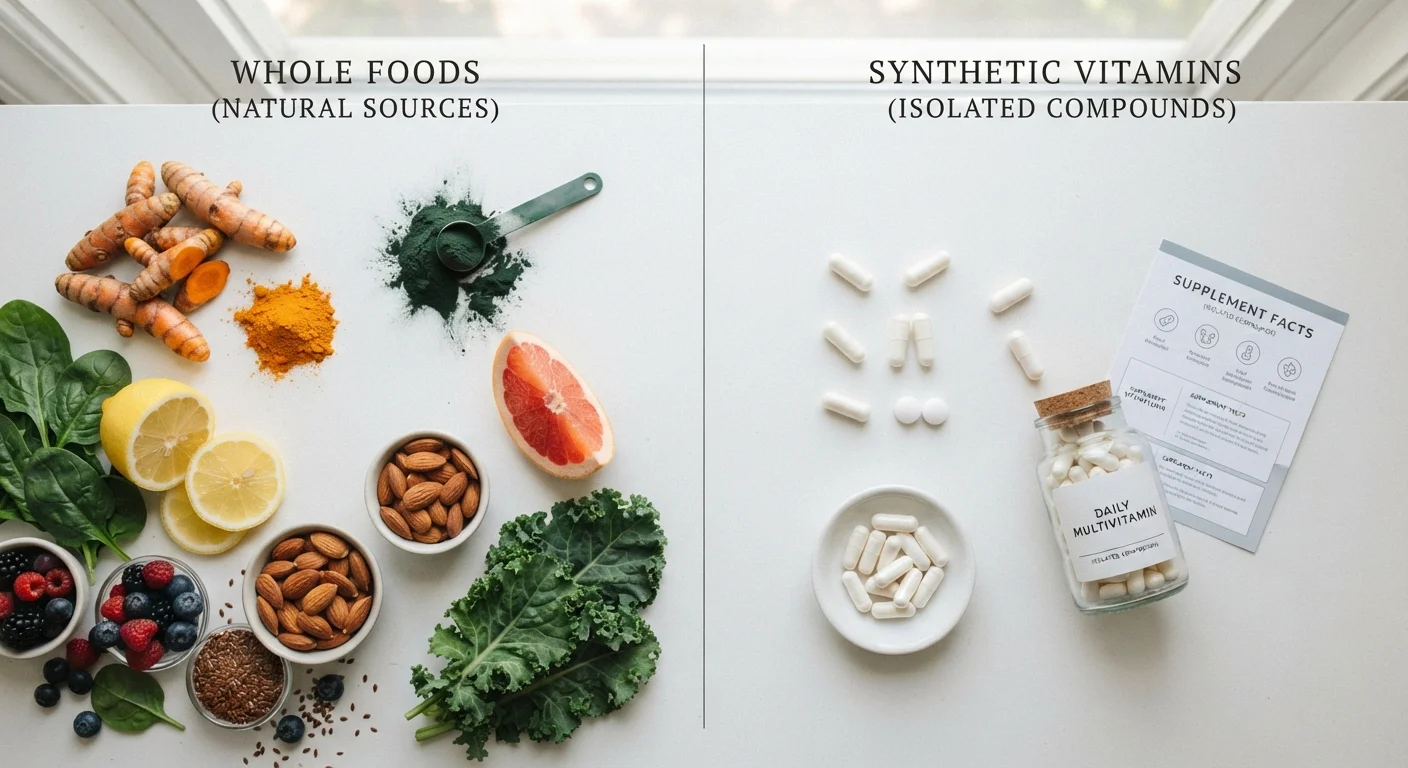
Before weighing the trade-offs, it helps to understand what these terms mean on a supplement label. Synthetic vitamins are isolated nutrients manufactured through chemical or fermentation processes. They are designed to be structurally identical - or nearly so - to the vitamins found in food. Whole food supplements, by contrast, are concentrated from actual food sources such as fruits, vegetables, or algae, and retain naturally occurring cofactors, enzymes, and phytonutrients alongside the core vitamin.
The distinction matters because whole food products aren't simply delivering the same isolated nutrient in a more expensive package - they're delivering a broader mix of compounds from the source food. Whether that broader mix translates to a meaningful health advantage is where the evidence gets complicated. For a plain-language breakdown of terminology like bioavailability and cofactor, see our supplement terminology glossary.
What the Evidence Says About Absorption and Effectiveness
The central marketing claim for whole food supplements is superior bioavailability - meaning the body absorbs and uses the nutrients more efficiently. For some nutrients, there is supporting evidence. For example, natural vitamin E (d-alpha-tocopherol) is retained in the body roughly twice as effectively as synthetic vitamin E (dl-alpha-tocopherol), according to published research. Similarly, some research suggests the folate form found in whole foods may behave differently than synthetic folic acid in individuals with certain genetic variants.
However, for the majority of vitamins - vitamin C, most B vitamins, vitamin D3 - well-conducted studies show that synthetic and food-derived versions are absorbed at comparable rates. The human digestive system processes isolated vitamin C from a supplement similarly to vitamin C from an orange, once digestion separates the vitamin from the food matrix. The cofactors present in whole food supplements may still offer complementary benefits, but the evidence base for clinically significant differences is limited for most nutrients in generally healthy adults.
| Whole Food Supplements | Synthetic Vitamins | |
|---|---|---|
| Source | Concentrated from real foods (fruits, vegetables, algae) | Manufactured via chemical or fermentation processes |
| Additional compounds | Cofactors, enzymes, phytonutrients included | Isolated nutrient only, unless added |
| Bioavailability evidence | Superior for select nutrients (e.g., vitamin E, folate) | Comparable for most common vitamins |
| Typical monthly cost | $40-$70+ for a daily multivitamin | $10-$20 for a comparable daily multivitamin |
| Digestive tolerance | Often easier on the stomach for sensitive individuals | May cause nausea in some people when taken without food |
| Quality assurance | Varies; look for third-party certification | Varies; look for third-party certification |
This means sweeping claims that whole food supplements are universally superior to synthetic ones outpace the current science. Selectivity - knowing which nutrients have documented differences - is more useful than a blanket preference for either category.
The Real Cost Difference
Price is where the gap becomes most tangible for cost-conscious shoppers. Whole food multivitamins routinely cost two to four times more per daily serving than comparable synthetic formulas. A monthly supply of a whole food multivitamin can run $40-$70 or more at retail, while synthetic equivalents often fall in the $10-$20 range. For single-nutrient supplements, the markup is similarly steep.
2-4×
Typical cost premium for whole food multivitamins
Retail price comparisons across major supplement categories consistently show whole food multivitamins priced significantly higher per daily serving than synthetic equivalents.
~2×
Natural vs. synthetic vitamin E retention advantage
Published bioavailability research indicates natural d-alpha-tocopherol is retained in body tissues at roughly twice the rate of synthetic dl-alpha-tocopherol.
That cost difference adds up quickly over a year. For consumers without a specific reason to prioritize whole food sourcing, this premium may not be justified by the available evidence. That said, paying more for a certified, high-quality product - whether synthetic or whole food - is generally more important than the sourcing method alone. Third-party certification from organizations like USP, NSF International, or ConsumerLab verifies that a product contains what the label states and meets purity standards.
To understand where formulation differences are genuinely meaningful versus where labels are mostly marketing, see our article on supplement myths that inflate your checkout total.
When the Premium May Be Worth Considering
There are specific situations where the whole food supplement argument carries more weight. Individuals who have difficulty tolerating synthetic vitamins - experiencing nausea or digestive discomfort from isolated nutrients - sometimes find whole food formulas easier to handle, likely because the food matrix slows absorption. People who eat very restricted diets and want to ensure a broader phytonutrient intake alongside core vitamins may also find value in whole food products.
Certain nutrients - vitamin K2, vitamin E, and folate - have documented cases where the form (not just the source) affects how the body processes them, particularly in individuals with specific genetic profiles or health conditions. These are decisions best discussed with a healthcare professional rather than made based on general supplement marketing.
For guidance on evaluating delivery formats alongside sourcing - which also affects cost and absorption - see our comparison of supplement delivery forms and their value trade-offs. And if you're comparing name-brand versus store-brand within either category, our store-brand vitamin comparison covers where those differences are real.
This article provides general health information for educational purposes and is not a substitute for advice from a qualified healthcare professional. Consult your doctor or pharmacist before starting, stopping, or changing any supplement regimen.