

Key Takeaways
Our Verdict
No single setting is right for every situation, but choosing the appropriate one almost always reduces your out-of-pocket costs significantly. For non-life-threatening issues, defaulting to primary care or urgent care over the ER can save hundreds of dollars per visit. Reserve the emergency room for genuine medical emergencies.
| Best for | Recommended |
|---|---|
| Routine, non-urgent health concerns and ongoing condition management | Primary Care |
| Same-day illness or injury that can't wait for a scheduled appointment | Urgent Care |
| Potential life- or limb-threatening symptoms requiring immediate intervention | Emergency Room |
| Minor complaints, medication questions, or follow-ups that don't require a physical exam | Telehealth |
Why Your Choice of Setting Changes the Bill Dramatically
The facility you walk into - or call - is one of the most consequential cost decisions in routine healthcare. A visit for a sinus infection treated at a primary care office might carry a $30-$50 copay under a typical employer plan. The same complaint handled in a hospital emergency room can generate facility fees exceeding $500 before any physician charges are applied. That gap isn't just a pricing quirk; it reflects genuine structural differences in how each setting operates and bills insurers.
Understanding those differences puts you in control. For a broader framework on reducing what you pay out of pocket, see the complete guide to reducing out-of-pocket healthcare costs.
| Primary Care | Urgent Care | Emergency Room | Telehealth | |
|---|---|---|---|---|
| Typical copay range (insured) | $20-$50 | $50-$150 | $150-$350+ | $10-$75 |
| Facility fee risk | Low | Low to moderate | High | None |
| Same-day availability | Limited | Usually yes | Yes | Usually yes |
| Appropriate for emergencies | No | No | Yes | No |
| Handles chronic condition management | Yes | Limited | No | Partial |
| In-network risk to verify | Moderate | High | High | Moderate |
| Physical exam capability | Full | Most common needs | Full | None |
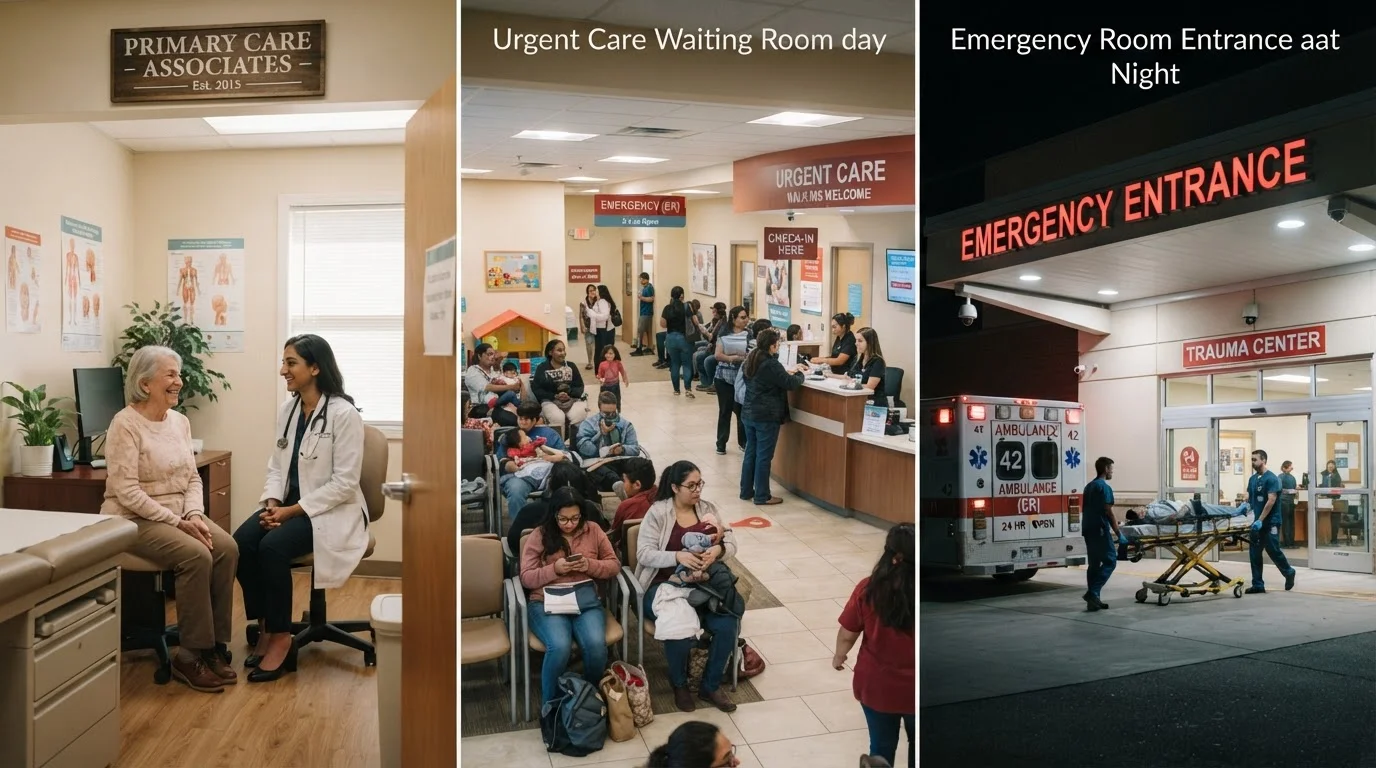
Primary Care: The Most Cost-Effective Default
Your primary care provider (PCP) is almost always the lowest-cost option for anything that isn't urgent. Beyond cost, your PCP has your medical history, can coordinate referrals without extra steps, and is best positioned to manage ongoing prescriptions or chronic conditions. Most insurance plans assign the smallest copay tier to PCP visits, and many preventive services are covered at no cost-sharing under the Affordable Care Act.
The practical limitation is access. Getting a same-day or next-day appointment can be difficult depending on your provider's patient load. If you can wait even 24-48 hours, though, calling your PCP first is nearly always worth it - they may also be able to triage you by phone or connect you to a telehealth option before you spend money on a walk-in visit.
Call Before You Go
Many primary care practices hold same-day slots for acute complaints that are released each morning. Calling first thing - rather than assuming none are available - frequently avoids an urgent care visit entirely. Your PCP's after-hours line may also direct you to an appropriate lower-cost option outside business hours.
Urgent Care: The Middle Ground Worth Using
Urgent care centers are designed for conditions that need prompt attention but are not life-threatening: sprains, minor lacerations, ear infections, flu symptoms, and similar issues. Walk-in availability and extended hours make them a practical alternative to the ER for same-day needs.
Cost-wise, urgent care typically falls between a PCP visit and an ER visit. Copays commonly run $50-$150 under commercial insurance, though your plan's specific cost-sharing applies. One important check: confirm the urgent care center is in-network before you go. Out-of-network urgent care can be significantly more expensive, sometimes approaching ER costs depending on your plan design.
For situations where an in-person exam may not even be necessary, telehealth appointments offer real savings potential worth considering before driving to a clinic.
~$2,200
Median ER visit cost without insurance
According to FAIR Health consumer data, average emergency room charges for common complaints substantially exceed urgent care costs for the same conditions.
3-5x
ER cost premium over urgent care
Industry analyses of insurance claims consistently find emergency room cost-sharing runs three to five times higher than urgent care for equivalent non-emergency diagnoses.
Emergency Room: Reserve It for True Emergencies
The emergency room exists for situations that genuinely cannot wait and may be life-threatening: chest pain, difficulty breathing, stroke symptoms, severe trauma, uncontrolled bleeding, or altered mental status. Using the ER for anything less than that exposes you to the highest cost tier in outpatient care - and often produces longer waits than urgent care as well.
Hospital ERs charge a facility fee that is separate from and in addition to the physician fee. Even with insurance, a non-emergency ER visit can leave you with hundreds to over a thousand dollars in cost-sharing depending on your deductible status. Some plans apply a higher cost-sharing tier specifically to ER visits that result in non-emergency diagnoses. Always check your Summary of Benefits and Coverage for how your plan treats ER costs.
Before your next visit to any care setting, the cost-awareness checklist for doctor's appointments can help you avoid surprise bills.
Making the Decision in the Moment
A quick mental triage can guide you to the right setting without second-guessing in a stressful moment:
- Is there a potential threat to life, limb, or vision? Go to the ER or call 911.
- Can it wait 24-48 hours? Call your PCP, who may offer telehealth or a same-day slot.
- Does it need same-day in-person care but isn't an emergency? Urgent care is the appropriate choice.
- Is it a minor complaint or question? Telehealth may be sufficient and lowest-cost.
Your insurance card's member services number can also confirm in-network urgent care locations on the spot - a 60-second call that can prevent an out-of-network bill. This is general health information and does not substitute for professional medical judgment. If you are unsure whether a symptom is an emergency, err on the side of seeking immediate care.
This article is for general informational purposes only and does not constitute medical or financial advice. Always consult a qualified healthcare professional regarding your specific symptoms or health situation.