

Key Takeaways
Low-Cost & Community Veterinary Clinic
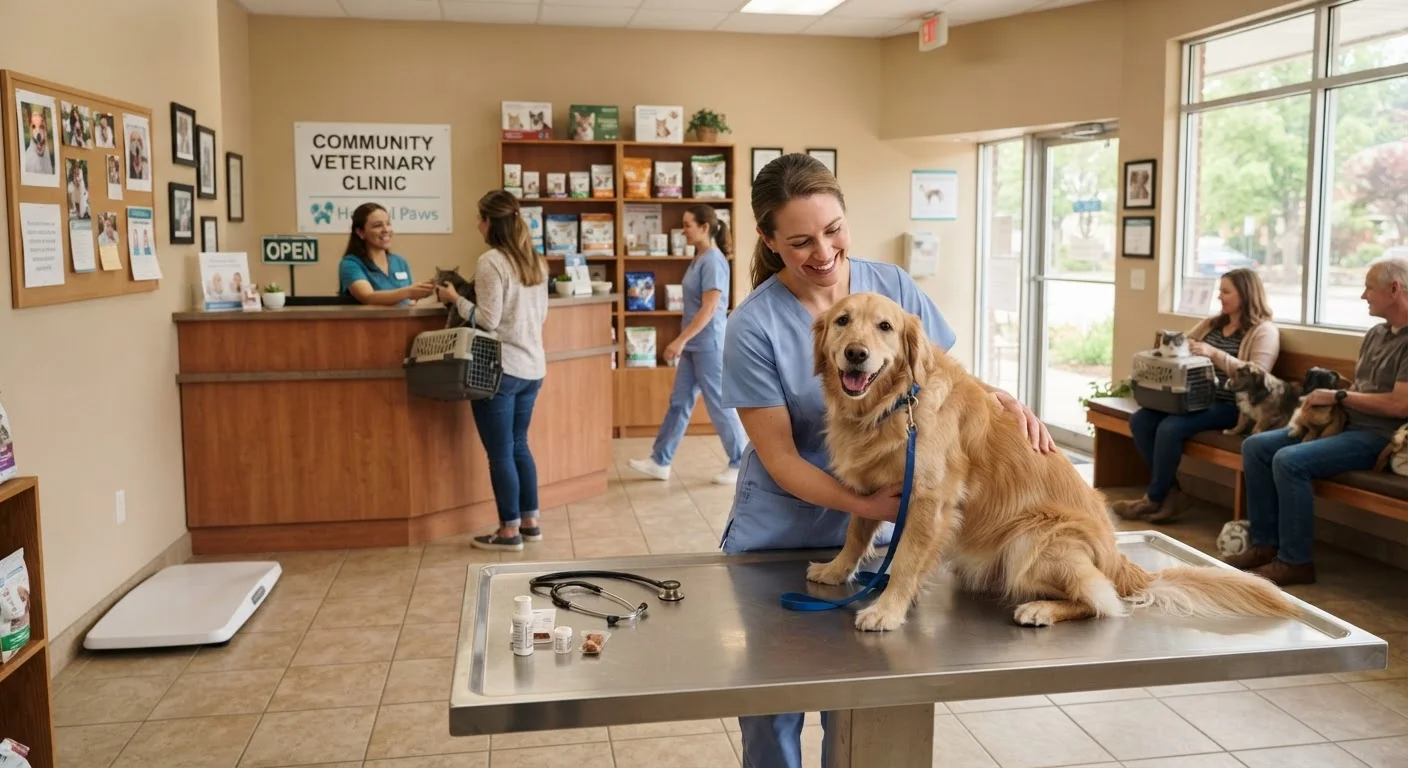
A low-cost or community veterinary clinic is a facility that provides basic pet health services at reduced or subsidized prices, typically targeting pet owners who face financial barriers to conventional veterinary care. These clinics are often operated by nonprofits, humane societies, municipal animal services, or veterinary schools. Their goal is to improve pet health outcomes across a community by making foundational care - vaccines, spay/neuter, parasite control - more widely accessible.
Some community clinics operate under a 501(c)(3) nonprofit structure and rely on grant funding, donations, or municipal contracts to offset costs; others are university-affiliated teaching clinics where supervised students provide services under licensed veterinarian oversight.
How These Clinics Operate
Low-cost and community veterinary clinics exist along a spectrum. On one end are nonprofit or municipally funded clinics that run periodic vaccination events or maintain a fixed low-fee schedule. On the other are full veterinary teaching hospitals affiliated with accredited universities, which offer a much wider scope of care at reduced rates because students carry out procedures under faculty supervision.
Somewhere in between sit humane society-operated clinics and ASPCA-affiliated programs, which often focus specifically on high-volume services like spay/neuter and rabies vaccination - procedures with clear public health and animal welfare benefits that justify subsidization.
Funding sources vary widely. Some clinics charge on a sliding scale tied to household income. Others operate at a flat reduced fee available to anyone. A few rely entirely on grants and donations, meaning service availability can shift if funding changes. Understanding how a specific clinic is funded helps set realistic expectations about appointment availability and what services are on offer at any given time.
Verify Licensure Before Your Visit
Not every clinic advertising 'low-cost' services is operated by licensed veterinarians. Before using any clinic, confirm that veterinary services are supervised by a licensed Doctor of Veterinary Medicine (DVM or VMD). Your state's veterinary medical board website can be used to verify license status. Legitimate community clinics are generally transparent about their staffing credentials.
What They Can and Cannot Provide
The scope of services at low-cost clinics is intentionally narrow. Core offerings typically include:
- Core and non-core vaccinations (rabies, distemper, parvovirus, bordetella)
- Spay and neuter procedures
- Flea, tick, and heartworm prevention products
- Microchipping
- Basic wellness exams
- Some dental cleanings (usually without advanced periodontal work)
What most of these clinics are not equipped for: emergency care, overnight hospitalization, advanced diagnostics (MRI, CT, endoscopy), orthopedic surgery, oncology, or management of chronic complex conditions. If your pet needs more than foundational preventive care, a full-service general practice or a specialty referral center is the appropriate setting. To understand why those services carry higher price tags, see our article on what actually drives veterinary bills so high.
~3,500
Low-cost spay/neuter clinics operating in the US
The Humane Society of the United States has estimated thousands of subsidized spay/neuter programs exist nationwide, including mobile units and fixed-location nonprofit clinics.
30+
Accredited veterinary teaching hospitals in the US
The American Veterinary Medical Association accredits veterinary programs at institutions across the country, most of which operate teaching clinics open to the public at reduced fees.
Navigating Eligibility and Expectations
Eligibility rules at community clinics are not uniform. Some programs serve any pet owner in a defined zip code. Others are tied to income verification - typically proof of participation in programs like SNAP, Medicaid, or WIC. A few are restricted to pets adopted through partner shelters.
Appointment availability can be limited, particularly at high-demand locations. Some clinics operate only on specific days or run as pop-up events rather than maintaining a fixed schedule. Walk-in slots may be available at vaccination events, but surgical procedures almost always require booking in advance.
Managing expectations matters. Exam thoroughness at a high-volume, low-cost clinic may differ from what a pet owner encounters at a private practice with longer appointment slots. That is not a failure of quality - it reflects a different operational model optimized for volume and access. For preventive services where the procedure is standardized (a vaccine dose, a microchip implant), that distinction rarely affects outcomes. For more nuanced diagnostic conversations, a full-service clinic is a better fit. Understanding what questions to ask before agreeing to a treatment plan can help in either setting.
Call Ahead to Confirm Current Services
Community clinic offerings can change based on funding cycles, staffing, and seasonal demand. Before making the trip, call or check the clinic's current website to confirm that the specific service you need is available and that you meet any eligibility requirements. Some clinics also maintain waitlists for popular procedures like spay/neuter.
Fitting Community Clinics Into a Broader Care Strategy
Low-cost clinics work best as one layer in a broader approach to pet health spending - not as a complete substitute for conventional veterinary care. Used strategically, they can meaningfully reduce the cost of routine prevention while freeing up budget for situations that genuinely require a full-service practice.
For example, a pet owner might use a community clinic for annual vaccines and heartworm testing, then maintain a relationship with a conventional vet for anything requiring diagnostics or treatment. This kind of split approach is practical, and most veterinarians understand it. Investing in preventive care that saves money over time - regardless of where it's delivered - remains one of the most reliable ways to keep overall costs manageable.
For situations where costs at a full-service clinic are still a concern, other tools exist. Pet insurance and veterinary payment plans each address different financial scenarios and are worth understanding before a crisis arises. Community clinics, insurance, and payment options are not mutually exclusive - many pet owners use a combination depending on what their pet needs at a given time.
This article is for general informational purposes only and does not constitute veterinary or financial advice. Consult a licensed veterinarian for guidance specific to your pet's health needs.