

Key Takeaways
Indoor Cat Enrichment
Indoor cat enrichment refers to the physical objects, activities, and environmental features that help a cat housed entirely indoors express natural behaviors - climbing, scratching, hunting, hiding, and observing. Without these outlets, indoor cats are prone to boredom-related problems including destructive scratching, over-grooming, and stress. Enrichment gear is the tangible side of meeting those behavioral needs.
Feline behavioral science distinguishes between 'passive' enrichment (structures a cat can use at will) and 'interactive' enrichment (play that requires human involvement). A well-rounded setup typically includes both.
Why Enrichment Gear Is Not Optional for Indoor Cats
An indoor cat's territory is fixed and human-controlled. Every instinct evolved for a dynamic outdoor environment - stalking, climbing, scratching territory markers, surveying from height - still fires daily with nowhere productive to go. The result, when those needs go unmet, is behavioral fallout: furniture destruction, anxiety, inter-cat conflict in multi-cat homes, and sometimes physical health problems from inactivity.
Enrichment gear is the practical solution. It isn't about spoiling a pet; it's about providing the minimum behavioral infrastructure an indoor cat requires. Before comparing any specific gear, it helps to understand what each type actually does - and why certain features matter more than marketing language suggests.
See our pre-purchase checklist to evaluate any enrichment item before committing to a purchase.
Scratching Posts: What Makes One Worth Buying
Scratching serves three purposes simultaneously: it maintains claw condition, it stretches the spine and forelegs, and it deposits scent markers. None of these needs disappear with indoor living - which is why a cat without a post will find a substitute, usually upholstered furniture.
What to Compare
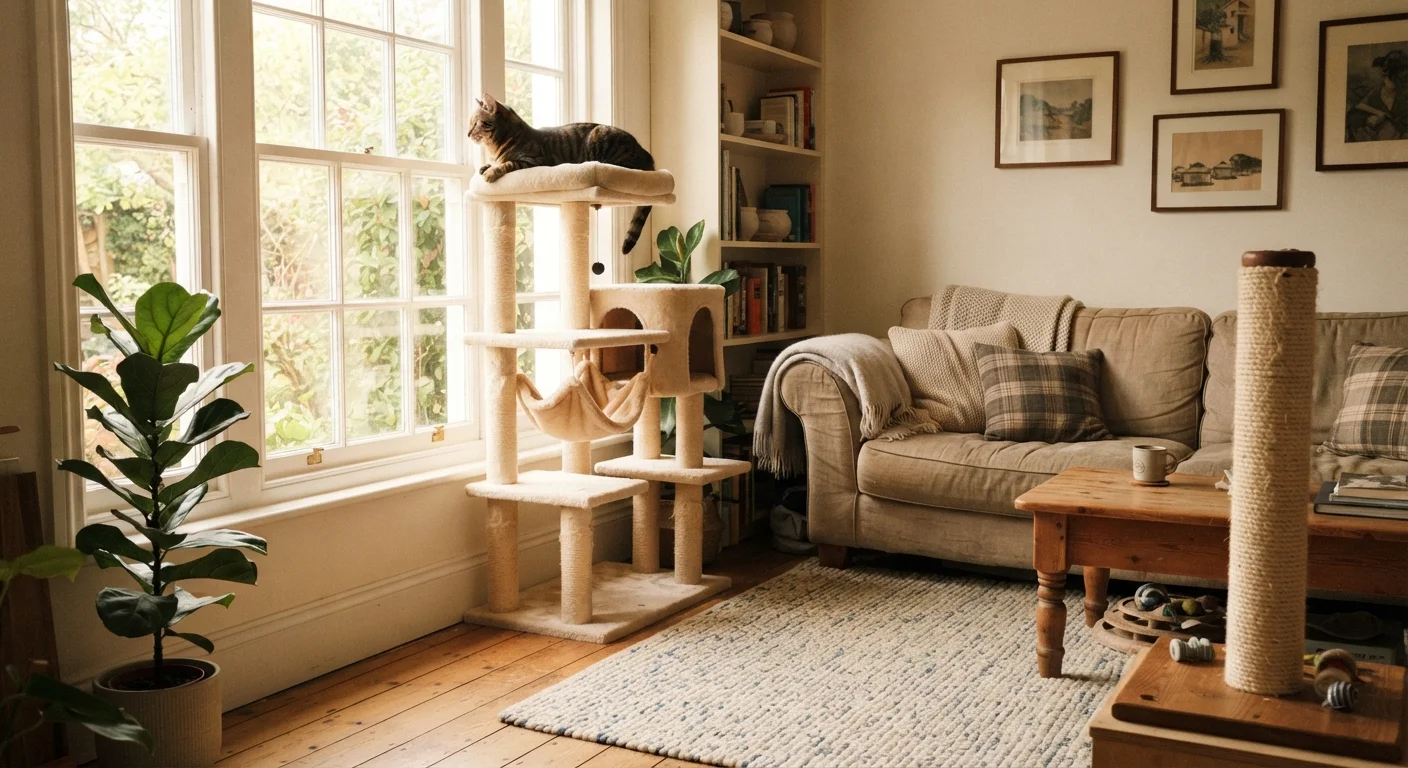
- Height: The post must allow a full body extension. For most adult cats, this means at least 28-32 inches. Shorter posts are routinely ignored.
- Stability: A post that wobbles when a cat leans into it will be used once and abandoned. A wide, heavy base or wall-mounting options solve this.
- Material: Sisal (rope or fabric), raw wood, and corrugated cardboard are the textures cats consistently prefer. Carpet-covered posts often discourage scratching because carpet provides no satisfying resistance - and they may train cats to scratch carpeted floors.
- Orientation: Some cats strongly prefer horizontal scratching surfaces (cardboard scratchers on the floor). Observing where your cat already scratches indicates preference.
Placement Often Matters More Than Price
The single biggest predictor of whether a cat uses enrichment gear is where it's placed, not what it costs. A scratching post in a back hallway will be ignored; the same post beside the couch the cat targets will be used immediately. Position new gear where the cat already spends time before assuming it's being rejected.
Placing a post directly beside the furniture your cat already targets - then gradually moving it to a preferred location - is one of the most reliably effective redirection strategies.
Climbing Structures: Matching Gear to Your Cat and Space
Height access is a stress-regulation tool for cats. Being able to observe a room from elevation allows a cat to feel in control of its environment - particularly important in multi-cat or busy households. Cat trees, wall-mounted shelving, and window perches each deliver this, with different footprints and price points.
~90%
US cats living exclusively indoors
Industry surveys from veterinary associations consistently find the majority of owned US cats are kept indoors full-time, making behavioral enrichment a near-universal need.
28-32 in
Minimum effective scratching post height
Feline behaviorists generally recommend this height range to allow a full body extension during scratching, based on average adult cat body length.
10-15 min
Recommended daily interactive play per session
Veterinary behavioral guidelines typically suggest short, frequent interactive play sessions to mimic natural prey-sequence hunting behavior in indoor cats.
Key Dimensions to Evaluate
- Total height vs. ceiling clearance: A tree that tops out at 48 inches in a room with a 9-foot ceiling still gives a cat meaningful elevation. Measure your space.
- Platform size: Platforms should be large enough for the cat to lie down fully without hanging over the edge. This matters more for larger breeds.
- Base stability: Heavier cats and active climbers can tip lightweight structures. Check the base dimensions and weight rating, not just the overall height.
- Wall-mounted shelving: A cost-effective option for small spaces. Individual shelf units can be arranged into a custom climbing path. Installation requires secure wall anchoring - consult the manufacturer's guidance and, for plaster or masonry walls, a hardware professional.
For households managing multiple cats, multi-pet budget planning principles apply to gear too - shared structures work when there are enough elevated spots that no single cat can monopolize them.
Beyond Posts and Trees: Filling the Enrichment Gap
Structures address territorial and physical needs, but they don't replicate the cognitive engagement of hunting. Puzzle feeders, wand toys, and window bird feeders (placed outside, in sight of a window perch) each serve a distinct function.
- Puzzle feeders: Slow feeding while simultaneously engaging problem-solving. Useful for cats prone to eating too fast or for households where a cat is left alone for long periods.
- Wand and interactive toys: These require human participation and provide the prey-sequence engagement - stalk, chase, pounce, catch - that unstructured solo play rarely delivers. Short daily sessions of 10-15 minutes are more effective than occasional long play periods.
- Hiding structures: Covered beds, paper bags, cardboard boxes. Hiding is a comfort behavior, not a sign of fear. Cats that can retreat to a defined safe space show lower baseline stress markers.
Spending on enrichment is part of a broader pet supply budget. If you're also comparing food costs, stretching a cat's food budget covers how to meet nutritional needs without overspending - a useful parallel read.
New to Cat Ownership? Start Here
New pet owners evaluating the full scope of indoor cat gear can get a grounded starting framework from our guide to buying pet supplies, which covers budgeting, sourcing, and what to prioritize on day one.
New pet owners evaluating the full scope of indoor cat gear can get a grounded starting framework from our guide to buying pet supplies, which covers budgeting, sourcing, and what to prioritize on day one.