

Key Takeaways
Option A
Retractable Leash
The flexible, longer-range option for exploratory walks.
Best for: Dogs that are reliably trained and walking in open, low-traffic areas where extra range is safe.
Option B
Fixed-Length Leash
The dependable, controlled choice for everyday walking.
Best for: Owners who need consistent control in busy streets, training situations, or crowded public spaces.
If you walk your dog in busy urban streets or near traffic
Fixed-Length Leash
Consistent length keeps your dog close and predictable, reducing the risk of sudden lunges into traffic or crowded pathways.
If your dog is still in obedience training
Fixed-Length Leash
A fixed leash reinforces consistent boundaries, which is essential when teaching heel position and leash manners.
If you walk a well-trained dog in open, low-traffic parks or trails
Retractable Leash
Extended range lets a calm, trained dog explore and sniff more freely without needing to go fully off-leash.
If you prioritise durability and low maintenance
Fixed-Length Leash
Simple construction means fewer parts to wear out or malfunction; flat or round nylon leashes can last for years with minimal care.
If you have a small dog in a quiet suburban neighbourhood
Retractable Leash
With reduced pulling force and lighter weight, a retractable can be manageable for small dogs in low-hazard environments where close control is less critical.
How Each Leash Type Works
A fixed-length leash is exactly what it sounds like: a strap - typically nylon, leather, or rope - with a fixed distance between the collar clip and the handle. Common lengths run from 4 to 8 feet. There are no moving parts, no mechanism to engage, and no variation in slack unless you physically change your grip.
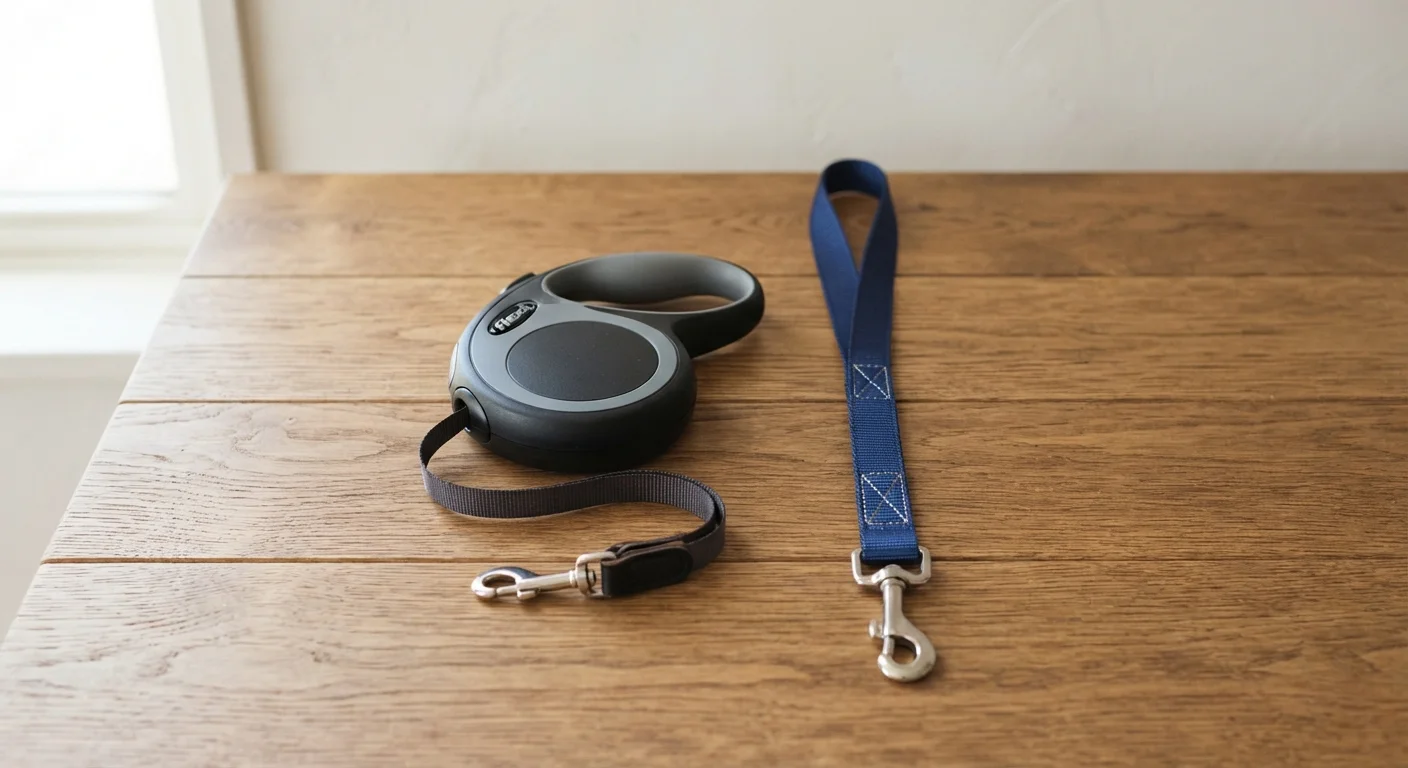
A retractable leash houses a thin cord or tape on a spring-loaded spool inside a plastic handle. As a dog moves forward, the cord extends - often up to 16 or 26 feet - and retracts automatically when the dog moves back. A button on the handle locks the cord at any length or activates a braking mechanism.
Understanding this mechanical difference is the starting point for evaluating which type fits your daily routine. See our guide to choosing walking gear for context on how leash choice interacts with collar and harness decisions.
| Criterion | Retractable Leash | Fixed-Length Leash |
|---|---|---|
| Typical Length | 10-26 feet (variable) | 4-8 feet (fixed) |
| Control Level | Variable, lower immediate control | Consistent, high immediate control |
| Training Suitability | Not recommended for active training | Strongly preferred by trainers |
| Safety in Traffic | Higher risk due to extended cord | Lower risk, predictable range |
| Mechanical Complexity | Spring-loaded spool, lock button | No moving parts |
| Durability | Moderate; mechanism can wear | High; simple construction lasts |
| Best Environment | Open, low-traffic areas | Urban, crowded, or any setting |
| Typical Price Range | Moderate to higher | Low to moderate |
Control, Safety, and Training Considerations
Control is where the two types diverge most sharply. A fixed-length leash gives you an immediate, consistent response - if your dog lunges, you feel it instantly and can correct it. A retractable leash introduces variable tension; the cord is often under low resistance right up until the dog hits the maximum extension, at which point the sudden jerk can be startling for both dog and owner.
Thin retractable cords can also cause rope burns to hands or legs if they wrap around a limb during a sudden sprint - a documented safety concern noted by veterinary and consumer safety organisations. The locking mechanism can fail, and the cord itself is more prone to snapping under stress from larger or stronger dogs.
For dogs in active training, most professional trainers recommend fixed-length leashes specifically because they create a consistent spatial relationship between handler and dog. Variable length sends inconsistent signals about how far ahead a dog is permitted to walk.
16-26 ft
Maximum cord length on common retractable leashes
At full extension, a dog can reach traffic or other hazards well before an owner can physically intervene.
4-6 ft
Standard fixed-length leash in urban use
Most dog training guidelines cite 4-to-6-foot leashes as the standard for teaching leash manners and maintaining safe proximity.
No. 1
Most commonly recommended leash type by trainers
Professional dog trainers broadly recommend fixed-length leashes for obedience work due to consistent spatial feedback.
In high-traffic environments - city sidewalks, near roads, busy parks - a fixed leash meaningfully reduces reaction time. If something unexpected happens, a 6-foot leash leaves far less margin for error than 16 feet of extended cord.
Where Retractable Leashes Can Work Well
Despite their limitations, retractable leashes are not categorically problematic for every dog or setting. A well-trained, calm adult dog walking in a quiet open park or along a rural trail can benefit from the extended range to sniff and explore - behaviours that are important for canine mental stimulation and wellbeing.
The key criteria for responsible retractable leash use are: a dog that reliably responds to recall commands, an environment with low pedestrian and vehicle traffic, and an owner who keeps a firm grip on the handle and uses the lock proactively rather than reactively.
Retractable Leash Use in Public Spaces
Many municipal parks, dog-friendly businesses, and urban trail systems have rules that require dogs to be kept on leashes of 6 feet or less. A retractable leash at full extension often violates these rules even if the lock is engaged. Before relying on a retractable in a public space, check posted signage or local ordinances - non-compliance can result in fines and, more importantly, creates genuine hazards for other park users and their dogs.
Size is also a practical factor. Retractable leashes designed for small dogs (typically under 25 lbs) are built with lighter cords and less tension, making them more manageable. Using a retractable designed for small dogs on a large breed is a common misuse that increases the risk of cord failure.
Cost and Practical Durability
Fixed-length leashes span a wide price range depending on material - basic nylon options are among the most affordable pet supplies available, while leather or padded versions cost more. Regardless of material, they have no mechanical components to wear out, making them straightforward to maintain and long-lasting.
Retractable leashes generally cost more upfront due to their mechanism. The internal spring and braking system can degrade with heavy use, and replacement is typically the whole unit rather than a single part. Cord-style retractables are generally more prone to tangling than tape-style versions, which is worth factoring into long-term cost.
For owners who walk daily in varied environments, keeping one of each type on hand is a practical approach - a fixed leash as the default, a retractable for specific low-risk outings where range is genuinely useful.