

Key Takeaways
Price Tracking Tool
A price tracking tool is a browser extension, website, or app that monitors a product's listed price across one or more online retailers over time. It records historical prices, displays them as a graph or table, and often sends an alert when the price drops below a threshold you set. The goal is to give shoppers objective data about whether a current price is genuinely low or just appears to be.
Most tools use automated web crawlers or retailer APIs to poll prices at regular intervals — commonly every few hours to once per day — then store the data in a time-series database for display.
What a Price Tracker Actually Does Under the Hood
At its core, a price tracking tool is a data-collection system. A software crawler — often called a bot or spider — visits a product page at scheduled intervals, reads the listed price, and records it alongside a timestamp. Repeat that process hundreds of times over weeks or months, and you get a time-series log that reveals how that product's price has moved.
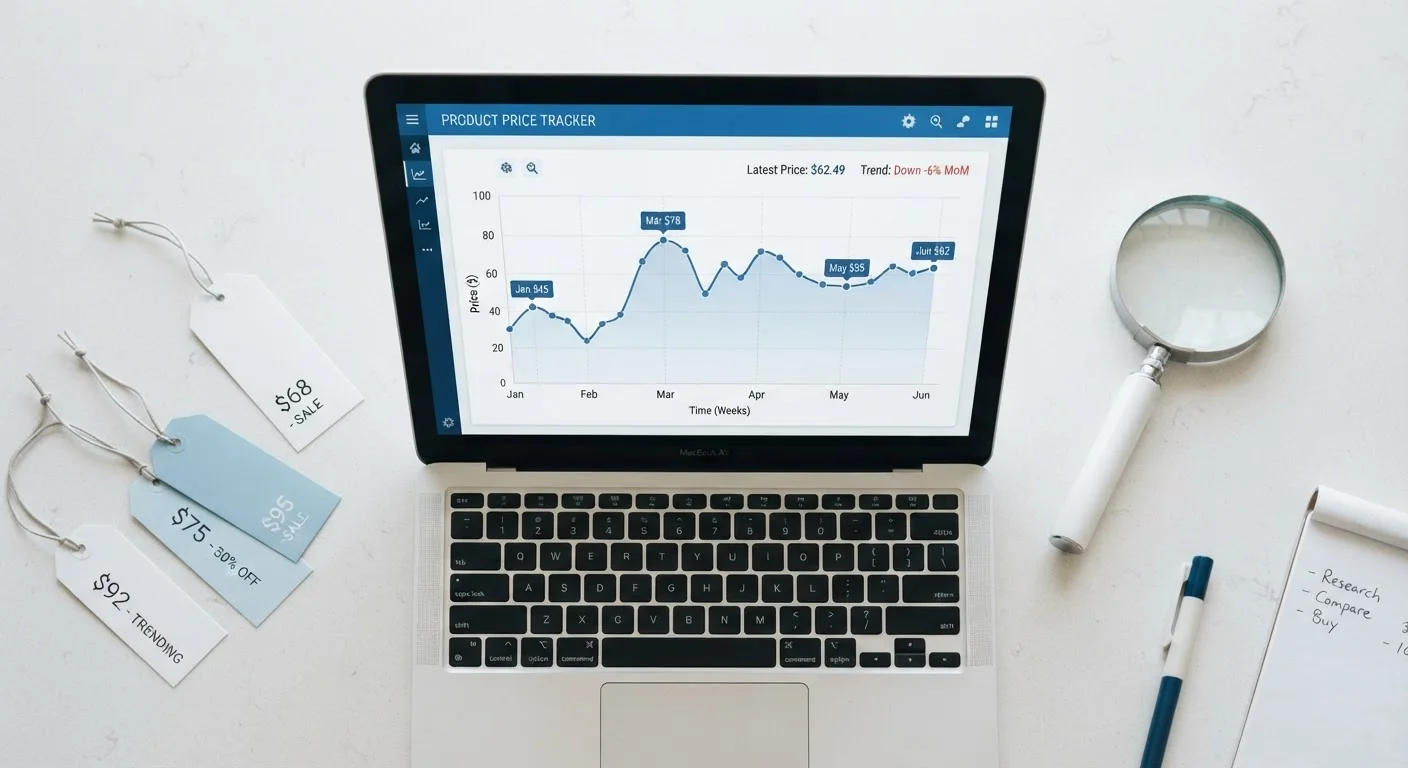
That logged data is then rendered as a price history graph. Instead of seeing only today's price, you see whether $89 is a genuine low, a return to the usual price, or actually higher than it was two months ago. This context is the tool's primary value — it converts raw price data into something you can reason about.
Understanding why retailers change prices so frequently makes this context even more useful. Retailers use algorithmic pricing engines that can adjust prices dozens of times per day based on competitor pricing, inventory levels, and demand signals. Our article on how retailers set and change prices online covers those mechanisms in detail.
Browser Extensions vs. Standalone Tracker Sites
Price tracking tools come in two main forms: browser extensions that activate automatically when you visit a product page, and standalone websites where you manually submit a product URL. Extensions offer convenience but require granting access to your browsing activity — review the permissions before installing. Standalone sites require more manual effort but involve no browser-level access. Both approaches access the same underlying price data, so the choice is primarily about convenience versus privacy preference.
How Alerts Are Triggered
Most tools let you set a target price for a specific product. When the crawler records a price at or below that target, the system queues an alert — typically an email or push notification — sent to you within the next check cycle. The alert contains the current price, the product name, and usually a link to the listing.
The practical implication: alerts are not instantaneous. A tool that polls every 24 hours could alert you hours after a flash sale started — or after it ended. Tools with shorter refresh intervals are more useful for time-sensitive price drops, though they're also more likely to be restricted on retailer sites that detect automated traffic.
Setting a realistic target price matters more than most shoppers realize. If you set a target at 10% below the product's all-time average, you'll receive meaningful alerts. If you set it at the all-time low — a price recorded once two years ago — you may never hear from the tool. The price history graph itself is the right input for choosing a target. This connects directly to the logic explored in our piece on why waiting pays off — knowing a product's price cycle helps you set targets that actually trigger.
Set Your Target Based on the Average, Not the All-Time Low
The all-time low price for a product is often a one-off error, a clearance event, or an outlier that won't repeat. Setting your alert target near the historical average — or 10–15% below it — produces alerts that actually fire and reflect realistic pricing. Use the price history graph to identify that average before you commit to a number.
Coverage Gaps and Data Limitations
No single price tracking tool covers every retailer. Most tools build and maintain their own crawler infrastructure for each supported site, which means smaller or regional retailers are frequently absent. Before relying on price history data, confirm the tool actually tracks the retailer you're shopping from — missing coverage looks identical to a product that has never changed price.
Data quality also varies. Prices recorded from marketplace listings may reflect a primary retailer's price but miss third-party seller prices on the same page. Bundled or variant products — different sizes, colors, or configurations — often have separate price histories that don't appear when you're looking at the default listing. These gaps don't make the tools useless, but they reward users who understand what they're actually seeing.
~2.5x
How often prices change on major retail platforms
Research from pricing analytics firms has found that prices on large e-commerce platforms can change multiple times per day for high-demand product categories, underscoring why static price checks miss meaningful variation.
30–60%
Share of 'sale' prices that aren't below recent averages
Consumer advocacy analyses of major retail events have consistently found that a significant portion of promoted discounts reflect prices that were already common in the preceding weeks.
A related issue is manufactured urgency. Some retailers temporarily inflate prices before a promotional event, making the subsequent discount appear larger than it actually is. Price history graphs expose this pattern directly — a sharp price spike immediately before a sale is a clear signal in the data. Our article on deal-hunting myths that cost shoppers money covers this tactic and others that can erode your savings if unrecognized.
Getting Practical Value From Price History Data
The most consistent use case for price trackers is patience-based shopping: identify a product you plan to buy, check its price history to understand its typical range, set a target alert below the average, and wait. This works especially well for non-urgent purchases — electronics, appliances, and seasonal goods that follow predictable markdown cycles.
Price history also surfaces seasonal patterns that are otherwise invisible. A product that drops reliably in January or during mid-summer sales becomes a candidate for planned purchasing rather than reactive buying. Pairing this data with a basic spending plan — as outlined in resources on budgeting basics — helps you build intentional purchase timing into your regular financial habits rather than treating it as a one-off tactic.
The straightforward takeaway: price trackers don't find deals for you. They give you the historical context to recognize a deal when one actually appears — which is a meaningfully different and more durable advantage. For a broader set of savings approaches, the saving strategies hub offers additional frameworks worth building into your routine.
This article is for general informational and educational purposes only. It does not constitute financial advice. Consult a qualified financial professional for guidance specific to your situation.