

Key Takeaways
Sinking Fund
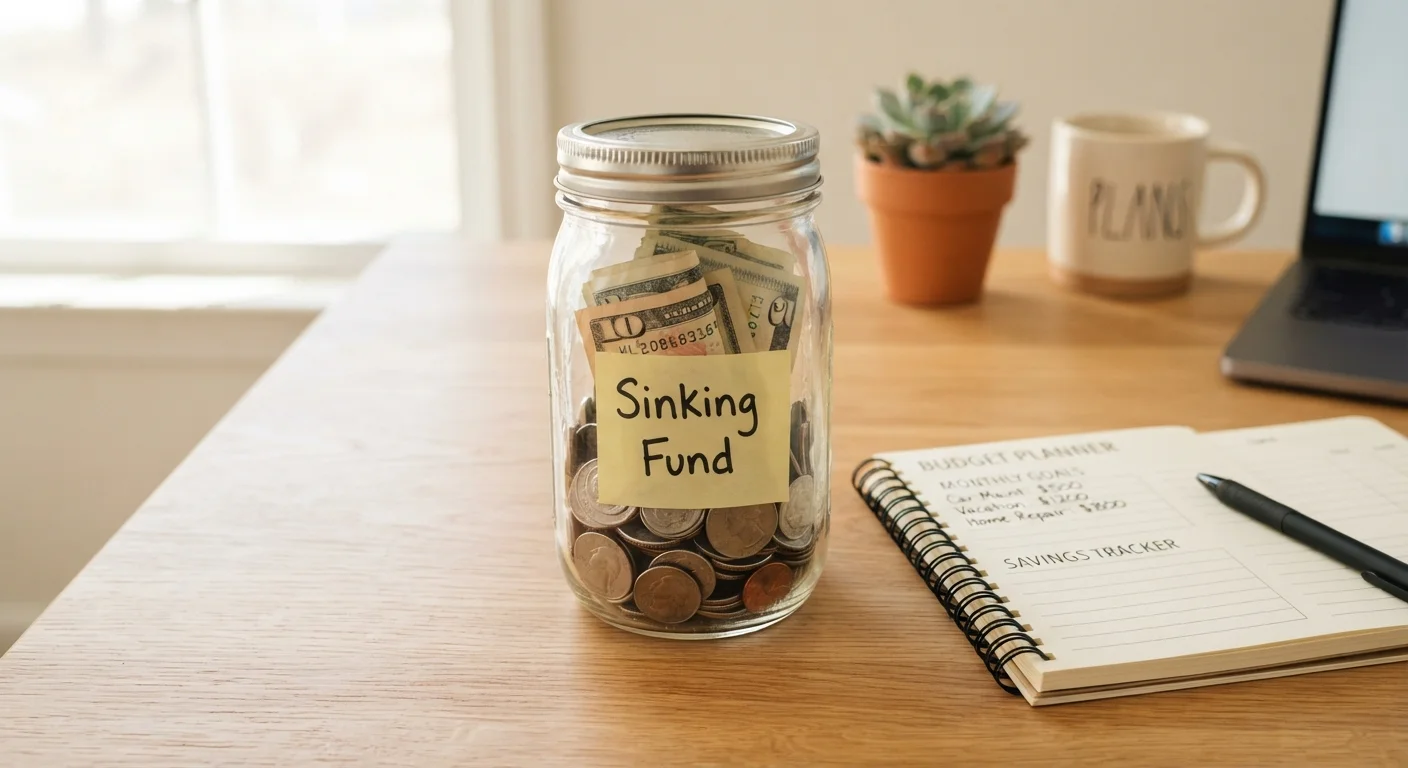
A sinking fund is a dedicated savings pool you build gradually to cover a specific, anticipated expense. Instead of scrambling for cash when the bill arrives, you set aside a fixed amount each month until you reach your target. The name comes from accounting, where companies 'sink' money into a reserve to retire future debt obligations.
In personal finance, sinking funds are distinct from both checking accounts and emergency funds — each category of savings has a defined purpose and target balance that prevents cross-contamination of money earmarked for different goals.
Why Irregular Expenses Break Budgets
Most household budgets are built around predictable monthly costs: rent, utilities, groceries, subscriptions. But real spending doesn't work that cleanly. Car registration, annual insurance premiums, holiday gifts, back-to-school supplies, veterinary checkups — these costs are perfectly predictable in aggregate, yet they consistently blindside people because they don't show up every month.
The result is a familiar pattern: a budget that looks balanced in January falls apart in November when holiday spending arrives. People either raid savings not intended for that purpose, carry a balance on a credit card, or simply go without. None of those outcomes are ideal. Sinking funds exist to close that gap.
36%
Americans with no dedicated savings for irregular expenses
A Bankrate survey found roughly a third of U.S. adults would need to borrow or carry credit card debt to cover an unexpected $1,000 expense, highlighting how common it is to lack any buffer for foreseeable costs.
$1,400+
Average U.S. household annual vehicle maintenance cost
According to AAA research, vehicle owners face meaningful annual upkeep costs that rarely align with monthly budget cycles, making car maintenance a textbook sinking fund candidate.
12×
Smaller monthly contribution vs. lump-sum annual payment
Dividing an annual expense into 12 equal parts turns a large, disruptive outlay into a manageable fixed line item — the core arithmetic behind every sinking fund.
How a Sinking Fund Actually Works
The mechanics are straightforward. Identify a future expense, estimate its total cost, determine when you'll need the money, then divide accordingly.
Example: If your car typically needs $600 in maintenance and tires annually, divide $600 by 12 months. You need to set aside $50 per month into a dedicated fund. When the bill arrives, the money is already there — no credit card, no disruption to other spending.
That same logic applies to any foreseeable, non-monthly cost. Annual renter's or homeowner's insurance premiums. Semi-annual dental visits not fully covered by insurance. A family vacation planned for next summer. Pet wellness care. Even a new laptop or appliance you know will eventually need replacing.
Compare this to lump-sum saving approaches, which require a windfall or discipline to hold a large sum untouched. Incremental sinking fund contributions align better with how most people actually get paid.
Sinking Funds vs. Emergency Funds: Understanding the Boundary
These two tools are frequently confused, but they serve opposite purposes. A sinking fund is for expected costs with a known or estimated amount and timeline. An emergency fund is for unexpected events — job loss, sudden illness, an appliance failing without warning — where the cost and timing are unknowable.
Keeping them separate is important. Raiding your emergency fund to pay for holiday gifts — something you knew was coming — depletes the buffer you actually need for genuine surprises. Likewise, vague savings with no assigned purpose tend to evaporate without producing results for either goal.
If you haven't yet established an emergency reserve, building an emergency fund on a tight budget walks through how to start one even when margins are slim. Both funds can grow in parallel once the system is in place.
Name Each Fund After Its Purpose
Label your sinking fund accounts by goal — 'Car Maintenance,' 'Holiday Gifts,' 'Annual Insurance' — rather than leaving them as generic savings accounts. Named accounts make it easier to track progress toward each target and reduce the temptation to treat the balance as freely available cash.
Setting Up and Managing Multiple Sinking Funds
Running several sinking funds at once is normal, and the system scales without becoming complicated. Start by listing every predictable non-monthly expense from the past year — check bank statements if memory is unreliable. Estimate the cost of each, note when it's due, and calculate the monthly contribution required.
Then add up all those monthly contributions and confirm the total fits your budget. If it doesn't, prioritize the most urgent or highest-cost categories first, and phase in others as cash flow allows. Explore the saving strategies hub for frameworks that help you decide which goals to fund first when resources are limited.
For organization, some households use separate labeled savings accounts — many online banks allow multiple sub-accounts at no cost. Others track multiple funds in a single account using a simple spreadsheet. Either method works as long as the money is mentally and practically ring-fenced.
Automation is the highest-leverage habit here. Schedule transfers to your sinking fund accounts on payday so the money moves before you can spend it. This removes the decision friction that causes most people to skip contributions when budgets feel tight.
This article is for general informational and educational purposes only. It is not personalized financial advice. For guidance specific to your financial situation, consult a qualified financial professional.