

Key Takeaways
Our Verdict
Both lump-sum and incremental saving can build meaningful reserves over time — the difference lies in execution and income structure. For salaried earners with predictable cash flow, incremental saving tends to be more reliable and habit-forming. For freelancers, gig workers, or anyone receiving irregular income, lump-sum deposits at peak earnings moments are often the more practical default. Many savers benefit from using both approaches deliberately rather than committing exclusively to one.
| Best for | Recommended |
|---|---|
| Salaried workers with steady, predictable income | Incremental saving |
| Freelancers, gig workers, or those with variable pay | Lump-sum saving |
| Anyone building their first savings habit from scratch | Incremental saving |
| Earners who receive annual bonuses or tax refunds | Lump-sum saving |
What Each Approach Actually Means
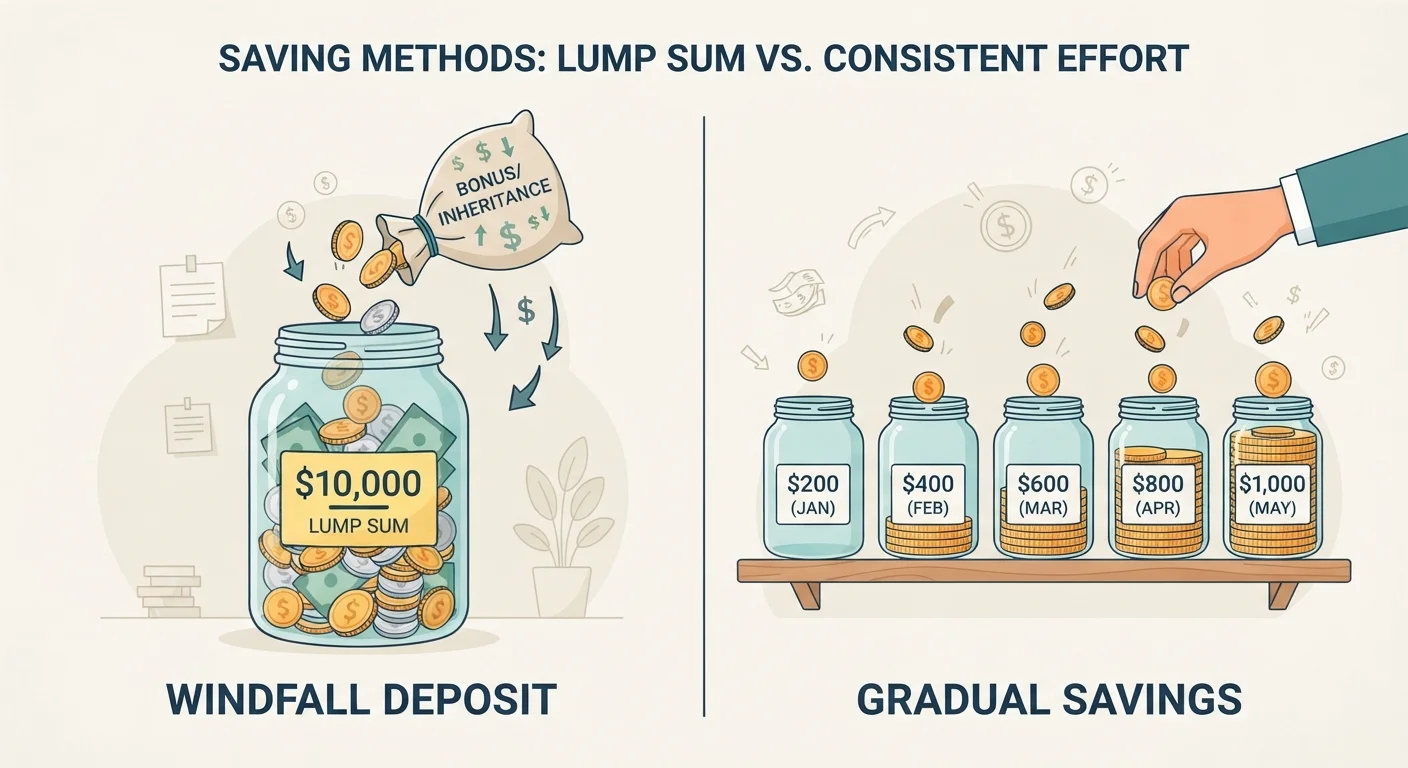
Lump-sum saving means depositing a large amount into savings at a single point in time — a tax refund, year-end bonus, freelance project payment, or any other windfall. Incremental saving means setting aside a fixed, smaller amount on a recurring schedule, typically weekly or monthly, often as a percentage of each paycheck.
Both methods move money out of spending reach and into a savings vehicle. The distinction is timing and regularity. Lump-sum saving is event-driven; incremental saving is routine-driven. That structural difference shapes how each approach interacts with your budget, your behavior, and your income type.
For a closer look at how these patterns apply across different budget sizes, see savings strategies that work at any income level.
The Case for Lump-Sum Saving
When income is unpredictable — freelance contracts, commission-based pay, seasonal work — waiting to accumulate small amounts over time can be frustrating or impractical. In those situations, lump-sum saving aligns deposits with the natural rhythm of when money actually arrives.
A key advantage is immediacy: depositing a windfall before it enters your spending account removes the temptation to consume it piece by piece. Research in behavioral economics consistently shows that money that lands in a dedicated savings account before it's mentally allocated to spending is more likely to stay saved.
The main risk is equally clear: if windfalls are infrequent or unpredictable, long stretches can pass without any savings activity. Lump-sum savers also face the challenge of resisting large, unplanned purchases between deposits — periods when their savings balance may appear artificially low.
| Lump-Sum Saving | Incremental Saving | |
|---|---|---|
| Best income type | Variable, irregular, or windfall income | Steady salaried or hourly pay |
| Habit-building potential | Lower — event-driven, not routine | Higher — repetition builds behavior |
| Temptation risk | High — windfall may be spent before depositing | Lower — small amounts are less tempting |
| Friction to start | Low — no recurring setup needed | Low — automation handles recurring transfers |
| Overdraft or cash-flow risk | Low — deposit when flush | Possible if calibrated too aggressively |
| Flexibility | High — deposit timing is discretionary | Moderate — requires adjusting automation |
The Case for Incremental Saving
Incremental saving — sometimes called pay-yourself-first when automated — turns saving into a non-negotiable line item in your budget rather than an afterthought. Small, consistent transfers build the psychological experience of saving as a default behavior rather than a sacrifice.
This regularity is the approach's biggest strength. Habits form through repetition, and a weekly $25 transfer repeated 50 times creates a more durable behavior pattern than a single $1,250 deposit. For earners on salaried or hourly pay with consistent paychecks, incremental saving is usually the lower-friction choice.
The limitation: if you're working with a very tight margin each pay period, even small automatic transfers can cause overdrafts or create anxiety. Poorly calibrated amounts that feel painful can lead people to cancel the transfer entirely — and abandon the habit. Automating your savings correctly matters more than simply automating it.
Set a Saving Rule Before the Money Arrives
Whether you save in lumps or incrementally, the most effective move is deciding your saving rule before income hits your account. For incremental savers, that means configuring your automatic transfer the day you set up direct deposit. For lump-sum savers, it means deciding in advance what percentage of any windfall is earmarked for savings — so you're not making that call when the money is already in hand.
Discipline: Which Approach Builds More of It?
Discipline isn't the same as willpower. A saving system that requires constant manual decisions will lose to one that reduces decisions — regardless of intent. Incremental saving, when automated, minimizes decision points and therefore builds structural discipline: the money moves before you can choose not to save it.
Lump-sum saving demands a different kind of discipline — the ability to resist spending a windfall before depositing it. For people prone to lifestyle inflation after a good earnings month, this can be genuinely difficult. However, earners who develop clear rules (such as "50% of every freelance payment goes straight to savings") can replicate much of the behavioral benefit of automation.
If you're working to establish your first real savings habit, building and sustaining that habit involves more than just picking an amount — it also means designing an approach you'll actually stick to. Similarly, incremental saving pairs naturally with habit stacking for smarter everyday spending, where saving is attached to an existing routine rather than treated as a separate effort.
For those building an emergency reserve with limited room to maneuver, building an emergency fund on a tight budget explores how even small incremental amounts compound into meaningful protection over time.
Combining Both Approaches Strategically
The most resilient savers often use both methods simultaneously. A practical framework: set up a small automatic transfer each payday to cover baseline savings goals — whether that's an emergency fund, a sinking fund for irregular expenses, or a longer-term goal. Then, treat any windfall (tax refund, bonus, side income) as an opportunity to make a supplemental lump-sum deposit.
This hybrid approach means your savings never stop growing entirely, even in slow months — but you also take full advantage of high-earning moments rather than letting extra income dissolve into day-to-day spending.
This article provides general financial education and is not personalized financial advice. Consult a qualified financial professional before making decisions specific to your circumstances.