

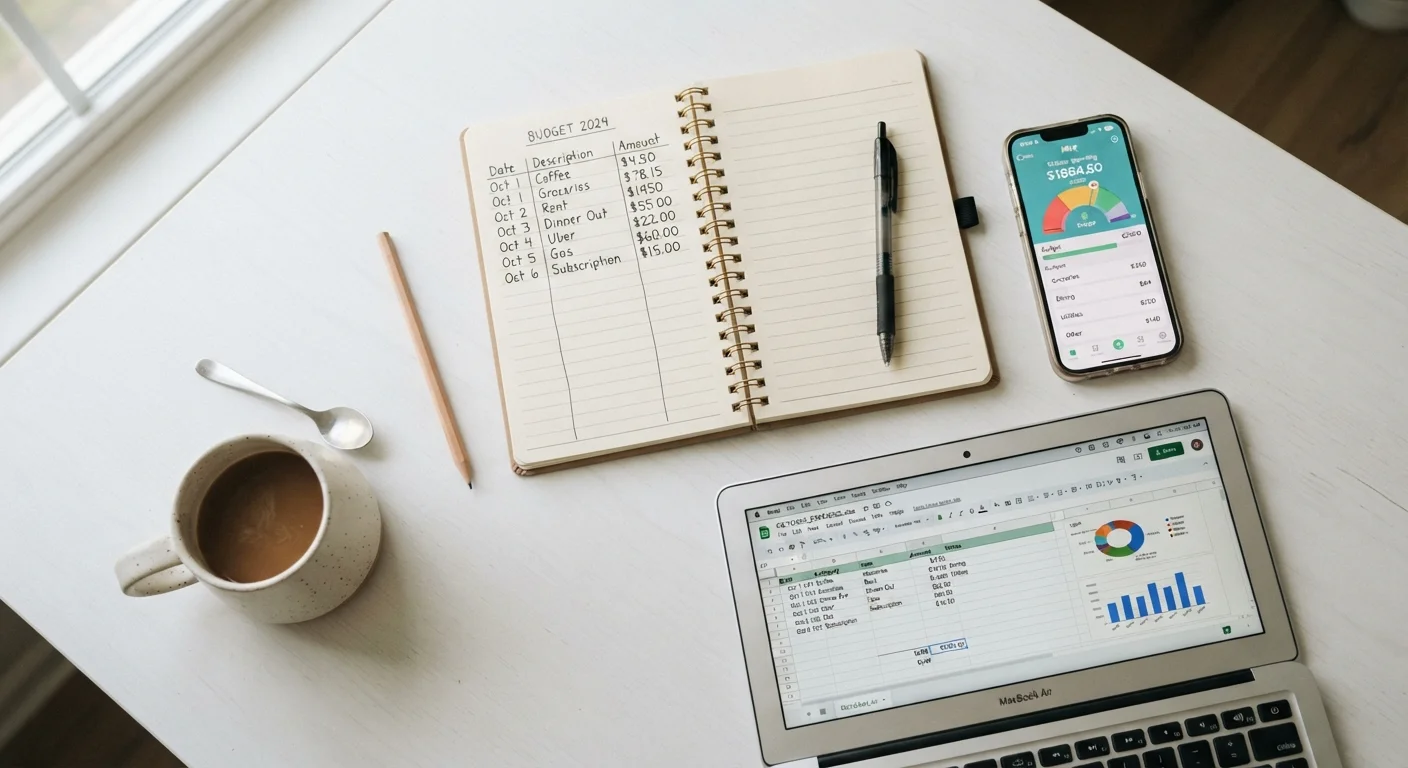
Key Takeaways
Our Verdict
Each tracking method has a legitimate place depending on your habits, financial complexity, and comfort with technology. The method most likely to cut unnecessary spending is the one you'll return to daily — not the one with the most features. Start simple, evaluate after 30 days, and adjust.
| Best for | Recommended |
|---|---|
| Those who want immediate awareness without any setup | Pen and Paper |
| Those with variable income, multiple categories, or a need for custom analysis | Spreadsheet |
| Those who want automation and spend across many digital payment methods | App |
| Those building a habit from scratch who've failed with apps before | Pen and Paper |
Why Your Tracking Method Matters More Than Your Budget Template
A budget that never gets updated is just a wish list. The real work of cutting unnecessary spending happens in the tracking — recording what actually leaves your account, not what you planned to spend. Yet most people pick a tracking method based on what sounds appealing rather than what fits their real behavior, and they abandon it within weeks.
Research on habit formation consistently shows that friction is the primary reason new habits fail. A method that takes 20 minutes a day will outlast one that takes two hours a week, even if the latter is technically more thorough. With that principle in mind, here's how the three dominant approaches compare across the dimensions that actually determine whether you'll stick with them. Once you have a method working, pair it with a structured monthly budget review to close the loop.
Pen and Paper: Low Friction, High Awareness
Writing down every transaction by hand is the oldest tracking method and still one of the most psychologically effective. The physical act of writing creates a moment of reflection that digital logging often skips. Studies in cognitive psychology suggest that manual writing engages the brain more deeply than typing, which can make the cost of a purchase feel more real.
Advantages:
- Zero cost, zero setup — a notebook works immediately.
- No privacy concerns; your data stays offline.
- Forces deliberate attention to each purchase.
- Works everywhere, including cash transactions.
Limitations:
- Time-consuming to total, categorize, or analyze.
- Easy to lose or forget when traveling or commuting.
- Doesn't connect to bank feeds, so entries depend entirely on your memory or receipts.
Pen and paper pairs naturally with physical cash budgeting, where every dollar is already tangible.
Start With One Week of Paper Logging
Even if you plan to switch to an app or spreadsheet, commit to writing every transaction by hand for seven days first. This forces you to confront every purchase in real time and often reveals surprise categories — like daily convenience-store stops — before you build your digital system around assumptions. One week of data is more useful than a beautifully formatted empty spreadsheet.
Spreadsheets: Maximum Control, Maximum Effort
A spreadsheet — whether in a free tool like Google Sheets or a desktop application — gives you full control over categories, formulas, and visualizations. You build it once and adapt it as your finances change. For people tracking variable income, irregular expenses like car ownership costs, or multiple accounts, a spreadsheet often outperforms rigid app templates.
Advantages:
- Fully customizable to your specific categories and goals.
- Enables trend analysis over months or years.
- Free options are widely available.
- Data stays under your control.
Limitations:
- Requires consistent manual entry unless you export bank data.
- Setup takes real time; poorly designed sheets get abandoned.
- Can become overcomplicated, especially for infrequent trackers.
If you're also tracking a vehicle budget, a dedicated sheet that mirrors your monthly car ownership costs alongside household spending gives a clearer total picture.
| Pen and Paper | Spreadsheet | App | |
|---|---|---|---|
| Setup time | None — start immediately | 30–90 minutes to build | 15–30 minutes to configure |
| Ongoing time per week | High — fully manual | Medium — manual entry or import | Low — mostly automated |
| Cost | Minimal (notebook) | Free to low cost | Free to ~$15/month |
| Privacy risk | None | Low (local file) or medium (cloud) | Higher (linked accounts) |
| Cash tracking | Excellent | Good (manual entry) | Poor (manual only) |
| Customization | Unlimited but unstructured | Fully customizable | Limited to app categories |
| Best for | Habit builders, cash users | Detailed analyzers, variable income | Digital spenders wanting automation |
Apps: Automation With Trade-Offs
Budgeting apps reduce the manual work by connecting directly to bank and credit card accounts, automatically categorizing transactions, and sending alerts when you approach a spending limit. For people who make most purchases digitally, this automation dramatically lowers the effort required to maintain a complete record.
Advantages:
- Automatic import from linked accounts cuts manual entry almost to zero.
- Real-time alerts can interrupt impulse purchases before they're finalized.
- Many apps generate spending reports that reveal patterns without manual calculation.
Limitations:
- Linking financial accounts involves sharing credentials or read-access tokens with a third party — a genuine privacy and security consideration.
- Auto-categorization makes errors that go unnoticed if you don't review entries.
- Subscription costs on premium tiers add up; free tiers often have feature limitations.
- Cash transactions rarely appear automatically.
Apps work best alongside a clear understanding of your spending triggers — because an alert means nothing if you override it reflexively. For broader saving strategies that complement any tracking method, see the Saving Strategies hub.
Choosing the Method You'll Actually Use
The honest answer is that consistency beats sophistication every time. A notebook used daily will outperform a feature-rich app opened twice a month. Before choosing, ask yourself three questions:
- Where does most of my spending happen? Mostly cash? Paper or a hybrid works better. Mostly digital? An app or spreadsheet fed by bank exports reduces friction.
- How much time am I genuinely willing to spend weekly? Less than 15 minutes? Apps or simple notebooks. More than 30 minutes? Spreadsheets become viable.
- Have I tried one of these before and quit? If so, diagnose why before repeating the same approach.
Many people find that combining methods works well: a pocket notebook for daily cash and card entries, then a monthly spreadsheet or app review to spot patterns. This also maps cleanly onto price tracking habits, where a simple log of recurring purchase prices builds awareness over time without overwhelming detail.
This article is for general informational and educational purposes only. It does not constitute personalised financial advice. For guidance specific to your financial situation, consult a qualified financial professional.