

Key Takeaways
Start here
What Price Tracking Actually Means
Next
How Price History Data Works
Then
Types of Price Tracking Tools
Apply it
How to Use Price Data to Time Purchases
Avoid pitfalls
Common Mistakes Beginners Make
What Price Tracking Actually Means
Price tracking is the practice of monitoring how much a product costs over time — across one retailer or many — so you can distinguish a genuine discount from marketing noise. Instead of trusting a "sale" badge at face value, you consult a historical record to see whether today's price is actually lower than usual.
This matters because retail pricing is far more fluid than most shoppers realize. Large online retailers can update prices on millions of items daily, sometimes multiple times. A product marked "20% off" may still be above its average price from three months ago. Price tracking closes that information gap.
For a broader framework on evaluating whether a price represents real value, cost-per-use thinking is a complementary approach worth understanding alongside historical price data.
Price history
A time-series record of every price change a product has undergone, used to judge whether the current price is genuinely low or just marketed as a discount.
Price alert
An automated notification (usually email or push) sent when a tracked product drops to or below a price threshold you set in advance.
Price scraper
An automated program that visits retailer product pages at regular intervals to record the listed price, building the historical data that tracking tools display.
Target price
The specific dollar amount you decide in advance you're willing to pay for an item — your trigger to buy when the tracked price reaches that level.
90-day average
The mean price of a product over the past 90 days, often used as a baseline to determine whether the current price is above, at, or below typical levels.
How Price History Data Works
Price tracking services use automated programs — commonly called bots or scrapers — that visit retailer product pages at regular intervals and record the listed price. Over time, these snapshots build a price history graph you can consult before buying.
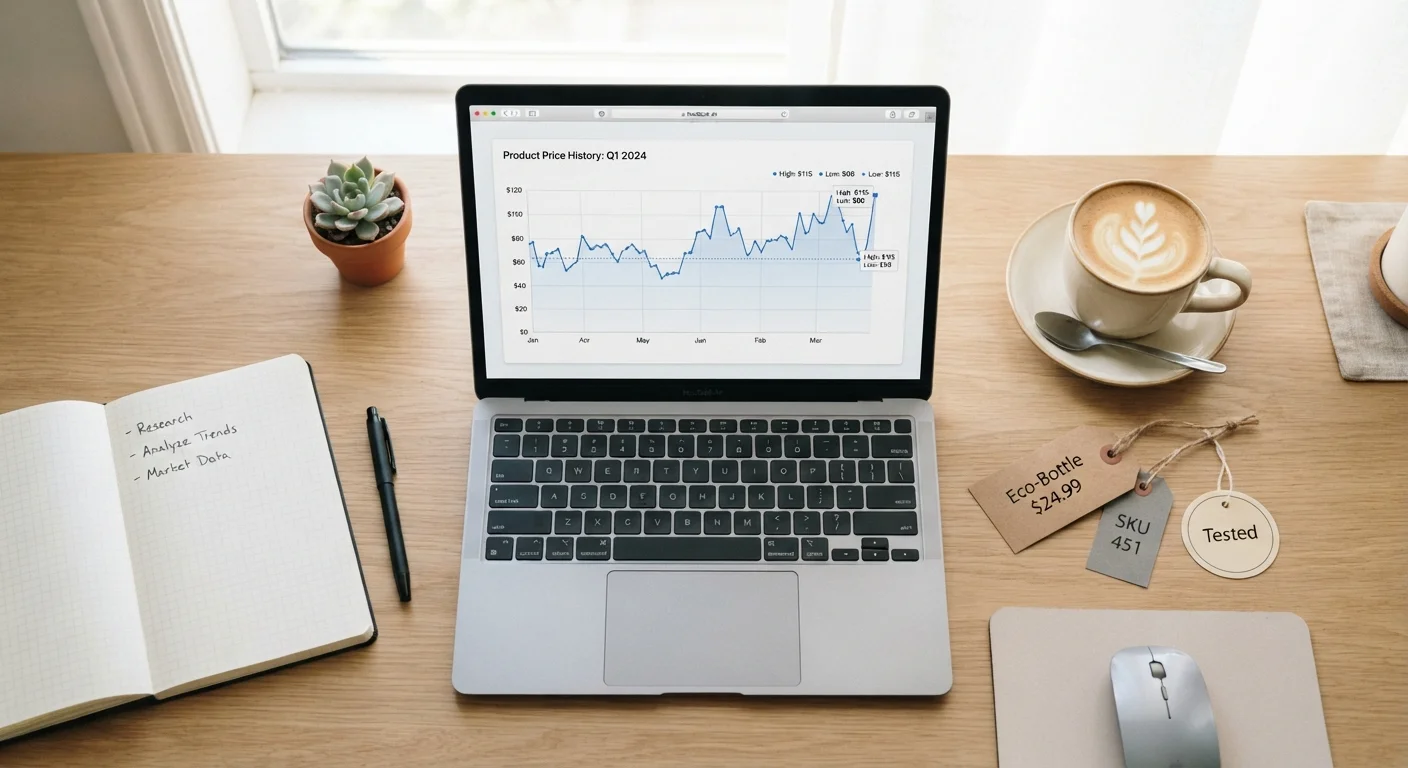
When you look at a price history chart, you're seeing a time-series view of every recorded price change. Peaks show when the item was priced high; valleys show genuine dips. The longer the history available, the more confidently you can identify a true low.
Most tools record the price on the specific retailer they monitor. Some aggregate data across multiple sellers, which is especially useful when the same product is sold by several vendors at different prices. For a detailed look at how these systems capture and surface data, price tracking tools and how they actually work covers the mechanics in plain language.
Types of Price Tracking Tools
Price tracking tools generally fall into three categories:
- Browser extensions: Install once and they automatically surface price history or alerts when you visit a supported product page. Low friction — the data appears without extra steps.
- Dedicated tracking websites: You search for a product, view its price history graph, and optionally set a target price for email alerts. Useful when you want to research before visiting a retailer's site.
- Retailer-native wish lists and alerts: Some retailers offer built-in price drop notifications for saved items. These are convenient but only cover that retailer's own pricing.
For travelers, a parallel ecosystem of fare alert tools monitors flight and accommodation prices. The underlying logic is identical, though the pricing dynamics differ. Our fare alerts and price tracking reference explains how that category works specifically.
Start With One Category
Rather than trying to track everything at once, pick one upcoming purchase — an appliance, a piece of tech, or a household staple you buy regularly — and practice the full workflow: find price history, set a target, wait for the alert. Building the habit with a single item is far more effective than setting up dozens of alerts you'll never act on.
How to Use Price Data to Time Purchases
Raw price history is only useful if you act on it with a clear framework. Here's a practical approach:
- Look at the 90-day average before drawing conclusions. A price that looks low against last week's figure may still be above the three-month average.
- Set a specific target price — not just "lower than now." Decide what you're willing to pay before you start monitoring, and commit to buying when that threshold is reached.
- Check for seasonal patterns. Many product categories follow predictable pricing cycles tied to model releases, seasonal demand, or retail events. timing your purchases strategically explores this logic in depth.
- Factor in total cost. A lower item price that comes with higher shipping can erase savings. Always compare fully landed cost, not list price alone.
Price tracking integrates naturally with broader budget discipline. If you're building spending habits from the ground up, budgeting basics provides the foundation that makes tools like these more effective.
Common Mistakes Beginners Make
Starting out, most people fall into a few predictable traps:
- Anchoring to the original listed price. Retailers sometimes inflate a "was" price to make a discount look larger. Historical data from an independent tracker is more reliable than the retailer's own comparison.
- Monitoring without a decision rule. Watching a price indefinitely without a clear buy threshold leads to decision fatigue and often results in purchasing at a worse price out of frustration.
- Ignoring product lifecycle timing. Tracking a price right after a new model launches will likely show a sustained high — not because the price is elevated, but because demand is peak. Understanding where a product sits in its cycle matters.
- Treating every drop as urgent. Price alerts should prompt a decision, not automatic buying. Check whether the drop meets your pre-set threshold and whether you still need the item.
If you're new to deal-seeking more broadly, deal finding from scratch offers a wider roadmap that puts price tracking in context alongside other money-saving habits.
Artificially Inflated Reference Prices
Some retailers establish a high "original" price for a short period before running a "sale," making the discount appear larger than it is. This practice, sometimes called reference price inflation, is exactly why independent price history data is more trustworthy than the retailer's own before/after comparison. Always verify with a third-party tracker before assuming a sale is genuine.