

Key Takeaways
Option A
Motel
The classic road-trip staple built for quick, drive-up convenience.
Best for: Road-trippers who want fast check-in, vehicle access from the room, and no-frills overnight stays along highways.
Option B
Budget Hotel
The urban-friendly option with more structure and shared amenities.
Best for: City visitors and multi-night stays where lobby services, a consistent brand standard, and walkability matter.
If you're driving between cities and need a reliable overnight stop
Motel
Drive-up room access, on-site parking, and highway proximity eliminate the friction of urban check-in and parking fees.
If you're spending multiple nights exploring a city
Budget Hotel
Central locations reduce transportation costs, and shared amenities like breakfast add value across a longer stay.
If you're traveling with a vehicle and need to keep gear secure
Motel
Exterior-facing rooms let you park immediately outside your door, simplifying loading, unloading, and overnight vehicle security.
If you're booking as a solo traveler focused on safety and social environment
Budget Hotel
Interior corridor layouts, staffed front desks, and lobby areas tend to offer a more controlled, observable environment.
If you want to earn loyalty points across a chain network
Budget Hotel
Many budget hotel brands belong to larger loyalty programmes, letting frequent travelers accumulate points toward free nights.
What Defines Each Lodging Model
The terms motel and budget hotel are often used interchangeably, but they describe structurally different products. Understanding the distinction helps you make a faster, smarter booking decision — not just a cheaper one.
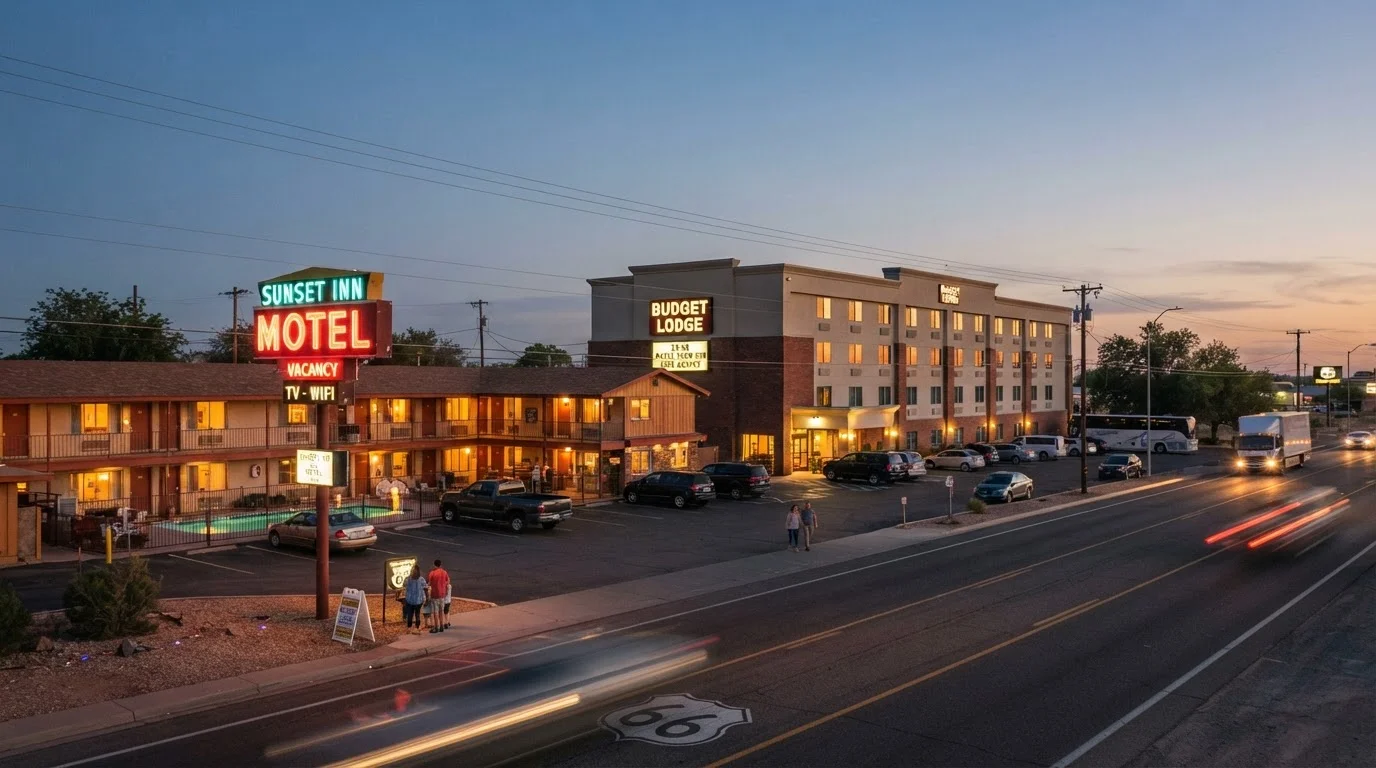
A motel (short for "motor hotel") was designed around the automobile. The defining feature is exterior room access: guests park directly in front of their door and enter without passing through a lobby. Rooms are typically on one or two floors, buildings are spread horizontally, and the entire layout prioritizes quick turnaround. Motels emerged alongside the US interstate highway system and still concentrate along Routes, state highways, and interstate exits.
A budget hotel, by contrast, follows the conventional hotel model but strips it down to control costs. Guests enter through a central lobby, rooms are accessed via interior corridors, and the property typically operates more floors. Budget hotels appear under recognizable chain names and independents alike, and they can be found near airports, downtown cores, and transit hubs as often as near highways. For a fuller breakdown of how budget hotels compare to other affordable lodging categories, see what distinguishes hostels, guesthouses, and budget hotels.
| Criterion | Motel | Budget Hotel |
|---|---|---|
| Room access | Exterior, direct from parking lot | Interior corridors, via lobby |
| Typical location | Highways, interstate exits | Urban centers, airports, transit hubs |
| Parking | Usually free, on-site | Varies; fees common in cities |
| Amenities | Minimal — bed, bath, Wi-Fi | Lobby, often breakfast, elevators |
| Building layout | 1–2 floors, horizontal spread | Multi-floor, vertical structure |
| Brand consistency | Low — many independents | Higher — chain standards common |
| Loyalty programme access | Rare | Common via chain networks |
| Best stay length | One or two nights | Multiple nights |
Location, Layout, and What That Costs You
Location is where the two models diverge most sharply in practical terms. Motels position themselves for drivers who won't pay for urban real estate — which is why their nightly rates often run lower per room but may force you to drive to restaurants, attractions, or transit stops. Factor in gas, parking, and food logistics before assuming the sticker price is the full cost.
Budget hotels in city centers sometimes cost more per night, but their walkable or transit-adjacent locations can offset those costs across a multi-day trip. A $15-higher nightly rate becomes neutral if it eliminates two rideshare trips per day. This trade-off analysis is a core principle of budgeting accommodation from scratch.
Interior vs. exterior room access also affects perceived safety and convenience. Exterior-access motel rooms are faster to reach with luggage but expose guests to outdoor conditions and reduce natural foot-traffic monitoring. Interior corridor hotels add a layer of controlled access. Neither is inherently safer, but the difference matters to some travelers — particularly those arriving late at night or in unfamiliar areas.
~60%
US motels located near highway corridors
Industry analyses consistently show the majority of US motel inventory clusters along interstate and state highway routes rather than in urban cores.
2–3x
Urban parking cost vs. motel parking
Downtown parking in major US cities can add $20–$50 per night, narrowing or erasing the rate advantage of a city-center budget hotel over a highway motel.
35%+
Budget hotel guests using loyalty programmes
Loyalty programme participation is measurably higher among budget hotel guests than motel guests, reflecting broader chain network coverage in the hotel segment.
Amenities, Consistency, and Hidden Value
Motels typically offer the essentials: a bed, a private bathroom, a TV, and Wi-Fi. Some add a small pool or vending machines; few offer food service or a staffed desk around the clock. That leanness is the point — every amenity removed is overhead the owner doesn't pass to you.
Budget hotels generally layer in more: a staffed lobby, sometimes complimentary breakfast, elevators, luggage storage, and in some cases a fitness room or business center. Chain budget hotels in particular maintain brand standards that give you a clearer idea of what to expect before you arrive. Independent motels, by contrast, vary widely — a well-maintained roadside motel can outperform a poorly managed budget hotel, so reading recent reviews matters more than the category label.
If you stay frequently, loyalty programme access is a meaningful differentiator. Most major budget hotel chains participate in points programmes that reward repeat stays with free nights or member-rate pricing. Motels — especially independents — rarely offer equivalent schemes. For travelers who book lodging regularly, understanding how accommodation loyalty programmes work can make the budget hotel model more cost-effective over time than its nightly rate suggests.
For multi-city itineraries where you're mixing both motel and hotel stays, see how to plan lodging across multiple destinations for a strategy-level walkthrough.
Terminology Varies by Region and Brand
Some properties market themselves as 'motor inns,' 'motor lodges,' or 'economy hotels' — labels that blur the motel-hotel line. The physical layout (exterior vs. interior access, parking design, lobby presence) is a more reliable guide than the name on the sign. If a booking listing is unclear, check the property photos for room entry style and parking configuration. Our lodging terms reference explains common accommodation labels in plain language.