

Key Takeaways
Option A
Budget Carriers
The stripped-down, low-base-fare model.
Best for: Price-sensitive travelers flying short distances with minimal checked baggage and flexible schedules.
Option B
Full-Service Airlines
The bundled, convenience-first approach.
Best for: Travelers who value included amenities, flexible rebooking, and frequent-flyer earning on short hops.
If you travel carry-on only with a fixed schedule
Budget Carriers
With no checked bag and no need for flexibility, the base fare advantage holds up and the stripped-down service barely registers on a 90-minute flight.
If you need to check a bag or might need to change your flight
Full-Service Airlines
Change fees and baggage charges on budget carriers can quickly close — or reverse — the original price gap, making bundled fares more economical.
If you're an active frequent flyer with status on a legacy carrier
Full-Service Airlines
Status perks like complimentary upgrades, priority boarding, and free bags compound the value on every segment, even short ones.
If the budget carrier operates from a secondary airport far from your destination
Full-Service Airlines
Ground transport costs and extra travel time to a secondary airport can easily exceed the fare savings, making the main-airport option more practical.
What Actually Separates the Two Models
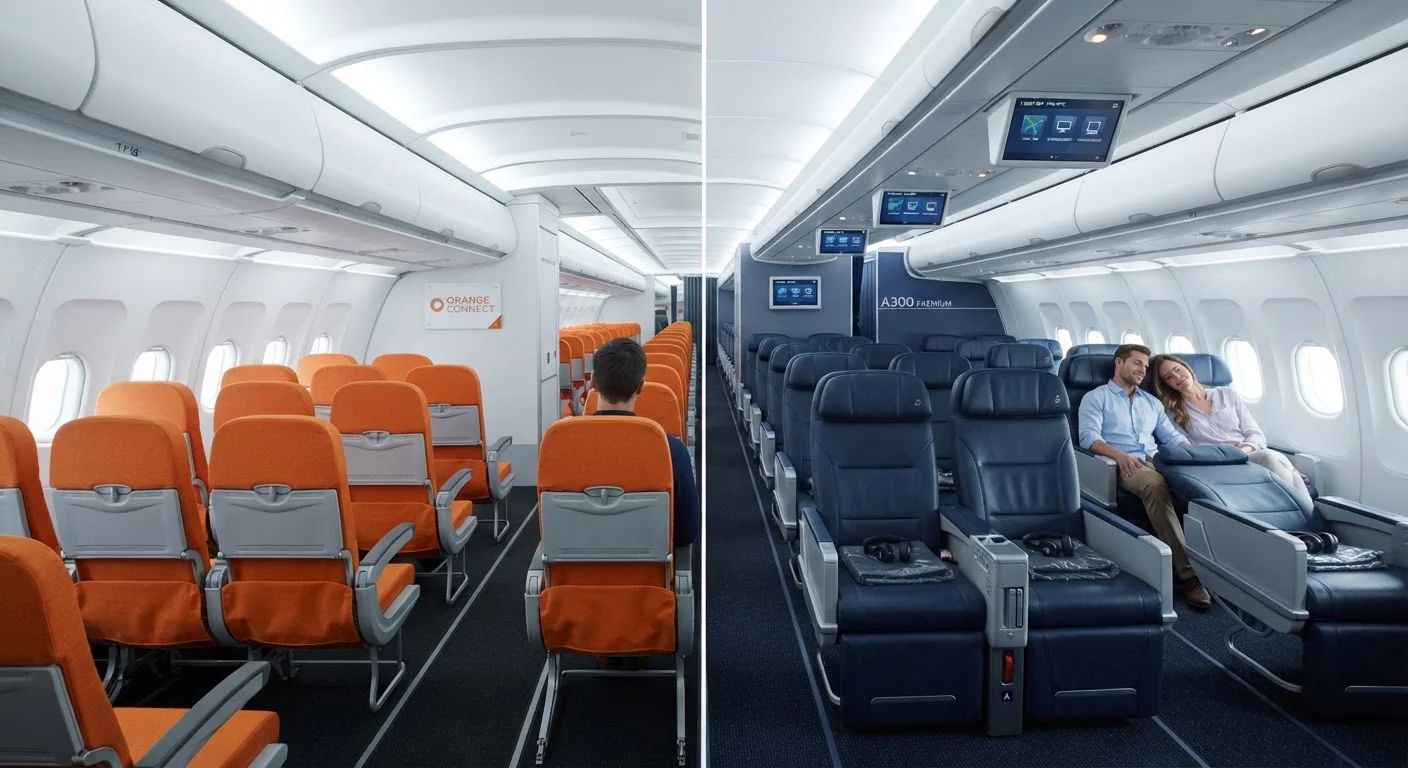
Budget carriers and full-service airlines operate on fundamentally different revenue architectures. Legacy carriers bundle most costs — checked bags, seat assignment, basic snacks — into the ticket price. Ultra-low-cost and low-cost carriers (ULCCs and LCCs) unbundle aggressively, selling a seat and charging separately for everything else. Understanding this distinction is the starting point for any honest comparison.
On short-haul routes specifically — think under two hours of flying — the practical in-cabin differences collapse. There's no meal service worth comparing, in-flight entertainment is largely irrelevant, and premium cabin upgrades rarely justify the fare delta for such a short flight. What remains are the structural factors: fees, schedule reliability, airport location, and rebooking flexibility.
To make a fair comparison, always build the all-in fare. Add the cost of any checked bag, a seat assignment if you need one (or care where you sit), and any booking or payment fees that budget carriers tack on. The hidden costs embedded in low airfares breakdown covers each of these charges in detail and helps you account for them before committing.
| Criterion | Budget Carriers | Full-Service Airlines |
|---|---|---|
| Base fare | Generally lower | Generally higher |
| Checked bag fee | $35–$75 per bag | Often included or waived with status |
| Seat selection fee | $10–$50 extra | Typically included at booking |
| Change/cancellation flexibility | Restricted; fees common | More flexible; waivers more common |
| Airport location | Often secondary airports | Usually main hub airports |
| Schedule frequency | Fewer daily flights | More daily frequency on busy routes |
| Loyalty earning | Proprietary program; variable value | Major alliance miles; status benefits |
| In-flight experience (under 2 hrs) | Minimal; snacks purchased | Minor difference at this duration |
Schedule, Airports, and the Time-Cost Trade-Off
Budget carriers frequently use secondary airports to keep their operating costs — and your base fare — lower. Flying into a smaller regional hub rather than a major international airport sounds like a minor inconvenience, but the ground transportation costs and time involved can be substantial. A $40 fare savings disappears quickly when a car service or dedicated bus to the city center costs $35 each way.
Frequency matters too. Full-service carriers on competitive short-haul routes often operate multiple daily flights, giving you more rebooking options if plans change. Budget carriers may run one or two daily flights on the same route, which narrows your flexibility considerably if you miss a connection or need to shift your departure.
Schedule reliability is harder to benchmark informally, but the US Department of Transportation publishes on-time performance data by carrier — worth consulting for routes you fly frequently. For a deeper look at how route competition and demand shape both price and schedule, see the architecture of a cheap flight.
~30%
Average base-fare gap, budget vs. legacy
US DOT data has historically shown budget carriers price base fares roughly 20–40% below legacy competitors on the same short-haul routes, before ancillary fees.
1 in 3
Budget travelers who underestimate ancillary fees
Research from the International Air Transport Association has found that a significant share of leisure travelers do not factor bag and seat fees into their total fare comparison.
$35–$75
Typical one-way checked bag fee (budget carriers)
Fee ranges vary by carrier and how early a bag is added; fees added at the gate are consistently the most expensive option.
Loyalty Programs and Short-Haul Value
Frequent-flyer programs are often cited as a reason to stick with full-service airlines. On short-haul routes, however, the math is less compelling. Most domestic segments under 500 miles earn relatively few redeemable miles or points — often not enough to move meaningfully toward a free ticket unless you fly the same carrier dozens of times per year.
Budget carriers have their own loyalty programs, and some offer straightforward cash-back or flight credit structures that are easier to redeem than traditional mileage programs. If you don't have existing status with a legacy carrier, the loyalty argument isn't a strong reason to pay a premium on short routes.
Where status does matter is in the peripheral benefits: free checked bags, priority security lanes, and complimentary upgrades. If you already hold mid-tier status or higher with a full-service airline, those perks may effectively close the fare gap on their own — making the legacy carrier the rational choice even when the sticker price looks higher.
Ultimately, short-haul air travel is just one line item in a trip budget. See where travel budgets actually go to understand how flight costs compare to accommodation, transport, and other spending categories when optimizing overall trip cost.