

Key Takeaways
Equity vs. Depreciation in Vehicle Ownership
Equity is the portion of a vehicle's current market value that you actually own - the difference between what the car is worth and what you still owe on it. Depreciation is the rate at which a vehicle loses market value over time. These two forces work against each other: as depreciation shrinks a car's value, your ability to build equity through loan payments slows or stalls.
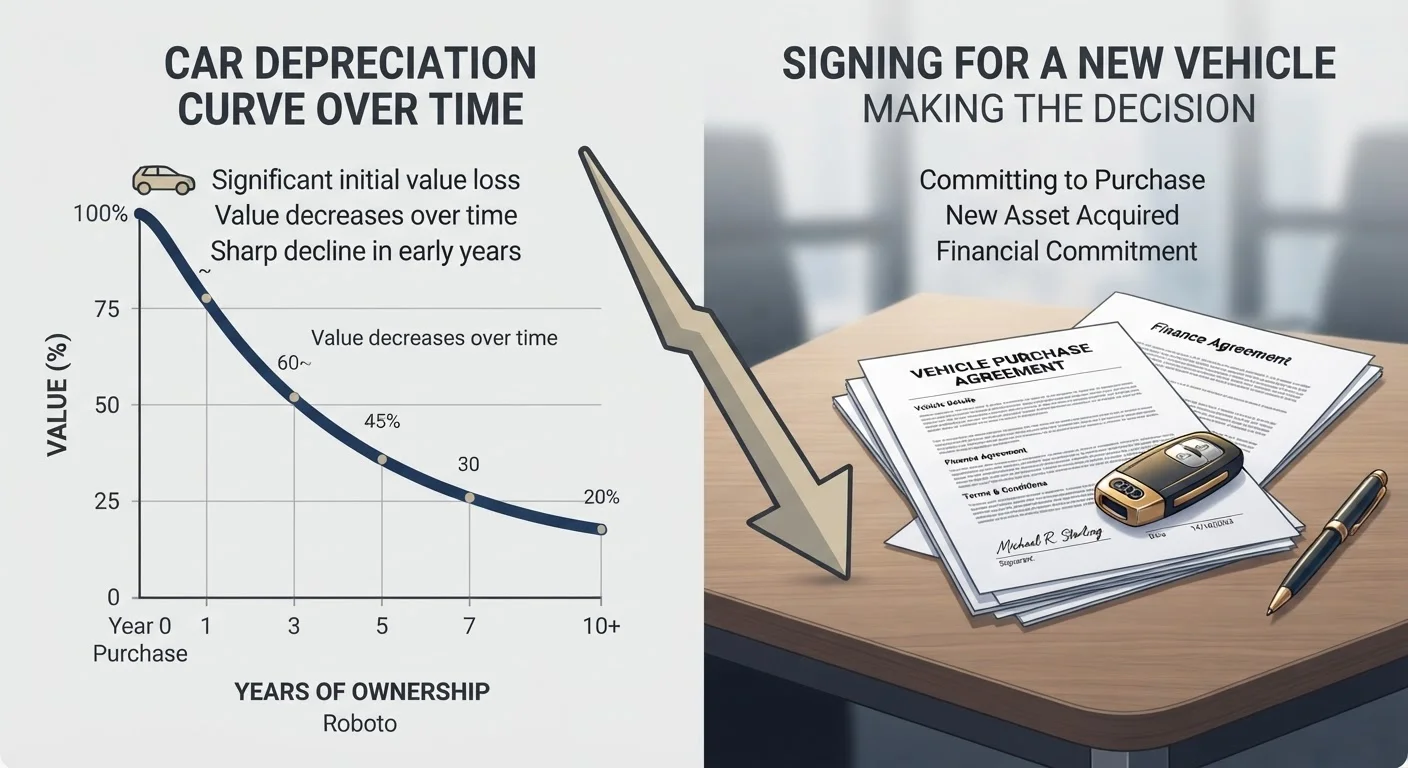
In the first year of ownership, a new vehicle can lose 15-25% of its value, meaning loan principal paydown often lags behind value loss - a condition sometimes called being "underwater" or having negative equity.
The Depreciation Curve Buyers Often Underestimate
Vehicle depreciation doesn't happen evenly over time - it front-loads. According to AAA's annual cost-of-ownership research, a new car can lose a significant share of its value in the first 12 months after purchase, with cumulative five-year depreciation averaging around 50% of the original purchase price for many mainstream models. That slope is steepest right at the start.
This matters enormously because most buyers finance their purchase with a loan structured to pay interest first. In the early months, the majority of each monthly payment reduces interest rather than principal. The result: your loan balance drops slowly while the car's market value drops quickly. That gap - negative equity - is the hidden risk that shapes every buy-vs-lease comparison.
For a deeper look at how depreciation is calculated and which vehicle categories lose value fastest, see how depreciation works as an ownership cost. Understanding the mechanics is the first step toward accounting for it in any financing decision.
~20%
Average first-year new-car depreciation
AAA and industry analysts consistently estimate new vehicles lose roughly 15-25% of their value within the first 12 months of ownership.
~50%
Five-year cumulative depreciation, typical new vehicle
AAA's cost-of-ownership studies indicate many mainstream vehicles lose approximately half their original value within five years.
3-5 years
Typical timeline to reach positive equity on a financed vehicle
The exact crossover from negative to positive equity depends on down payment size, loan term, interest rate, and vehicle-specific depreciation rates.
How Equity Accumulates - or Fails To - When You Buy
Equity in a financed vehicle is straightforward in concept: subtract your remaining loan balance from the car's current market value. A positive number means you own something real; a negative number means the lender is effectively ahead of you.
The problem is timing. Early in a loan, amortization tables favor interest, and depreciation is aggressive. Most buyers don't reach a positive equity position until at least year three, and some not until year four or five depending on loan term length and how large a down payment was made. Anyone who trades in or sells during that window may owe more than they receive - and that shortfall rolls into the next loan, compounding the cycle.
The longer a buyer holds a vehicle after the loan is paid off, the stronger the equity argument becomes. A paid-off car with 80,000 miles still has real market value and zero outstanding debt - that's pure equity, and it's a financial outcome that leasing structurally cannot replicate. Owning a vehicle outright has genuine advantages, but they require patience and holding discipline that short-term financial comparisons tend to overlook.
Run a Break-Even Projection Before Deciding
Before choosing between buying and leasing, estimate the total outflows for each option over the same time horizon - typically five to seven years. For buying, include the loan payoff, estimated repairs post-warranty, and the vehicle's likely resale value. For leasing, multiply monthly payments across successive lease cycles. The vehicle you'd own outright at year six or seven is an asset that doesn't appear in monthly payment comparisons but has real financial weight.
What Leasing Actually Transfers - and What It Doesn't
A lease is essentially a contract to rent a vehicle's depreciation. You pay for the value the car loses during your term, plus a financing charge - and then return it. The lessor absorbs any residual market risk. If used-car prices fall unexpectedly at lease-end, that's the leasing company's problem, not yours.
This depreciation transfer sounds appealing, and in some circumstances it genuinely is. For drivers who cycle vehicles every two to three years, leasing avoids the negative-equity trap that catches buyers who trade in too early. It also provides predictable payments without repair uncertainty during the warranty period.
But the exchange is permanent: no matter how many lease cycles a driver completes, they exit with no asset. Monthly payments that feel lower than a loan payment are actually covering the steepest part of the depreciation curve - the period when a car loses value fastest. Over a decade of continuous leasing, total outflows can exceed what a buyer pays, while the buyer may hold a vehicle with thousands of dollars in residual value.
Short-term affordability versus long-term value is the core tension this creates - and it's why side-by-side monthly payment comparisons routinely mislead. The full financial picture requires projecting both scenarios over the same time horizon, including what a buyer owns at the end.
Framing the Decision Around Your Actual Situation
Neither buying nor leasing wins universally - the math depends on variables specific to each driver. Hold period is the most decisive: buyers who keep vehicles eight or more years almost always come out ahead on total cost. Drivers who realistically change vehicles every two to three years face a harder case for buying, since they're most exposed to early depreciation and negative equity.
Mileage is the second lever. Leases impose contractual mileage caps, typically 10,000-15,000 miles per year, with per-mile penalties above that threshold. High-mileage drivers face cost overruns that erode the lease payment advantage quickly.
Cash flow and liquidity matter too. A lease's lower monthly payment may free capital for other uses - though this is only a genuine benefit if that capital is actually deployed productively rather than simply spent. For context on how these trade-offs interact with broader debt management, understanding how debt and credit decisions intersect is worth reviewing before committing to either path.
For a comprehensive framework covering all the cost dimensions - taxes, insurance, maintenance, and financing charges - the full financial picture of buying vs. leasing walks through each component in detail. And if your situation might genuinely favor a lease, specific scenarios where leasing makes financial sense identifies the circumstances where the numbers tend to support that path.
This article is for general informational and educational purposes only and does not constitute personalized financial or legal advice. Consult a qualified financial professional before making vehicle financing decisions.