

Key Takeaways
Our Verdict
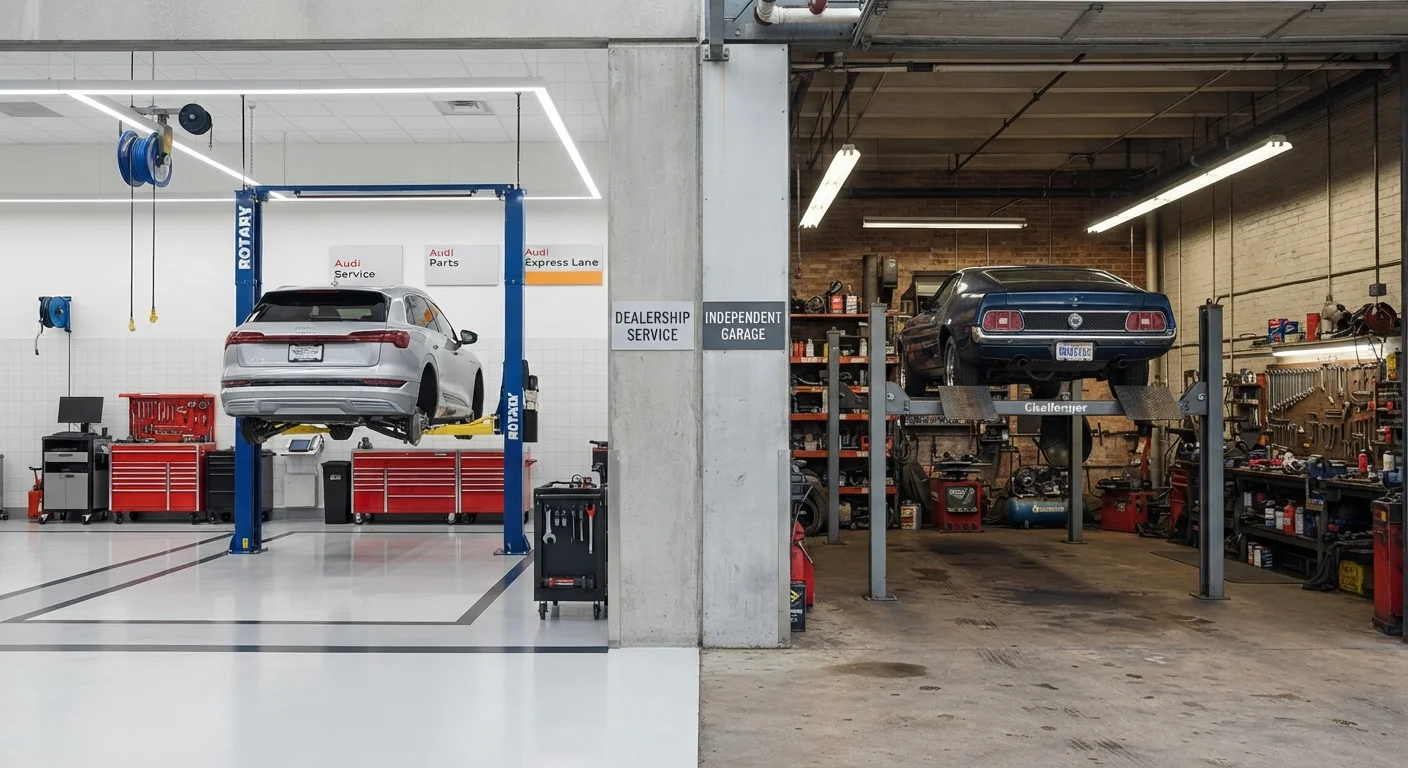
Neither dealership service centres nor independent garages are universally superior. For newer vehicles under an active manufacturer warranty or with complex electronics, dealership service offers access to OEM tooling and factory expertise that's difficult to replicate. For older, out-of-warranty vehicles, a well-credentialed independent garage can deliver comparable quality at meaningfully lower labour rates. The smartest approach is matching the service venue to the vehicle's specific needs rather than defaulting to one out of habit.
| Best for | Recommended |
|---|---|
| Drivers with vehicles under manufacturer warranty | Dealership Service Centre |
| Owners of older, out-of-warranty vehicles seeking lower labour costs | Independent Garage |
| Those needing brand-specific software programming or recalls | Dealership Service Centre |
| Drivers prioritising a long-term mechanic relationship and flexible scheduling | Independent Garage |
The Real Differences Between These Two Service Channels
Price is the most visible difference between dealership service centres and independent garages, but it's rarely the most consequential one. Labour rates at dealerships typically run higher - industry data suggests a range of $130-$180 per hour at franchise dealerships, compared to $80-$130 at many independent shops - but those figures don't capture what you're actually buying. Understanding the structural differences helps you allocate your maintenance budget more deliberately. For a broader view of how service costs fit into total vehicle expenses, see the full picture of car ownership costs.
Dealership service departments are authorised by the vehicle's manufacturer, which means they receive brand-specific technical service bulletins, proprietary diagnostic software updates, and OEM (original equipment manufacturer) parts sourced through official channels. Independent garages source parts from the aftermarket supply chain - parts that may be equivalent in quality but are not manufactured by the original supplier. The distinction matters most for precision-fit components and for vehicles with tightly integrated electronics.
Warranty Implications: What the Magnuson-Moss Act Actually Says
A persistent misconception is that using an independent garage automatically voids a manufacturer's warranty. Under the Magnuson-Moss Warranty Act (a federal consumer protection law), manufacturers generally cannot void a warranty solely because a consumer used an independent shop for routine maintenance - provided the work meets OEM specifications and parts of equivalent quality are used. However, there are important caveats.
If a manufacturer can demonstrate that an independent service caused or contributed to a specific failure, warranty coverage for that component can be denied. Detailed service records become your primary protection in this scenario. Keep dated receipts showing parts specifications and the scope of work performed.
Lease and Finance Agreements Can Override Federal Protections
The Magnuson-Moss Act protects consumers from blanket warranty voidance, but it does not override private contracts. If your lease or dealer service plan requires authorised-facility servicing, using an independent garage - regardless of work quality - may breach that contract. Review your agreement carefully, or contact the lender or lease company directly before changing service providers.
There is also the matter of dealer-enforced service agreements. Some lease contracts and dealer-sold service plans explicitly require that maintenance be performed at an authorised facility. Violating these terms - even if federal law would otherwise protect you - can create contractual disputes that are costly to resolve. Always read your financing or lease agreement before choosing where to service. For more on service plan obligations, see extended warranties and service plans.
Expertise, Equipment, and What Each Shop Is Built For
Dealership technicians complete manufacturer-specific training programmes and have access to factory scan tools that can read proprietary fault codes independent shops may not recognise without third-party software. This matters significantly for vehicles with advanced driver-assistance systems (ADAS), hybrid battery management, or over-the-air software integration. A routine brake job on a 2018 conventional sedan is a very different proposition from recalibrating ADAS sensors on a late-model crossover after windshield replacement.
Independent garages, by contrast, often develop deep expertise in either a broad range of common repairs or a narrow vehicle speciality (European imports, classic vehicles, diesel trucks). A well-equipped independent shop with ASE-certified (Automotive Service Excellence) technicians can handle the majority of maintenance tasks on most vehicles competently. The limiting factor tends to be proprietary software access and specialised tooling - not technician skill.
| Dealership Service Centre | Independent Garage | |
|---|---|---|
| Labour rate (typical range) | $130-$180 per hour | $80-$130 per hour |
| Parts sourcing | OEM parts via manufacturer channels | Aftermarket parts (quality varies by supplier) |
| Diagnostic software | Factory/proprietary scan tools | Third-party tools; may miss brand-specific codes |
| Technician training | Manufacturer-certified, model-specific | ASE-certified; may specialise by vehicle type |
| Warranty alignment | Seamless for active manufacturer warranty | Permitted under Magnuson-Moss; documentation critical |
| Loaner/shuttle availability | Common at franchise locations | Less consistent; shop-dependent |
| Scheduling flexibility | Can be limited at high-volume stores | Often more flexible and faster turnaround |
| Best suited for | New/warrantied vehicles, complex electronics | Older vehicles, routine maintenance, cost control |
For guidance on evaluating any shop before you commit, finding a trustworthy mechanic outlines what credentials and communication signals to look for.
Accountability, Recourse, and Practical Considerations
When something goes wrong after a service, your recourse differs by venue. Dealership service departments are accountable to both the consumer and the manufacturer - a pattern of complaints can affect a dealership's franchise status, which creates meaningful institutional pressure to resolve disputes. Independent garages are regulated primarily by state licensing boards and, in many states, must provide written estimates and itemised invoices under consumer protection statutes. Customer reputation and word-of-mouth serve as the primary accountability mechanism in practice.
Practical factors also shape the decision. Dealerships typically offer loaner vehicles or shuttle services more consistently; scheduling lead times can be longer at busy franchises. Independent shops tend to offer more scheduling flexibility and, in many cases, faster turnaround on standard services. If ownership structure matters to your decision-making, see owning a car outright for context on how repair risk changes with ownership type.
Drivers who prefer hands-on involvement in simpler maintenance tasks may also find it useful to consider which jobs are safe to handle yourself before committing all maintenance to either channel.