

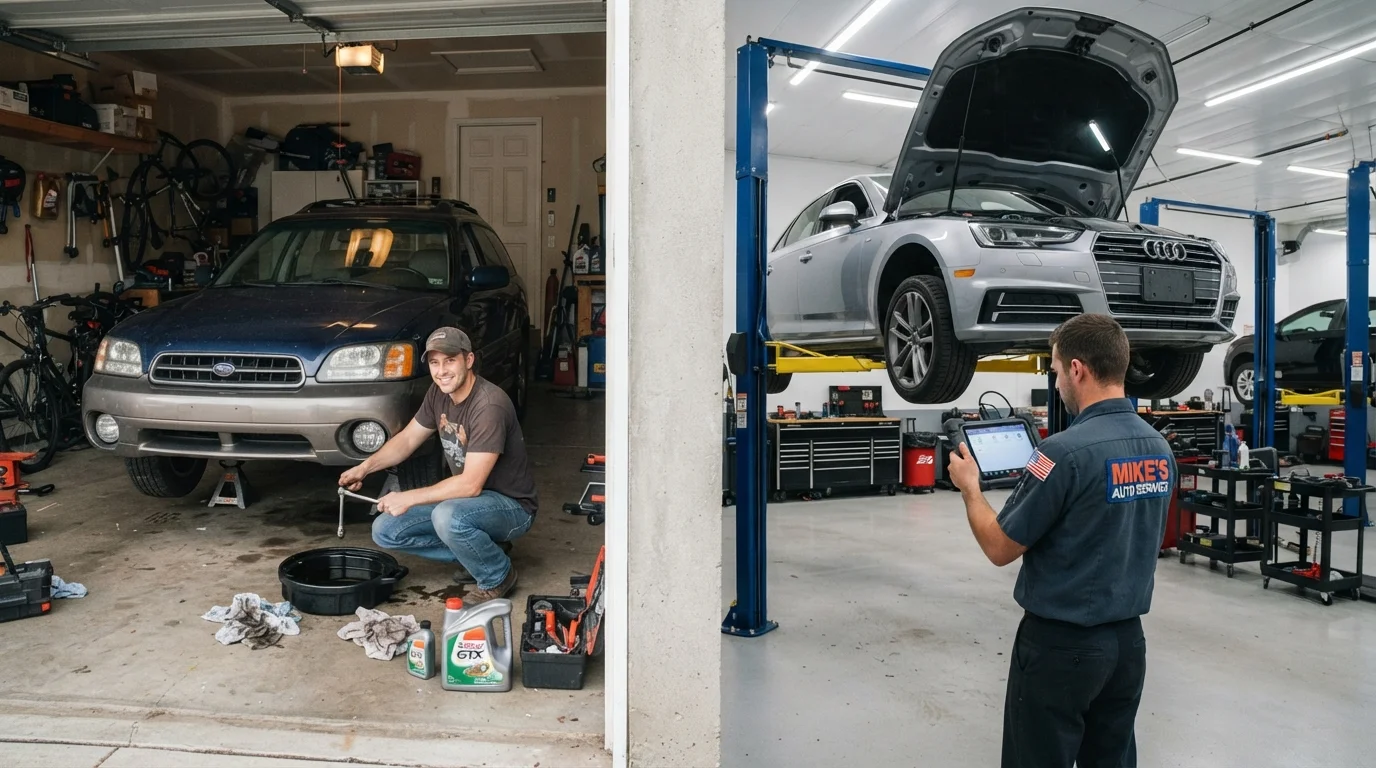
Key Takeaways
Option A
DIY Home Garage Maintenance
The hands-on, cost-saving approach for routine upkeep.
Best for: Drivers with basic mechanical aptitude who want to reduce routine maintenance costs on straightforward, well-documented tasks.
Option B
Professional Workshop Service
The accountable, equipment-backed choice for complex repairs.
Best for: Jobs involving safety-critical systems, specialized diagnostic tools, or work where an error could multiply costs significantly.
If you want to reduce routine maintenance costs with minimal risk
DIY Home Garage Maintenance
Tasks like engine air filter replacement, cabin filter changes, and wiper blade swaps require only basic tools and carry low safety stakes if done carefully.
If your vehicle has a warning light or fault code you cannot diagnose
Professional Workshop Service
Modern OBD-II codes narrow the field but rarely pinpoint the exact fault - misreading them can lead to replacing parts that weren't the root cause.
If the repair touches brakes, steering, or suspension components
Professional Workshop Service
Errors on safety-critical systems can create unpredictable failure modes at speed. Professional accountability and the right torque specifications matter here.
If you are comfortable with fluids and want to build low-cost maintenance habits
DIY Home Garage Maintenance
Checking and topping off engine oil, coolant, and windshield washer fluid costs almost nothing and can prevent expensive failures caused by neglect.
If your vehicle is under a manufacturer or extended warranty
Professional Workshop Service
Improperly performed DIY work - or using non-approved fluids and parts - can complicate or void warranty claims, so verify terms before proceeding.
Where the Real Decision Lives
Every maintenance decision is really two questions at once: Can I do this safely? and Will it actually cost less if I do? Drivers who skip the second question often end up spending more - buying a specialty tool used once, or correcting a DIY error at a shop that now charges extra for the teardown. The goal isn't to maximize home repairs; it's to match the job to the right setting.
According to AAA's ongoing vehicle ownership research, Americans spend an average of roughly $1,200 per year on vehicle maintenance and repair. A realistic DIY strategy targets the predictable, lower-stakes slice of that - not the entire bill. Fluid checks are a practical starting point: they require no specialized equipment, and neglecting them is one of the leading causes of preventable engine damage.
| Criterion | DIY Home Garage | Professional Workshop |
|---|---|---|
| Upfront cost | Parts only (tools amortized) | Parts + labour charge |
| Tool requirement | Basic to moderate | Specialist equipment available |
| Safety-critical work | Not recommended | Appropriate and accountable |
| Diagnostic capability | Limited (consumer OBD-II readers) | Full factory-level diagnostics |
| Warranty implications | Risk if terms require documented service | Generally preserves warranty record |
| Best task type | Filters, wipers, fluid top-offs | Brakes, transmission, SRS, timing |
| Error correction cost | Can be high if compounded | Shop accountability applies |
Tasks That Belong in the Home Garage
The clearest DIY candidates share three traits: they are well-documented in your vehicle's owner manual, they do not involve pressurized or safety-critical systems, and their failure mode is low-stakes (something stops working rather than something fails dangerously).
- Engine and cabin air filters: Typically a tool-free swap taking under 15 minutes. OEM service intervals are listed in the owner manual - most fall between 15,000 and 30,000 miles.
- Wiper blades: Replacement kits include adapter sets for most attachment types. Incorrect installation is immediately obvious and easily corrected.
- Battery terminals: Cleaning corrosion from terminals with a wire brush and applying protective spray is straightforward. Replacing the battery itself is manageable if you understand the reset implications for vehicles with memory-sensitive electronics.
- Tire pressure and visual tread checks: A quality tire pressure gauge costs a few dollars. Maintaining correct inflation - per the placard inside the driver's door, not the tire sidewall - measurably improves fuel economy and tire longevity.
- Fluid top-offs: Windshield washer fluid, and topping off engine oil between changes using the grade specified on the oil cap, are among the safest and most impactful habits a driver can build.
For drivers building out their tool kit for both vehicles and the home, the right set of basic tools covers a surprisingly wide range of tasks across both contexts.
~$1,200
Average annual vehicle maintenance spend per US driver
AAA's vehicle ownership cost research consistently places annual maintenance and repair in this range for typical passenger vehicles.
15,000-30,000 mi
Typical engine air filter replacement interval
OEM service intervals vary by vehicle and driving conditions; always verify in your owner's manual rather than relying on generic estimates.
Up to 3%
Fuel economy improvement from correct tire inflation
The U.S. Department of Energy estimates that properly inflated tires can improve gas mileage by up to 3% compared to under-inflated tires.
Jobs That Genuinely Require a Workshop
Certain repairs carry consequences that make DIY attempts inadvisable regardless of mechanical confidence. The risks aren't hypothetical - they're structural to how the systems work.
- Brake hydraulics and pad replacement: While pad replacement is occasionally described as beginner-friendly, the full system - calipers, rotors, brake lines, and fluid - requires proper torque specs, bleeding procedures, and a test protocol. An improperly bled brake line or under-torqued caliper bolt creates a failure that may not appear until hard braking is needed.
- Airbag and supplemental restraint systems (SRS): Working near airbag components without proper disarmament procedures can trigger accidental deployment. This is shop work, period.
- Transmission service beyond fluid checks: Internal transmission work requires specialized tools and knowledge of shift calibration. Errors here are typically catastrophic and expensive.
- Advanced diagnostics: A basic OBD-II scanner reads codes - it doesn't confirm which component caused the condition. Misinterpreting a P0420 catalyst efficiency code, for example, has led many drivers to replace an oxygen sensor when the catalytic converter was the actual fault. Professional diagnostic equipment and experience narrow this gap substantially.
- Timing belt or chain service: Incorrect timing destroys engines. This requires precision, the right specialty tools, and often access to manufacturer service data that goes beyond what generic guides provide.
When you do need a workshop, the choice of where to go carries its own trade-offs. See our comparison of dealership service centres vs. independent garages for a fuller picture of what changes beyond the price.
Calculating the Real Cost of DIY
The labour saving from DIY is real but not always as large as it appears. Consider an oil change: shop labour might be $25-$40, but if you don't already own a drain pan, filter wrench, jack stands, and torque wrench, your first-time tool investment can exceed the service cost several times over. Those tools amortize over subsequent changes - but only if you continue doing the work yourself.
A useful framework: divide any DIY job into three cost buckets - materials (fluid, filter, parts), tools (one-time or amortized), and risk premium (what a correction would cost if something goes wrong). If the risk premium on an error is higher than the shop's labour charge, the math usually favours the professional - even before factoring in your time.
This mirrors the decision framework used in home repair contexts. The skill, risk, and cost framework outlined for interior home repairs applies directly: low skill requirement + low failure consequence = strong DIY candidate. The inverse is equally reliable.
Finally, verify your vehicle's warranty terms before performing any service yourself. Some extended warranties require documented professional service at specified intervals. When in doubt, finding a trustworthy mechanic you can consult for occasional jobs is as valuable as the DIY skills themselves.
This article is for general informational purposes only. Vehicle maintenance involves safety-critical systems - always consult your owner's manual and, where appropriate, a qualified mechanic before performing repairs. Improper maintenance can void warranties or create hazardous conditions.