

| Minimum hand tools for a starter kit | Approximately 10-12 items |
| Most-reached-for tool in household repairs | Cordless drill/driver |
| Wall anchor type for hollow drywall | Toggle bolt or expansion anchor |
| Recommended tape measure length for home use | 25 feet |
| Safety item required near any wiring | Non-contact voltage tester |
| Caulk type for wet areas (bath, kitchen) | 100% silicone caulk |
Why a Baseline Toolkit Pays for Itself
Every homeowner eventually faces a dripping faucet, a loose cabinet hinge, or a screw that won't stay put. Without the right tools on hand, minor issues drag on or trigger a service call that costs far more than the fix warrants. Building a core toolkit upfront is a one-time investment that reduces both repair costs and project delays across the life of a home.
This reference covers the hand tools, fasteners, and safety items that handle the widest range of common household repairs - organized so you can stock up strategically rather than reactively. If you're newer to homeownership, the practical introduction to DIY home repair gives helpful context on scope and skill level before you start building your kit.
| Minimum hand tools for a starter kit | Approximately 10-12 items |
| Most-reached-for tool in household repairs | Cordless drill/driver |
| Wall anchor type for hollow drywall | Toggle bolt or expansion anchor |
| Recommended tape measure length for home use | 25 feet |
| Safety item required near any wiring | Non-contact voltage tester |
| Caulk type for wet areas (bath, kitchen) | 100% silicone caulk |
The Core Hand Tools Every Kit Needs
The following categories cover the majority of non-structural, non-electrical household repairs. Prioritize quality in items you'll reach for constantly; budget versions are acceptable for tools used only occasionally.
Striking and Fastening
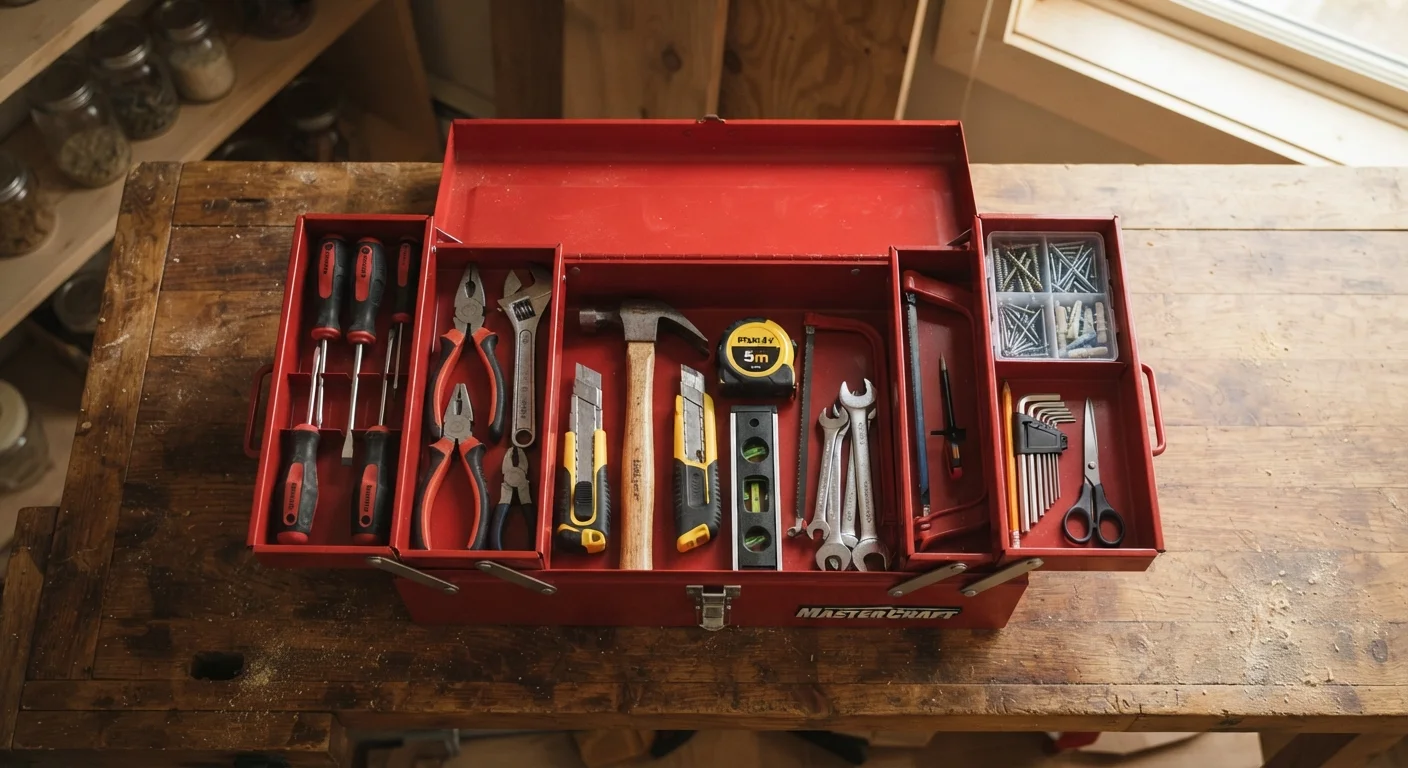
- Claw hammer (16 oz) - Drives and pulls nails; the most universally used striking tool in residential repairs.
- Rubber mallet - Drives materials without marring surfaces; useful for flooring, furniture assembly, and tile work.
- Screwdriver set - Include both flathead and Phillips in multiple sizes. A 6-piece set covers most household fasteners.
Measuring and Marking
- Tape measure (25 ft) - Essential for hanging shelves, fitting trim, and almost any installation task.
- Combination square - Confirms 90° angles and acts as a depth gauge and marking guide.
- Pencil or marking chalk - Accurate lines reduce wasted cuts and off-center fasteners.
Gripping and Cutting
- Needle-nose pliers - Reaches into tight spaces for wire management, hardware assembly, and fixture repairs.
- Slip-joint pliers - Adjustable grip handles pipes, nuts, and irregular shapes.
- Utility knife with spare blades - Scores drywall, cuts caulk lines, and trims weatherstripping cleanly.
- Hacksaw - Cuts metal pipe, threaded rod, and small bolts where a power saw would be excessive.
Leveling and Alignment
- Spirit level (24 in) - Ensures shelves, frames, and fixtures hang straight. A 24-inch version is versatile without being unwieldy.
Pilot hole
A small hole drilled before driving a screw or nail. It prevents wood from splitting and makes fastener placement more accurate.
Toggle bolt
A wall anchor that uses a folding metal or plastic wing to grip the back of hollow drywall. Used for mounting heavier items where studs aren't accessible.
PTFE tape
Polytetrafluoroethylene thread seal tape, commonly called plumber's tape. Wrapped around threaded pipe fittings to create a watertight seal on low-pressure connections.
N95 mask
A respirator rated to filter at least 95% of airborne particles. Used during dusty tasks like drywall sanding to protect respiratory health.
Non-contact voltage tester
A handheld safety device that detects electrical current without touching bare wires. Signals with a light or beep when an energized line is nearby.
Spirit level
A tool with a sealed liquid-filled vial that shows whether a surface is perfectly horizontal or vertical based on the position of an air bubble.
Power Tools Worth Adding Early
A modest power tool addition dramatically expands what you can tackle without a contractor. Two tools justify early investment for most homeowners:
- Cordless drill/driver combo - Drills pilot holes, drives screws, and assembles furniture. Choose a model with interchangeable batteries if you plan to expand later. A set of drill bits (twist, spade, and masonry) rounds this out.
- Oscillating multi-tool - Cuts, sands, scrapes, and flushes-cuts in spaces where other tools can't fit. Particularly useful for trim work, grout removal, and subfloor patches.
Before adding power tools to any project, run through the pre-project safety checklist to confirm the work area is prepared correctly.
Consumables and Safety Supplies
Tools only work well when supported by the right consumables and safety gear. Stock these alongside your hand and power tools:
Fasteners and Adhesives
- Assorted screws: coarse-thread drywall screws, wood screws, and sheet metal screws in common lengths
- Finish nails and brad nails (for trim work)
- Wall anchors: plastic expansion anchors and toggle bolts for hollow-wall mounting
- Construction adhesive and wood glue
- Plumber's tape (PTFE thread seal tape) for minor threaded pipe connections
Patching and Sealing
- Spackle or lightweight joint compound for drywall nicks and nail holes
- Caulk (paintable interior, silicone for wet areas) plus a caulk gun
- Painter's tape for clean edges on paint touch-ups
Safety Essentials
- Safety glasses - Required any time you're cutting, drilling, or striking
- Work gloves - Protects hands from sharp edges and splinters
- Dust mask (N95 rated) - Necessary when sanding drywall, cutting treated wood, or disturbing older materials
- Voltage tester (non-contact) - Confirms circuits are de-energized before working near any wiring. Do not skip this. For work involving electrical panels, gas lines, or structural elements, consult a licensed professional regardless of your skill level.
Understanding which repairs belong in your toolkit versus a professional's hands is covered in detail in the DIY vs. tradesperson framework.
Storage and Maintenance Habits That Protect Your Investment
A disorganized toolkit costs time and money. Tools left damp rust; blades stored loose dull faster. A few habits extend tool life significantly:
- Store metal tools dry - wipe down after use and keep a small silica gel packet in the toolbox to reduce moisture buildup.
- Hang or rack frequently used tools on a pegboard rather than piling them in a drawer.
- Label consumable bins by type (screw gauge, anchor size) so restocking is quick and accurate.
- Replace blades proactively - a dull utility knife blade requires more force and creates more risk than a fresh one.
If you're weighing whether a specific repair is genuinely within DIY scope, reading the job before you start can prevent costly mistakes. The goal of a well-stocked toolkit isn't to take on every repair - it's to handle the right ones efficiently and safely.