

Key Takeaways
Pharmaceutical Grade
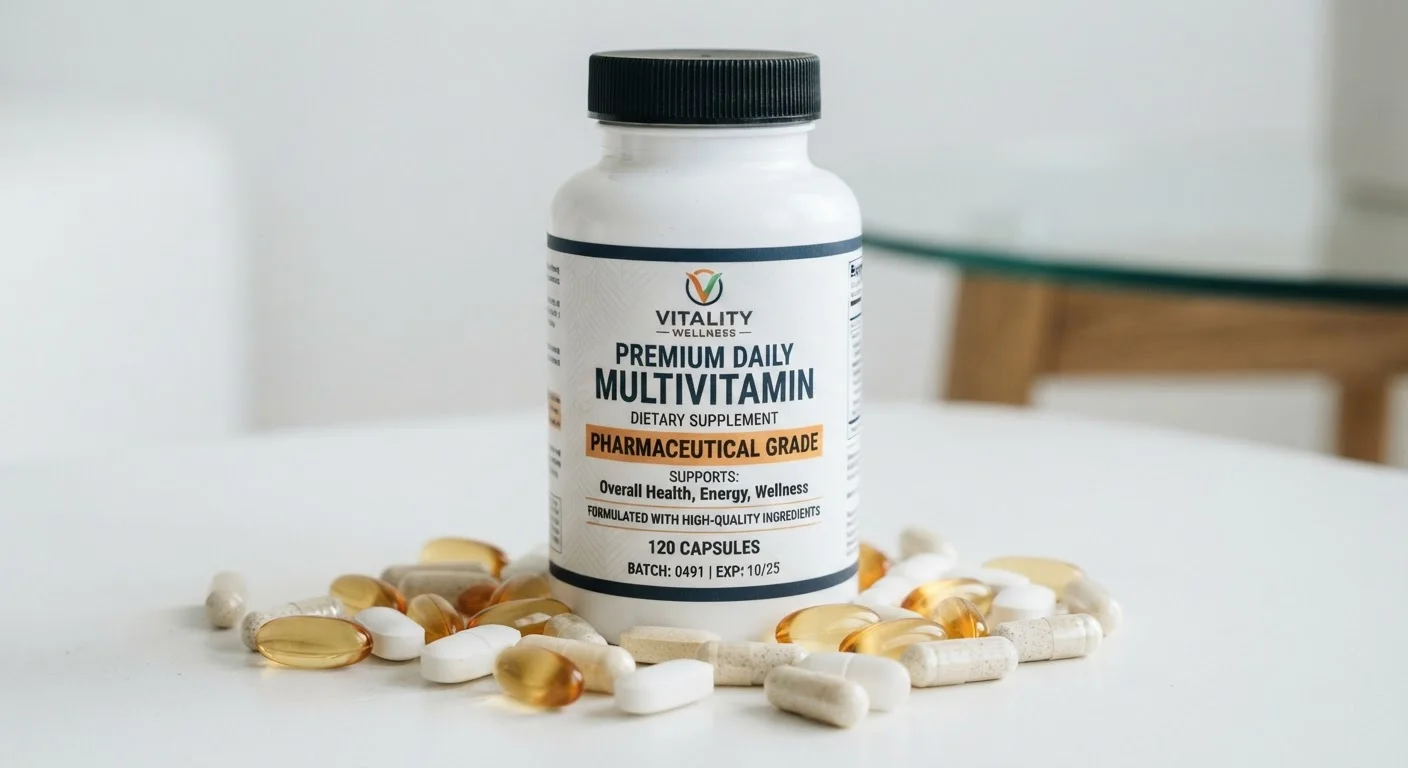
"Pharmaceutical grade" on a supplement label is a marketing claim suggesting the product meets a high standard of purity and manufacturing quality - similar to the standards applied to prescription drugs. In the United States, however, there is no government-enforced definition or FDA certification for this term when it appears on dietary supplements. Any manufacturer can print it without independent verification.
Actual pharmaceutical-grade standards (such as USP grade for raw materials) specify minimum purity thresholds - commonly 99% or higher - along with limits on contaminants. Whether a finished supplement product actually meets those thresholds depends entirely on the manufacturer's internal practices and any voluntary third-party testing they pursue.
Why the Term Exists - and What It Implies
Walk down any supplement aisle or browse a health retailer's website and you'll see "pharmaceutical grade" printed confidently on bottles of protein powder, fish oil, and multivitamins. The phrase borrows authority from the pharmaceutical industry, where strict manufacturing standards govern prescription drug production. The implication is that the supplement inside meets a comparably rigorous bar.
In the pharmaceutical world, raw ingredients are graded by purity level. A "pharmaceutical grade" ingredient typically meets standards published by bodies such as the United States Pharmacopeia (USP) - often specifying purity of 99% or greater, with defined limits on impurities and contaminants. That is a meaningful technical benchmark when applied to a raw chemical compound in a drug manufacturing context.
The problem is that dietary supplements are a different regulatory category entirely. Understanding the gap between that technical origin and its current marketing use is essential for spending wisely. For a broader look at how label language can mislead across product categories, see how the same dynamics play out in pet supply label claims.
The Regulatory Reality for Supplement Labels
The FDA regulates dietary supplements under the Dietary Supplement Health and Education Act (DSHEA) of 1994 - a framework that is notably less stringent than the one governing prescription drugs. Manufacturers are required to follow Good Manufacturing Practices (GMPs), which cover facility cleanliness, record-keeping, and basic quality controls. But the FDA does not pre-approve supplement formulations before they reach consumers, and it does not certify label claims like "pharmaceutical grade."
That means any manufacturer - regardless of their actual production standards - can legally print the phrase on packaging. There is no government audit, no minimum purity threshold to demonstrate, and no certification body whose approval is required. The burden of proof sits entirely with the consumer trying to decode the claim.
0
FDA-defined standards for 'pharmaceutical grade' supplements
The FDA has not established a regulatory definition or certification process for the term 'pharmaceutical grade' as applied to dietary supplement products.
~$50B
US dietary supplement market annual revenue
The US dietary supplement industry generates tens of billions in annual sales, creating strong commercial incentives for premium-sounding label claims, according to industry research estimates.
99%+
Typical USP pharmaceutical-grade ingredient purity threshold
When the term originates from USP raw material standards, it generally refers to chemical purity of 99% or higher - a benchmark that applies to ingredients, not necessarily finished products.
This stands in contrast to how active ingredients in prescription and over-the-counter drugs are evaluated. For perspective on how regulatory oversight shapes quality and cost in the drug space, our article on generic vs. brand-name medications explains how verified equivalence standards work for regulated pharmaceutical products.
What to Look For Instead
Because "pharmaceutical grade" on a supplement label is essentially self-declared, savvy shoppers need verification tools that come from outside the manufacturer's own marketing team. Several options provide more meaningful evidence of quality:
- Third-party certification seals: Organizations like USP, NSF International, and Informed Sport independently test products and verify label claims before awarding their seals. These certifications are auditable and require ongoing compliance.
- Certificate of Analysis (COA): A COA from an independent laboratory documents actual test results for a specific batch - including potency, purity, and contaminant screening. Reputable manufacturers make these available on request or online.
- GMP compliance documentation: Confirm a manufacturer holds a current GMP certification, ideally verified by a third party rather than self-reported.
For a detailed breakdown of what specific certification seals actually verify, see our guide on third-party supplement testing certifications.
Ask for the Certificate of Analysis
Before purchasing a supplement based on a 'pharmaceutical grade' claim, contact the manufacturer and request the most recent Certificate of Analysis from an independent laboratory. A company confident in its quality standards will provide one. If they can't or won't, that itself is useful information.
If you encounter unfamiliar terms elsewhere on a supplement label, our supplement terminology glossary defines the most common ones in plain language.
This article is for general informational purposes only and is not medical advice. Consult a qualified healthcare professional before making decisions about supplements or your personal health.