

Key Takeaways
Start here
How Pet Food Is Regulated in the US
Next
Reading a Pet Food Label
Then
Understanding the Main Food Formats
Going deeper
What Drives Pet Food Costs
Apply it
Building a Sustainable Feeding Budget
How Pet Food Is Regulated in the US
Pet food sold in the United States operates under a layered oversight system. At the federal level, the FDA sets safety standards covering manufacturing, labeling, and contamination. At the state level, most states adopt the model regulations developed by AAFCO - the Association of American Feed Control Officials - a body that defines nutritional standards and label requirements.
The most important thing AAFCO does for everyday shoppers is establish the nutritional adequacy statement, sometimes called the AAFCO statement. This line on a label tells you whether the food is formulated to meet established nutrient profiles for a specific life stage, or whether it has been tested through actual feeding trials. If a food lacks this statement entirely, it has not been verified as nutritionally complete.
It's worth noting that AAFCO itself does not test or approve products - it sets the standards manufacturers voluntarily follow. Regulatory enforcement sits with the FDA and state feed control officials. This distinction matters: a product meeting AAFCO standards reflects formulation against published minimums, not a government seal of approval.
AAFCO Standards Are a Floor, Not a Ceiling
Meeting AAFCO nutritional minimums means a food is adequate for the labeled life stage - it does not mean all compliant foods are nutritionally equivalent. Ingredients, digestibility, and manufacturing quality vary among products that all carry the same AAFCO adequacy statement. Your veterinarian can help you evaluate options beyond the label minimum.
Reading a Pet Food Label
US pet food labels must include six core elements: product name, net weight, manufacturer name and address, ingredient list, guaranteed analysis, and the nutritional adequacy statement. Understanding just two of these - the ingredient list and the guaranteed analysis - gives you most of the practical information you need.
Ingredient list: Ingredients appear in descending order by weight before processing. This is important because raw chicken, for example, contains roughly 70-75% water. After cooking, its contribution to the finished product is much smaller than its top-of-list position suggests. A food listing chicken first is not necessarily higher in protein than one listing chicken meal (a concentrated, pre-dried protein source) second or third.
Guaranteed analysis: This panel lists minimum percentages of crude protein and fat, and maximum percentages of moisture and fiber. These figures give you a more reliable picture of nutrient density than ingredient order alone. To compare a wet and a dry food meaningfully, you need to adjust both to a dry-matter basis - our companion piece explains how to read the guaranteed analysis panel in detail.
AAFCO
The Association of American Feed Control Officials. A non-governmental body that establishes the nutritional standards and labeling guidelines that most US pet food manufacturers follow.
Nutritional adequacy statement
A required label statement confirming that a pet food meets AAFCO nutritional standards for a specific life stage, either by formulation or feeding trial.
Guaranteed analysis
A panel on pet food packaging that lists minimum and maximum percentages of key nutrients - protein, fat, moisture, and fiber - giving a standardized nutrient snapshot.
Dry matter basis
A calculation method that removes moisture from the equation so you can compare nutrients in wet and dry foods on an equal footing.
Life stage formula
A pet food designed for a specific phase of an animal's life - growth (puppies/kittens), adult maintenance, or senior - with nutrient levels adjusted accordingly.
Crude protein
A measure of total nitrogen-containing compounds in a food, used as a proxy for protein content on the guaranteed analysis panel. It includes protein from all sources, both animal and plant.
Understanding the Main Food Formats
Pet food falls into four broad categories, each with different handling requirements, nutritional profiles, and price points.
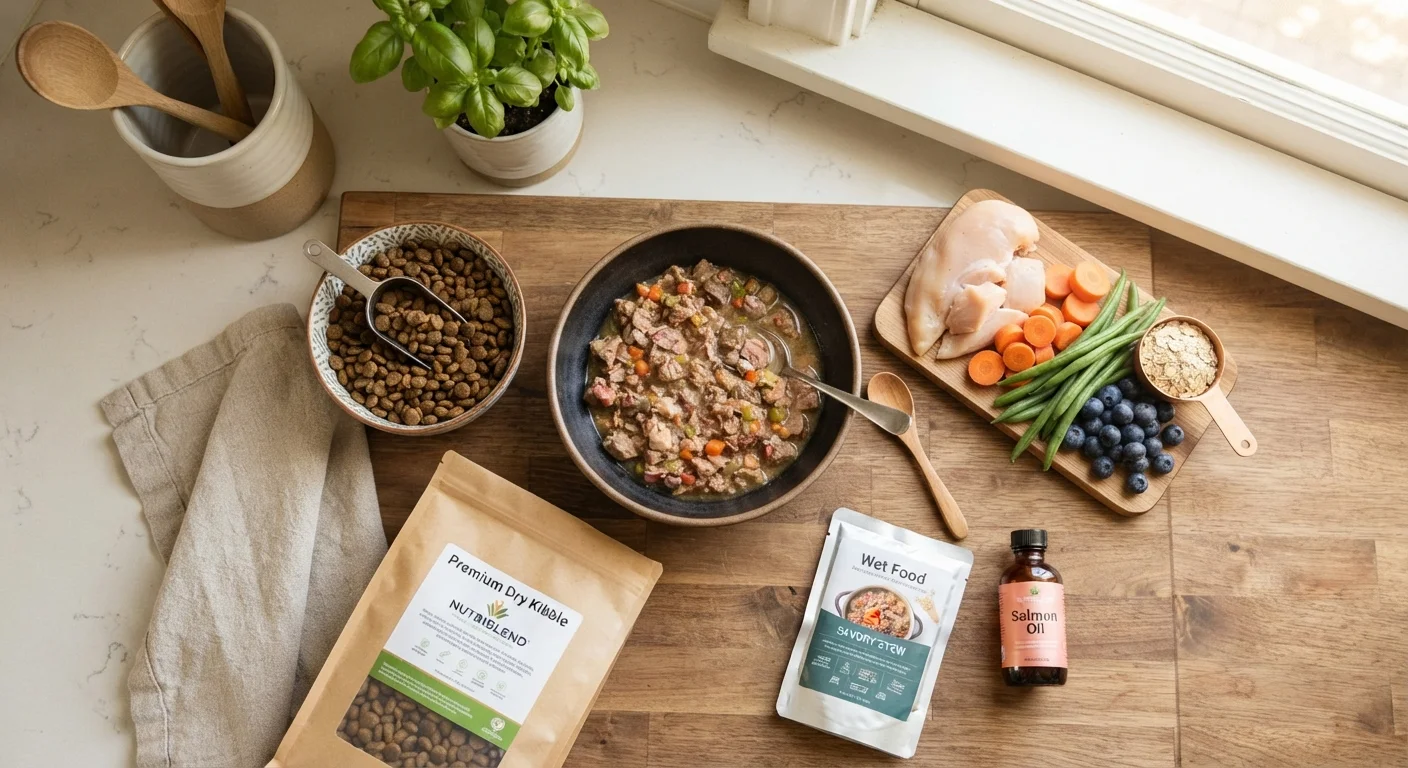
- Dry (kibble): The most widely used format. Low moisture (around 10%), shelf-stable, and generally the most affordable on a cost-per-calorie basis. Convenient for free-feeding or precise portioning.
- Wet (canned or pouch): Higher moisture content (typically 70-80%), which can aid hydration. Usually more expensive per calorie than kibble but palatable for picky eaters or animals with dental issues.
- Raw: Either frozen or freeze-dried, raw diets aim to mimic an ancestral diet. They require careful handling to manage pathogen risk and tend to carry higher price tags. Regulatory standards and veterinary guidance on raw diets vary.
- Fresh/lightly cooked: A growing category typically sold refrigerated or delivered by subscription. Minimally processed with whole-food ingredients, these sit between raw and traditional wet food in cost and convenience.
For a side-by-side cost comparison of all four formats, see our full breakdown of pet food format costs.
What Drives Pet Food Costs
Price variation in pet food comes from several factors that are useful to understand before you start comparing options.
Ingredient sourcing: Named animal proteins (e.g., salmon, lamb) typically cost more to source than generic meat meals or plant proteins. Formulations that use higher proportions of named, single-source proteins usually carry higher price tags.
Manufacturing standards: Facilities that follow stricter quality control processes - such as those that operate under human-food-grade standards - tend to produce more expensive products.
Format and packaging: Wet and fresh formats cost more per calorie to produce and package than dry kibble. Portion-controlled pouches add packaging costs compared to large bags or cans.
Life stage and specialty formulas: Puppy, senior, weight management, and breed-specific formulations often carry a premium over standard adult maintenance products, sometimes for meaningful nutritional reasons and sometimes primarily for marketing.
Calculate Cost Per Day Before Deciding
Sticker price alone is a poor guide to pet food value. A larger bag at a higher upfront cost often works out cheaper per day than a smaller one. Divide the package price by the number of days it will last at your pet's recommended daily portion to get a true comparison figure.
Building a Sustainable Feeding Budget
The most practical way to estimate monthly food costs is to calculate cost per day: divide the package price by the number of days it will last based on the feeding guidelines for your pet's weight. This lets you compare formats and package sizes on equal footing.
A few other principles help new owners spend more efficiently without compromising nutrition:
- Match format to your pet's actual needs. Not every pet requires a premium or specialty diet. A healthy adult animal with no diagnosed conditions often does well on a nutritionally complete maintenance formula. Ask your vet before spending more on specialized products.
- Buy in volume where storage allows. Dry food purchased in larger bags typically costs less per pound, provided you can store it properly and use it before the expiration date.
- Transition gradually between foods. Switching foods abruptly can cause digestive upset, wasting both food and money. A 7-10 day transition - gradually increasing the new food - is widely recommended by veterinarians.
- Factor in all feeding-related costs. Supplements, toppers, and treats add to your monthly spend. Account for them when setting a budget.
If you have multiple pets with different dietary needs, the budgeting calculus becomes more complex - our multi-pet household feeding guide offers a practical framework. And for a broader view of managing new pet expenses beyond food, our guide to buying pet supplies covers day-one essentials and what you can skip.
This article provides general educational information about pet food and is not a substitute for advice from a licensed veterinarian. Dietary needs vary by species, breed, age, and health status - consult your vet for guidance specific to your animal.