

Key Takeaways
Our Verdict
No single food format wins across all criteria. Dry kibble offers the clearest cost advantage for most pet owners, while wet food adds moisture value at moderate extra expense. Raw and fresh-cooked diets cost considerably more and require greater time or handling investment, though some pets with specific needs may benefit. The right choice depends on your pet's health requirements, your budget, and how much daily preparation you can realistically manage.
| Best for | Recommended |
|---|---|
| Budget-conscious owners feeding average-sized dogs or cats | Dry kibble |
| Pets with low water intake or urinary health concerns | Wet canned food |
| Owners wanting minimally processed food without home-prep complexity | Fresh-cooked commercial |
| Owners advised by a vet to try a species-appropriate raw protocol | Raw diet |
Why Format Affects Cost More Than Brand
When pet owners compare food prices, they often fixate on the sticker price of a bag or can. But the format - dry, wet, raw, or fresh - is a stronger predictor of what you'll actually spend each month than the brand tier alone. Format determines caloric density, moisture content, shelf life, and portion size, all of which feed directly into daily cost.
The most reliable way to compare across formats is cost per day, not cost per package. Calculating cost per serving requires knowing your pet's daily caloric needs by weight and the caloric density of each food - figures that differ dramatically between a bag of kibble and a tray of fresh-cooked food. Without that math, you're comparing apples to oranges.
Dry Kibble: The Cost Baseline
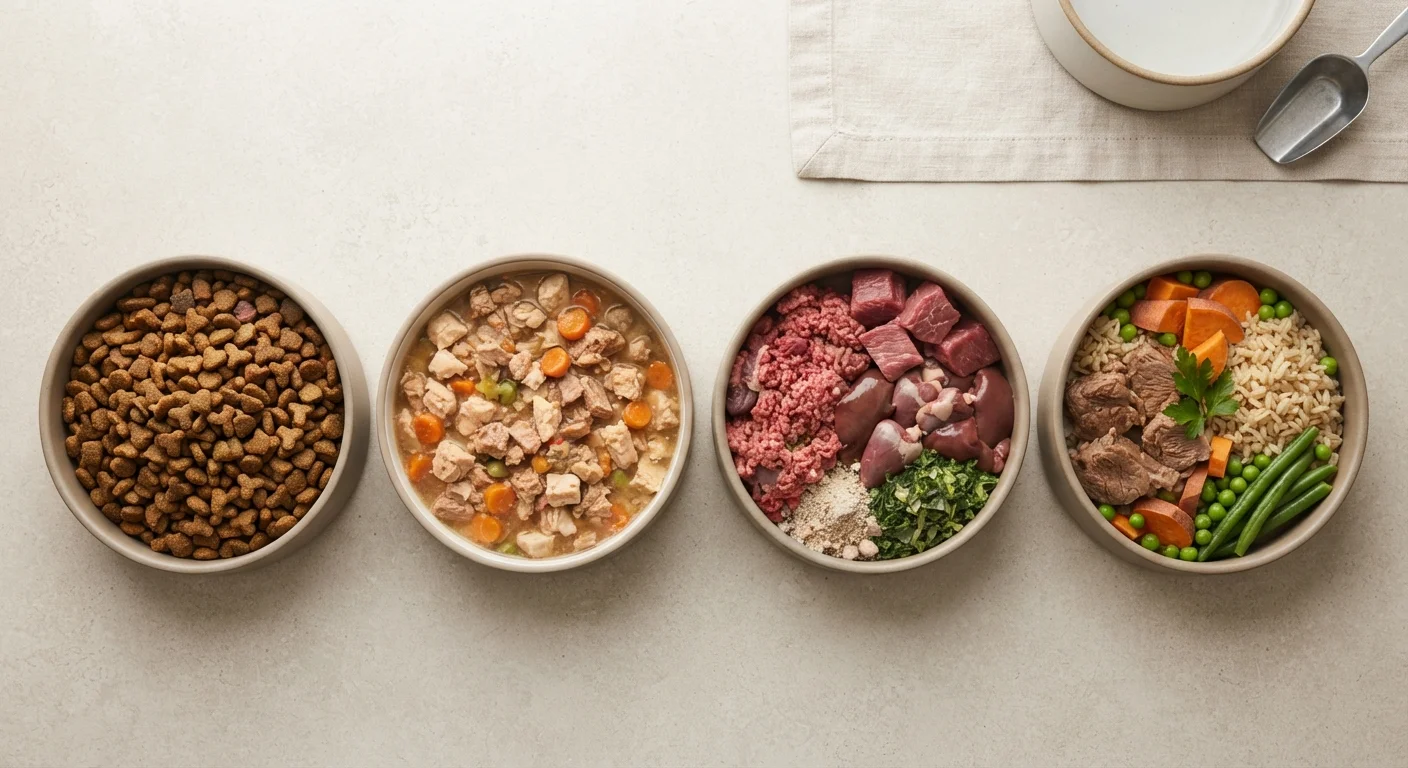
Kibble is the most widely used pet food format in the US, and it holds that position largely because of cost and convenience. With moisture levels around 10%, dry food is calorie-dense, meaning smaller volumes feed larger animals. A 30-pound bag of kibble can feed a medium-sized dog for 30-40 days, depending on portion guidelines.
Daily costs for dry food typically run between $0.50 and $2.50 for a 30-lb dog, depending on the product's caloric content and ingredient quality. For cats, daily costs are generally lower given their smaller size. Shelf life is another advantage: unopened bags last months, and opened bags stay fresh for several weeks if stored properly. Bulk buying kibble can reduce per-serving costs further, though storage conditions and palatability changes over time are real considerations.
The main limitation of dry food is moisture: dogs and cats on exclusively dry diets may not drink enough water to compensate, which can matter for urinary health. Ingredient quality also varies widely - not every premium-labeled ingredient justifies a higher price point.
| Dry Kibble | Wet Canned | Raw | Fresh-Cooked Commercial | |
|---|---|---|---|---|
| Typical daily cost (medium dog) | $0.50-$2.50 | $2-$5+ | $5-$10+ | $3-$7 |
| Moisture content | ~10% | 70-80% | 60-70% | 60-75% |
| Shelf life (unopened) | 12-18 months | 2-5 years | 6-12 months (frozen) | 2-4 weeks (frozen) |
| Prep and handling effort | Minimal | Low | High | Low to moderate |
| Food safety considerations | Low | Low | Higher (bacterial risk) | Low to moderate |
| Caloric density | High | Low to moderate | Moderate | Moderate |
| Nutritional completeness assurance | AAFCO standard | AAFCO standard | Varies by product/source | AAFCO standard |
Wet Canned Food: Higher Moisture, Higher Cost
Canned food typically contains 70-80% moisture, which means you're buying a lot of water weight. On a dry matter basis - stripping out moisture to compare nutrients directly - wet food is often less calorie-dense than kibble. That means you need larger volumes to meet daily energy needs, which drives up cost.
For a medium dog, daily wet food costs often range from $2 to $5 or more, depending on can size and caloric density. Many owners use wet food as a kibble topper rather than a complete diet replacement, which softens the cost impact. Understanding how to read a guaranteed analysis panel helps you convert moisture-distorted figures into real nutrient comparisons between wet and dry formats.
Wet food's higher moisture content is genuinely useful for pets prone to dehydration, urinary issues, or those who eat slowly. Shelf life after opening is short - most cans should be refrigerated and used within 2-3 days - so waste is a real cost factor for single-pet households.
Raw Diets: High Cost, High Handling Requirements
Raw feeding - whether commercially prepared frozen patties or home-assembled meals - is consistently the most expensive format. Commercially prepared raw diets for a medium dog can cost $5 to $10 or more per day. Home-assembled raw diets can vary widely depending on sourcing, but achieving complete and balanced nutrition without supplementation is difficult without professional guidance.
Beyond cost, raw diets require careful food safety practices. The FDA and the American Veterinary Medical Association have flagged risks of bacterial contamination - including Salmonella and Listeria - in raw pet foods, with potential exposure risks to both pets and human household members. This doesn't make raw feeding impossible, but it does add non-trivial time and hygiene demands that factor into true cost of ownership.
Raw Diet Food Safety Risks Are Real
The FDA and American Veterinary Medical Association have documented contamination risks - including Salmonella and Listeria - in raw pet food products. These pathogens can affect pets and humans in the same household, including children and immunocompromised individuals. If you're considering a raw diet, discuss the full risk profile with your veterinarian before proceeding.
If you're considering a raw diet, consult a veterinarian or board-certified veterinary nutritionist before starting. Nutritional balance is difficult to achieve without expert input, and health implications vary by individual pet.
Fresh-Cooked Commercial Diets: The Middle Ground
Fresh-cooked commercial pet food - delivered refrigerated or frozen in pre-portioned pouches - has grown substantially as a category. These products are typically made with whole-food ingredients, cooked at lower temperatures than kibble, and formulated to meet AAFCO nutritional standards. They sit between wet food and raw on most cost measures, generally running $3 to $7 per day for a medium dog.
The main trade-off is convenience versus cost. Subscription delivery removes the need for handling raw meat, and pre-portioned servings simplify daily feeding. Storage requires refrigerator or freezer space, and delivery schedules must be managed. For multi-pet households, fresh-cooked subscription costs can scale steeply. Compared to home-cooked meals, commercial fresh options carry a significant price premium but offer nutritional formulation assurance that home cooking typically cannot match without veterinary nutritionist involvement.
Making the Format Decision Work for Your Budget
There's no universal answer to which format offers the best value - it depends on your pet's size, health status, and your household logistics. A few practical principles apply across formats:
- Calculate daily cost, not package cost. Divide the package price by the number of days it will last based on your pet's actual portion size.
- Factor in waste. Wet food left uneaten and raw food past its safe window both add to real cost.
- Account for storage. Kibble requires cool, dry storage in a sealed container. Raw and fresh diets need freezer or refrigerator space.
- Match format to your pet's needs. A cat with a history of urinary issues may genuinely benefit from a higher-moisture diet, making wet food a cost-effective choice relative to potential veterinary expenses.
Mixing formats - using kibble as a base with occasional wet food additions - is a common strategy that can balance cost and palatability. Whatever combination you choose, regular vet check-ins help confirm that your pet's diet is meeting their nutritional needs over time. For general health information, always consult a licensed veterinarian for decisions specific to your animal.
This article is for general informational purposes only and does not constitute veterinary or nutritional advice. Consult a licensed veterinarian before making significant changes to your pet's diet.