

| Regulatory body | AAFCO (Association of American Feed Control Officials) |
| Required GA nutrients | Crude protein, crude fat, crude fiber, moisture |
| Typical kibble moisture | 8-12% |
| Typical wet food moisture | 75-82% |
| Protein listed as | Minimum percentage |
| Fiber listed as | Maximum percentage |
What the Guaranteed Analysis Panel Actually Is
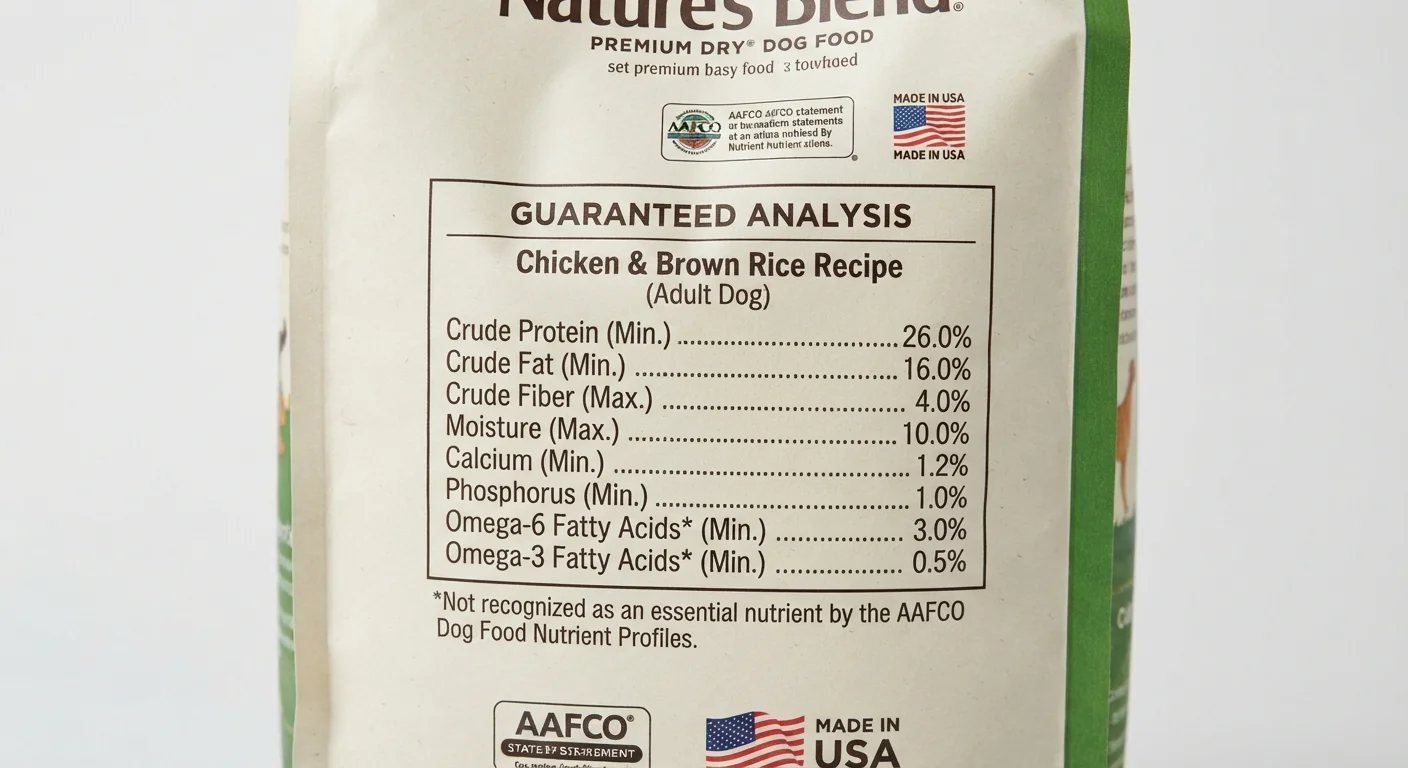
Every commercially sold pet food in the United States must carry a Guaranteed Analysis (GA) panel - a standardized nutrient disclosure regulated by the Association of American Feed Control Officials (AAFCO) and enforced at the state level. It lists minimum or maximum percentages for four core nutrients: crude protein, crude fat, crude fiber, and moisture. Some labels voluntarily add others, such as ash or specific amino acids.
The word "guaranteed" means the manufacturer is legally required to meet those figures - it does not indicate quality, digestibility, or source of the nutrient. A food can meet its guaranteed protein figure using a mix of highly digestible meat meal and lower-quality plant proteins. The GA panel tells you how much is present, not how useful it is to your pet's body.
For a broader look at how label language around ingredients and claims can be misleading, see Pet Supply Labels Decoded.
| Regulatory body | AAFCO (Association of American Feed Control Officials) |
| Required GA nutrients | Crude protein, crude fat, crude fiber, moisture |
| Typical kibble moisture | 8-12% |
| Typical wet food moisture | 75-82% |
| Protein listed as | Minimum percentage |
| Fiber listed as | Maximum percentage |
Dry Matter Basis: The Only Fair Way to Compare Foods
The biggest pitfall when reading GA panels is comparing figures across different food formats - kibble, canned, raw - without accounting for water content. Wet foods often contain 75-82% moisture; kibble typically runs 8-12%. A canned food showing 10% protein and a dry food showing 28% protein may actually be nearly identical once water is removed from the equation.
To convert any nutrient to a dry matter basis (DMB), use this formula:
Dry Matter % = (As-Fed % ÷ (100 − Moisture %)) × 100
For example, a canned food with 10% protein and 78% moisture: (10 ÷ 22) × 100 = 45.5% protein on a dry matter basis. That same food likely delivers more protein per calorie than most dry kibbles. This calculation is essential for meaningful cost-per-nutrient comparisons. See how dry, wet, raw, and fresh formats compare on real cost to put these numbers in context.
Guaranteed Analysis (GA)
A legally required panel on US pet food labels listing minimum or maximum percentages of crude protein, fat, fiber, and moisture. It ensures manufacturers meet disclosed nutrient levels but does not address nutrient quality or digestibility.
Dry Matter Basis (DMB)
A method of expressing nutrient percentages after mathematically removing all moisture from a food. It allows direct, apples-to-apples comparison between foods with different water content, such as kibble and canned food.
Crude Protein
A measurement of total nitrogen in a food, converted to an estimated protein percentage. 'Crude' indicates the measurement method, not a judgment about quality - it does not distinguish between animal and plant protein sources.
AAFCO Nutritional Adequacy Statement
A declaration on pet food labels indicating whether the product meets nutrient profiles established by the Association of American Feed Control Officials for a specific species and life stage, either through formulation or feeding trials.
As-Fed Basis
Nutrient percentages as they appear on the GA panel, including moisture content. These figures are useful for understanding what your pet physically eats but require conversion to dry matter basis for cross-format comparisons.
Crude Fiber
A measure of indigestible plant material in a pet food, listed as a maximum on the GA panel. It reflects general fiber content but does not distinguish between fiber types such as soluble and insoluble.
Reading Each Line: What the Numbers Mean in Practice
Crude Protein (minimum): Reflects total nitrogen content converted to a protein estimate. Dogs and cats have very different requirements - cats are obligate carnivores with higher baseline protein needs. AAFCO publishes minimum nutrient profiles by species and life stage; the GA panel alone doesn't tell you if a food meets those profiles, which is why the AAFCO nutritional adequacy statement on the label matters.
Crude Fat (minimum): Fat is the most calorie-dense macronutrient (roughly 2.25× protein or carbohydrates per gram). Higher fat figures raise caloric density and palatability. For weight-management or less-active pets, a lower fat figure on a dry matter basis is a meaningful signal.
Crude Fiber (maximum): Fiber is listed as a maximum rather than a minimum, reflecting a regulatory convention that treats high fiber as a quality dilution concern. Fiber aids digestive health but at high levels can reduce overall nutrient absorption.
Moisture (maximum): The moisture cap allows you to perform the dry matter conversion above. A figure above 20% typically indicates a wet or semi-moist product.
~45%
Dry matter protein in a typical 10% canned food (78% moisture)
Illustrates how wet foods can rival or exceed dry food protein density once moisture is removed from the calculation.
2.25×
Caloric density of fat vs. protein or carbohydrates per gram
A standard nutritional chemistry figure relevant for interpreting crude fat percentages on pet food labels.
If your pet has a specific health condition, consult a licensed veterinarian or board-certified veterinary nutritionist before making dietary changes based on GA panel data alone. This content is general educational information, not veterinary advice.
Putting It Together: A Practical Comparison Workflow
When comparing two foods on price or nutrition, a simple four-step process keeps the analysis honest:
- Note the moisture percentage for each food.
- Convert protein and fat to dry matter basis using the formula above.
- Divide by cost per ounce to estimate nutrient density per dollar.
- Check the AAFCO statement to confirm the food is formulated for your pet's life stage (growth, maintenance, or all life stages).
This workflow won't reveal ingredient quality or digestibility - those require looking at the ingredient list and, ideally, a manufacturer's published digestibility data - but it gives you a reliable baseline for filtering out overpriced options with similar nutrient profiles. First-time pet owners can get more context on how pet food is regulated and priced in Understanding Pet Food for First-Time Owners. The same label-reading discipline applies when comparing human supplements; Reading a Supplement Facts Panel Without Getting Lost covers a parallel process for that category.