

Key Takeaways
Pet Food Label
A pet food label is the standardized set of panels printed on commercial pet food packaging that discloses ingredients, nutrient content, feeding directions, and manufacturer information. In the United States, these labels must meet requirements set by the Association of American Feed Control Officials (AAFCO) and individual state feed laws. Understanding what each panel actually measures - and what it deliberately omits - helps pet owners evaluate nutrition independently from marketing claims.
AAFCO establishes model regulations that states adopt into law; the FDA enforces federal adulteration and misbranding rules. Neither agency pre-approves individual pet food labels before sale.
The Five Required Label Panels - and What Each One Actually Shows
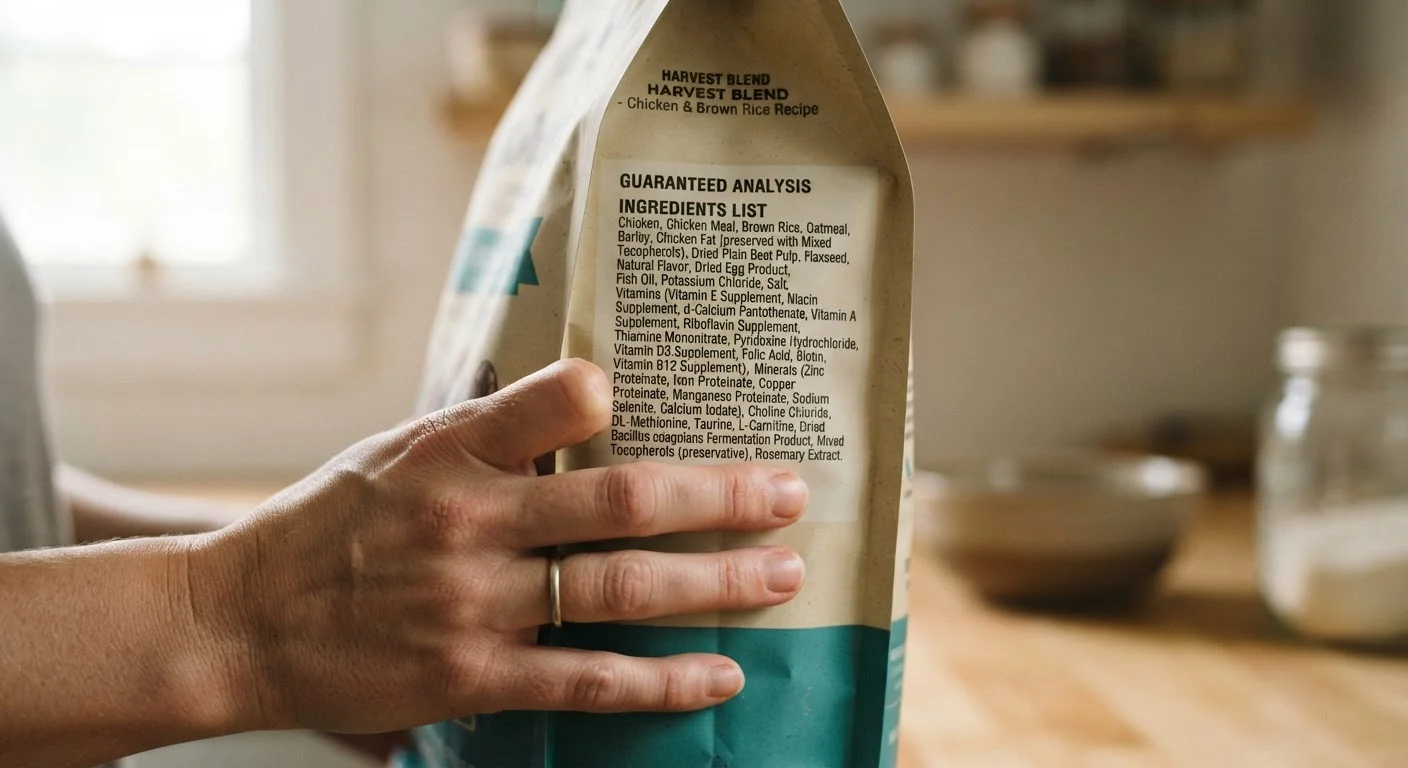
Every pet food sold in the US must carry five core label elements: the product name, net weight, manufacturer information, ingredient list, and guaranteed analysis panel, plus an AAFCO nutritional adequacy statement. Each panel operates under different rules and reveals different things.
The product name is more regulated than most shoppers realize. AAFCO's ingredient naming rules dictate that if a single ingredient appears in the product name (e.g., "Chicken Formula"), it must constitute at least 25% of the product by weight. A name like "Chicken Dinner" or "Chicken Entrée" requires only 25% combined named ingredients, while "with Chicken" requires just 3%. "Chicken Flavor" requires only enough to be detectable. These thresholds directly affect what you're actually buying.
The ingredient list runs in descending order by pre-cooking weight - a detail that matters enormously. Fresh chicken is roughly 70% water, so it weighs more before cooking than after. A "chicken meal" listed third may actually deliver more protein per serving than fresh chicken listed first, because meal is a concentrated, moisture-reduced ingredient. See our guide on pet food nutrition myths for more on why ingredient rank alone is an unreliable quality signal.
3%
Minimum ingredient needed for 'with [Ingredient]' claim
AAFCO model regulations require only 3% of a named ingredient when the product name uses the word 'with,' such as 'with Real Beef.'
25%
Minimum needed for a single-ingredient name claim
Products using a sole ingredient in the name (e.g., 'Chicken Formula') must contain at least 25% of that ingredient by weight, per AAFCO guidelines.
70-80%
Typical moisture content in wet pet food
Most canned and wet pet foods contain 70-80% moisture, making direct protein comparisons with dry kibble unreliable without dry-matter conversion.
Guaranteed Analysis: What the Numbers Mean and Don't Mean
The guaranteed analysis panel lists minimum percentages for crude protein and crude fat, and maximum percentages for moisture and crude fiber. Notice the asymmetry: minimums for the nutrients you want, maximums for the ones you want limited. The actual values in any given batch could be notably higher or lower than what's printed.
"Crude" refers to the measurement method, not ingredient quality. Crude protein is measured by total nitrogen content, which means non-protein nitrogen sources - including some synthetic additives - can inflate the figure. Crude fiber measures only insoluble fiber and understates total dietary fiber, which includes fermentable fibers beneficial to gut health.
Comparing wet and dry foods directly from the panel is misleading because moisture content differs so dramatically. A wet food showing 10% protein and a dry kibble showing 28% protein are not necessarily far apart once you account for water. Our reference guide to guaranteed analysis panels walks through the dry-matter conversion calculation step by step.
The AAFCO Statement: The Most Important Line Most People Skip
The nutritional adequacy statement is the single most informative line on any pet food package, yet it's routinely overlooked in favor of front-panel marketing. It answers two questions: what life stage is this food designed for, and how was that claim verified?
Substantiation method matters. A statement reading "Animal feeding tests using AAFCO procedures" means the food was actually fed to animals and monitored for health outcomes over a defined period. A statement reading "formulated to meet the nutrient levels established by AAFCO" means the recipe was modeled against a nutrient profile on paper. Both are legal; neither is fraudulent. But they represent different levels of real-world evidence.
Foods labeled "for intermittent or supplemental feeding only" have not met adequacy standards for any life stage and should not serve as a primary diet. This label appears frequently on toppers, broths, and some raw or freeze-dried products - it's easy to miss on packaging dominated by lifestyle photography.
Check the Adequacy Statement Method First
Before reading ingredient lists or marketing language, find the AAFCO nutritional adequacy statement - usually near the guaranteed analysis panel on the back or side of the package. Look specifically for whether it says 'feeding tests' or 'formulated to meet nutrient profiles.' That single distinction tells you more about real-world nutritional confidence than any front-panel claim.
What Labels Don't Tell You - and Where to Look Instead
Labels tell you ingredient order and minimum nutrient levels, but they don't disclose ingredient sourcing geography, actual amino acid profiles, digestibility, or batch-level quality control. They also carry no obligation to disclose recalls or manufacturing changes.
Certain label claims carry no regulatory definition at all. "Holistic," "premium," "human-grade" (with limited exceptions), and "natural" are applied inconsistently across manufacturers. "Natural" has a loose AAFCO definition excluding synthetic ingredients, but enforcement is limited. For a full look at which label claims have real regulatory teeth, see our breakdown of pet supply label terms.
For a deeper look at which specific ingredients have genuine nutritional backing versus marketing positioning, our article on ingredients worth paying more for separates evidence-backed formulations from window dressing.
If you're considering bypassing commercial food altogether, understand that homemade diets carry real nutritional risks. What homemade pet food actually requires covers the veterinary guidance and nutritional balancing a home-cooked diet demands before it's safe long-term.
This article provides general educational information about pet food labeling. It is not veterinary nutrition advice. Consult a licensed veterinarian or board-certified veterinary nutritionist for guidance specific to your pet's health needs and life stage.