

Key Takeaways
Delivers meals on a consistent, reliable schedule
Pets fed at regular intervals tend to show fewer stress-related behaviors around mealtimes. A programmed feeder maintains timing even during travel, long workdays, or disrupted routines.
Supports portion discipline without daily effort
Once calibrated, a feeder removes the guesswork of eyeballing servings. This can be especially useful for pets prone to overeating when food is freely available.
Reduces dependency on human presence for every meal
For owners with variable schedules, a feeder provides a meaningful buffer - covering meals during short absences without requiring a pet sitter or neighbor.
Can slow eating speed in fast-eating pets
Some feeder designs dispense small amounts at timed intervals rather than one large serving, which may reduce the risk of bloating or regurgitation in dogs prone to eating too quickly.
Relatively low ongoing operational cost for basic models
Simple timer-based feeders have few moving parts and minimal power requirements, making them durable and inexpensive to run over months or years.
Not suitable for wet food in most cases
Standard automatic feeders are designed for dry kibble. Wet food spoils rapidly at room temperature, making automated dispensing a food safety concern unless the unit includes active refrigeration.
Portion accuracy degrades with kibble size and humidity
Small or irregularly shaped kibble can clump or jam the dispensing mechanism, leading to missed meals or over-dispensing. This is a particular concern in humid climates.
Mechanical failures can mean a missed meal
Motor failures, jammed drums, and power outages can all result in a pet receiving no food. Owners who rely heavily on feeders should have a backup plan.
Reduces direct observation of appetite and behavior
Changes in how much a pet eats are often early indicators of illness. When a feeder handles all meals, these subtle shifts are easier to miss until a problem becomes more serious.
Does not resolve multi-pet competition at the bowl
In households with more than one pet, an automatic feeder may still result in one animal eating another's portion unless physical separation is in place during mealtimes.
App-connected models add software dependency and cost
Smart feeders require Wi-Fi connectivity and manufacturer app support. If a company discontinues support for an older model, remote scheduling and monitoring features may stop working.
Our Verdict
Automatic feeders are a practical tool for pet owners with predictable schedules and pets that do well on dry food. They reduce the daily burden of timed meals and can support portion discipline - but they are not a substitute for attentive pet care. Reliability varies significantly across price points, and certain pets or dietary needs are simply not well served by automation.
Pet owners who feed dry kibble on a regular schedule and need schedule flexibility without sacrificing meal consistency.
What Automatic Feeders Actually Do
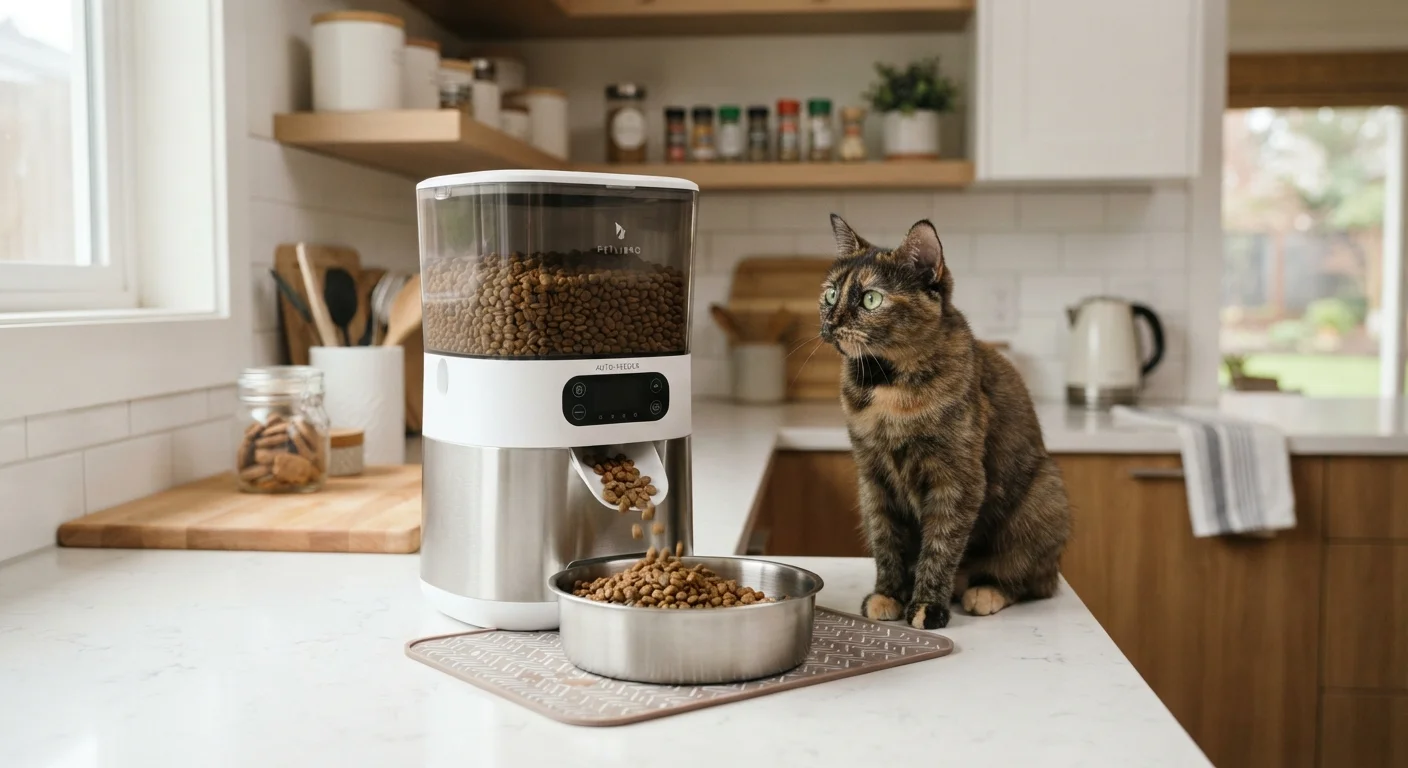
Automatic feeders dispense a pre-set amount of food at scheduled times - typically controlled by a timer or, in more advanced units, a smartphone app. The core appeal is straightforward: meals happen on time even when you can't be present to serve them.
Most units on the market use a gravity-feed or rotating-drum mechanism to release dry kibble or pellets. A smaller category of feeders includes ice packs or cooling chambers for wet food, though these carry their own limitations. Understanding how a feeder works mechanically is the first step in evaluating whether it fits your pet's specific diet. See the guide to pet food formats and nutrition for context on how different food types interact with feeding equipment.
Wet Food and Automatic Feeders: A Compatibility Gap
The majority of automatic feeders on the market are engineered specifically for dry kibble or pelleted food. Wet food, raw diets, and semi-moist formulas generally require specialized units with cooling systems to prevent spoilage. If your pet's diet includes anything other than dry food, verify feeder compatibility before purchasing - this detail is frequently buried in product specifications rather than prominently featured.
The Real Advantages
When matched to the right situation, automatic feeders deliver genuine value.
Delivers meals on a consistent, reliable schedule
Pets fed at regular intervals tend to show fewer stress-related behaviors around mealtimes. A programmed feeder maintains timing even during travel, long workdays, or disrupted routines.
Supports portion discipline without daily effort
Once calibrated, a feeder removes the guesswork of eyeballing servings. This can be especially useful for pets prone to overeating when food is freely available.
Reduces dependency on human presence for every meal
For owners with variable schedules, a feeder provides a meaningful buffer - covering meals during short absences without requiring a pet sitter or neighbor.
Can slow eating speed in fast-eating pets
Some feeder designs dispense small amounts at timed intervals rather than one large serving, which may reduce the risk of bloating or regurgitation in dogs prone to eating too quickly.
Relatively low ongoing operational cost for basic models
Simple timer-based feeders have few moving parts and minimal power requirements, making them durable and inexpensive to run over months or years.
Consistent meal timing matters more than many owners realize. Irregular feeding schedules can contribute to digestive upset, food anxiety, and overeating behaviors - issues explored in depth in the article on why pets eat more than they should. A feeder that reliably delivers the same portion at the same time each day removes one variable from the equation.
For households with multiple pets on different caloric needs, a programmed feeder can also be part of a broader management strategy - though it rarely solves competition at the bowl on its own. The multi-pet household feeding guide covers the fuller picture.
Where They Fall Short
No feeding tool is without trade-offs, and automatic feeders have several that are easy to underestimate before purchase.
Not suitable for wet food in most cases
Standard automatic feeders are designed for dry kibble. Wet food spoils rapidly at room temperature, making automated dispensing a food safety concern unless the unit includes active refrigeration.
Portion accuracy degrades with kibble size and humidity
Small or irregularly shaped kibble can clump or jam the dispensing mechanism, leading to missed meals or over-dispensing. This is a particular concern in humid climates.
Mechanical failures can mean a missed meal
Motor failures, jammed drums, and power outages can all result in a pet receiving no food. Owners who rely heavily on feeders should have a backup plan.
Reduces direct observation of appetite and behavior
Changes in how much a pet eats are often early indicators of illness. When a feeder handles all meals, these subtle shifts are easier to miss until a problem becomes more serious.
Does not resolve multi-pet competition at the bowl
In households with more than one pet, an automatic feeder may still result in one animal eating another's portion unless physical separation is in place during mealtimes.
App-connected models add software dependency and cost
Smart feeders require Wi-Fi connectivity and manufacturer app support. If a company discontinues support for an older model, remote scheduling and monitoring features may stop working.
Portion consistency is one of the most cited complaints in owner feedback. Kibble size, humidity, and feeder age all affect how accurately a unit dispenses. For pets on calorie-restricted diets or with specific medical needs, even small daily discrepancies add up. Owners managing tight budgets should also weigh this against strategies like feeding on a tight budget without cutting nutritional corners, where manual portion control is often more precise.
Cost Considerations Over Time
Entry-level automatic feeders can be found for under $30, while app-connected, camera-equipped units run well over $150. The price gap reflects real differences in build quality, motor reliability, and software support - though higher cost does not automatically mean better suitability for your pet's needs.
$30-$200+
Typical price range for automatic pet feeders
Entry-level gravity or timer models start around $30, while camera-equipped, app-connected units regularly exceed $150 at retail.
~40%
Share of US pets estimated to be overweight
According to the Association for Pet Obesity Prevention, a significant portion of US dogs and cats are classified as overweight or obese, making portion control a meaningful health concern.
Beyond the up-front cost, consider the ongoing inputs: batteries or power consumption, replacement parts if a dispensing mechanism wears, and the food format the feeder requires. Locking into a unit that only handles small kibble, for instance, constrains your future food choices. For owners who buy in volume, it's worth reading about bulk buying pet food to understand how storage and feeder compatibility intersect. Veterinary costs related to dietary mismanagement are also a long-tail consideration - the pet health savings hub outlines how feeding decisions connect to overall care expenses.