

Key Takeaways
Why Most Grooming Kits Grow Too Big (and Too Costly)
Pet grooming aisles and online listings are dense with tools promising salon-quality results. The reality is that most pet owners - and most pets - need far fewer items than retailers suggest. Overbuying happens for two reasons: generic gift-set bundles that ignore coat type, and single-use gadgets marketed as must-haves for every animal.
Before purchasing anything, consider your pet's coat category. Short, smooth coats (think Beagles or domestic shorthair cats) need very different tools than double-coated breeds (Huskies, Golden Retrievers) or curly-coated dogs (Poodle mixes). Buying the wrong brush for a short-coated dog doesn't just waste money - it can also cause skin irritation.
If you're building your supply list from scratch, the new pet owner supplies guide provides a useful framework for distinguishing day-one essentials from gear you can safely defer or skip entirely.
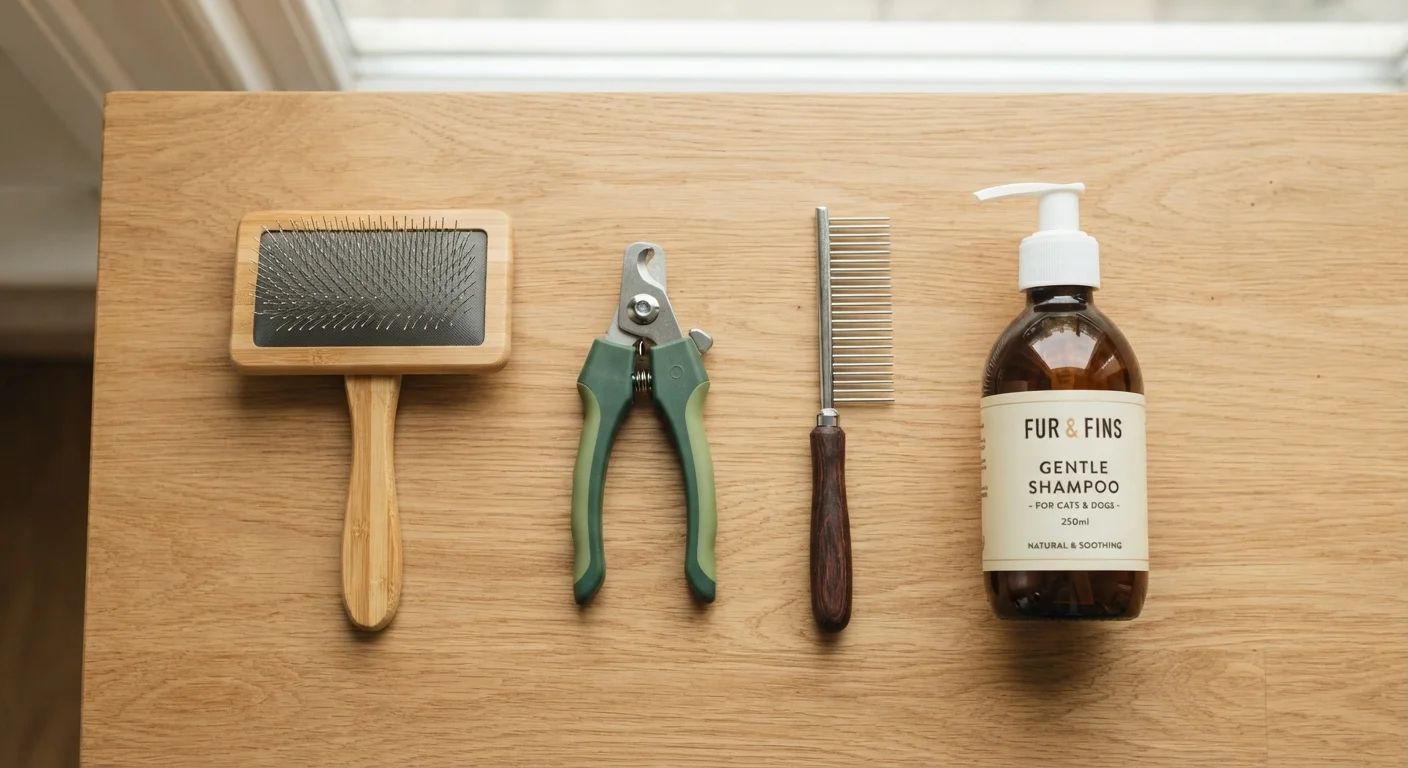
Slicker Brush
Removes loose fur, light tangles, and debris from most coat types; suits dogs and long-haired cats.
Fine-Tooth Metal Comb
Detects hidden mats and checks coat condition after brushing; especially useful for medium and long coats.
Nail Trimmers (species-appropriate)
Maintains nail length between professional visits; choose guillotine or scissor style based on pet size.
Pet-Safe Shampoo
Formulated for the correct pH of your species; human shampoo disrupts skin barrier in dogs and cats.
Rubber Curry Brush or Grooming Mitt
Ideal for short-coated animals; stimulates circulation and lifts surface shedding without a hard-bristle brush.
Dematting Comb
Safely works through dense mats in long or double coats where a slicker brush alone is insufficient.
Styptic Powder
Stops minor bleeding quickly if a nail is trimmed too short; a small amount lasts a long time.
Building Your Core Kit: Tools That Earn Their Keep
A sensible home grooming kit centers on tools that serve multiple coat types or daily routines, rather than specialty items used once a season. The goal is coverage without redundancy.
What you will need
Identify your pet's coat category
Group your pet into one of five coat categories: short/smooth, medium, long, double (dense undercoat plus topcoat), or curly/wire. This single decision filters out roughly half the grooming tools marketed to you. A rubber curry mitt is ideal for a Labrador; a slicker brush and metal comb are the workhorses for a Golden Retriever or Maine Coon.
Select a brush matched to that coat type
For short or smooth coats, a rubber curry brush or grooming mitt is sufficient and doubles as a massage tool. For medium, long, or double coats, start with a slicker brush as the primary tool. Curly or wire coats often need a pin brush with wider spacing to avoid breakage. Avoid buying more than one brush style initially - test the primary tool across several sessions before adding anything.
Add a metal comb as your second tool
A fine-to-medium metal comb is the most versatile single item in any grooming kit and often the most overlooked. Run it through the coat after brushing to confirm no mats remain near the skin. For short-coated pets, a comb may serve as the only coat tool needed, making the brush optional.
Choose nail trimmers sized for your pet
Nail trimmers are non-negotiable for most dogs and cats. Guillotine-style trimmers work well for small-to-medium nails; scissor-style handles larger breeds more reliably. Always have styptic powder accessible before you begin trimming. If your pet's nails are dark and the quick (the blood vessel inside) is not visible, trim small increments only - or ask a vet or groomer to demonstrate safe technique first.
Select a single pet-safe shampoo appropriate for your species
Dogs and cats have different skin pH ranges, and human shampoo - including baby shampoo - can disrupt their skin barrier over time. Choose a shampoo labeled for your specific animal and, if your pet has a known skin condition, consult your veterinarian before selecting a formulation. One bottle of a general-purpose, species-correct shampoo handles the vast majority of baths; medicated or specialty shampoos are only needed when a vet recommends them.
Evaluate specialty tools only after using the core kit
After four to six weeks of regular grooming with your core kit, you'll have a clear picture of what's missing. Double-coated dogs that shed heavily in spring may genuinely benefit from a deshedding undercoat rake during that window. Long-coated pets prone to matting may need a dematting comb added to the kit. Add tools in response to observed need, not preemptive worry - this is where most overspending happens.
What to Skip - and When to Hire a Professional
Certain tools appear in starter kit bundles but rarely justify the shelf space. Electric clippers are one example: unless your pet has a coat that requires regular trimming (like a Bichon or a Doodle mix), a quality pair of grooming scissors handles the occasional tidy-up at far lower cost. Similarly, mechanical deshedding tools are genuinely useful for double-coated breeds during seasonal blows - but redundant for short or single-coated pets.
Professional grooming remains worth budgeting for at strategic intervals, particularly for breed-specific cuts, ear plucking (where appropriate), or deep de-matting that's beyond home handling. Incorporating those sessions into your overall pet care budget makes sense. The preventive care savings guide explains how routine maintenance - including grooming - can head off more expensive health issues down the line.
Frequency Cuts Long-Term Costs
Regular short grooming sessions - even five to ten minutes every few days - prevent the mat buildup and nail overgrowth that make professional visits more expensive and time-consuming. Consistency with a simple kit outperforms an elaborate kit used infrequently. This principle applies broadly across pet care spending, as outlined in the preventive care savings guide.
Before committing to any tool purchase, run through a compatibility check. The pre-purchase checklist covers safety, life-stage fit, and durability - all relevant when evaluating grooming gear that needs to last.