

Key Takeaways
Start here
Start With the Owner's Manual
Next
The Core Services Every Driver Needs to Know
Then
Building a Simple Maintenance Schedule
Apply it
Budgeting for Maintenance Costs
Complete the picture
Finding Reliable Help and Tracking Your Service History
Start With the Owner's Manual
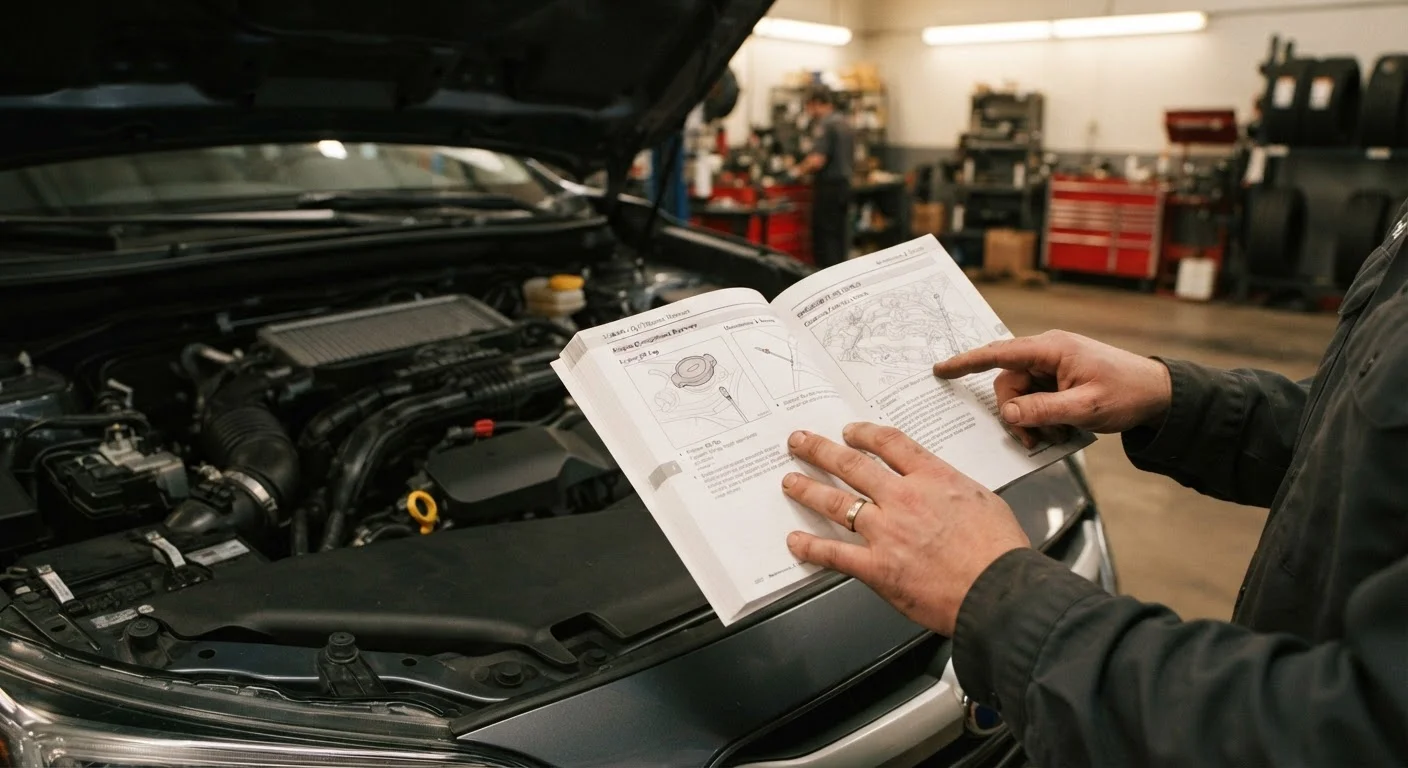
Before searching online or asking a friend, open the glove box. Your vehicle's owner's manual contains the manufacturer's exact service schedule - intervals calibrated for that engine, transmission, and drivetrain. Generic advice is a starting point; the manual is the authority.
The manual lists scheduled maintenance by mileage or time, whichever comes first. It also defines severe-duty driving conditions - frequent short trips, extreme temperatures, towing, or stop-and-go traffic - which typically require more frequent service than the standard schedule. If your commute involves any of these patterns, your service clock runs faster.
Service interval
The recommended mileage or time period between a specific maintenance task, as set by the vehicle manufacturer in the owner's manual.
Severe-duty conditions
Driving patterns - such as frequent short trips, towing, or extreme climates - that accelerate component wear and require more frequent service than the standard schedule.
Preventive maintenance
Scheduled upkeep performed before a component fails, designed to extend vehicle life and avoid larger, more costly repairs down the road.
OBD-II / check engine light
The onboard diagnostics system that monitors engine and emissions performance. When a fault is detected, the check engine light illuminates as an alert to the driver.
ASE certification
A credential issued by the National Institute for Automotive Service Excellence indicating that a technician has passed standardized competency tests in specific automotive repair areas.
Fluid flush
A service that drains old, degraded fluid from a vehicle system - such as the cooling or braking system - and replaces it with fresh fluid to restore protective properties.
If you acquired a used vehicle, cross-reference the ownership options guide to understand what service records you should have received at purchase. Missing records mean you may need to start certain service intervals from scratch to be safe.
The Core Services Every Driver Needs to Know
Maintenance tasks fall into two categories: high-frequency items you'll deal with every year, and longer-interval items that surface every few years. Prioritizing the first category prevents the second from becoming catastrophic.
High-Frequency Tasks
- Engine oil and filter: The most critical routine service. Frequency depends on oil type and engine design - check the manual.
- Tire pressure and rotation: Under-inflated tires wear unevenly and reduce fuel economy. Rotation every 5,000-7,500 miles extends tire life significantly.
- Fluid checks: Coolant, brake fluid, power steering fluid, and transmission fluid each have inspection intervals. Low or degraded fluid is an early warning sign.
- Air filter: A clogged engine air filter reduces efficiency. Cabin air filters affect HVAC performance and are inexpensive to replace.
- Wiper blades: Visibility is a safety issue; replace blades annually or when streaking appears.
Longer-Interval Services
- Brake inspection: Pads and rotors wear gradually; most manufacturers recommend inspection every 12,000-15,000 miles, though driving style affects actual wear rates.
- Coolant flush: Typically every 30,000-50,000 miles depending on coolant type.
- Spark plugs: Modern iridium plugs can last 60,000-100,000 miles; copper plugs need replacement more frequently.
- Transmission service: Often overlooked - consult the manual for your specific interval.
For a structured seasonal approach to these checks, the seasonal car checks guide offers a useful companion framework.
Building a Simple Maintenance Schedule
A written schedule removes the guesswork. Use your odometer reading at the time of purchase as the baseline, then map out the next 12 months of expected services using the manual's mileage intervals and your average monthly mileage.
Use Your Mileage to Set Reminders
Check your current odometer, then calculate how many miles you drive per month on average. Divide each service interval by that number to get an approximate month count, and set a phone or calendar reminder. This takes about ten minutes and eliminates the most common reason drivers miss scheduled service: simply forgetting.
Most drivers cover 12,000-15,000 miles per year, or roughly 1,000-1,250 miles per month. Divide your manual's mileage intervals by your monthly average to get an approximate number of months between each service. Add a calendar reminder one month before each is due.
When intervals conflict - for example, the manual says "every 7,500 miles or 12 months" - always act on whichever threshold arrives first. Time-based degradation happens even in low-mileage vehicles: brake fluid absorbs moisture and coolant loses its protective additives regardless of miles driven.
The maintenance schedules decoded guide explores how to reconcile manufacturer recommendations with mechanic advice when the two diverge - a common source of confusion for new owners.
Budgeting for Maintenance Costs
AAA's annual cost-of-ownership research consistently places maintenance among the more predictable vehicle expenses - predictable because it follows known intervals. That predictability is an advantage: unlike an unexpected repair, scheduled maintenance can be budgeted in advance.
A reasonable starting estimate for routine maintenance on a typical passenger sedan is $100-$150 per month, though actual figures vary considerably by vehicle age, make, and how much of the work you can do yourself. Older vehicles with higher mileage tend to require more frequent attention and may encounter unscheduled repairs alongside routine service.
To understand how maintenance fits within the full picture of what you'll spend, see hidden first-year ownership expenses and the broader lifetime cost management guide. Both are relevant to building a realistic multi-year ownership budget.
For general money management principles that complement a maintenance fund, personal finance for beginners covers how to structure savings for irregular but predictable expenses.
Finding Reliable Help and Tracking Your Service History
Not every maintenance task is suited to a first-time owner working in a driveway - and attempting work beyond your skill level on safety-critical systems (brakes, steering, suspension) creates real risk. Knowing your limits is part of good maintenance practice. When in doubt, have the work done by an ASE-certified technician.
Choosing a shop deserves care. The guide to finding a trustworthy mechanic outlines what credentials, transparency, and communication to look for before handing over your keys - particularly useful if you're evaluating a shop for the first time.
Equally important: keep a record of every service performed. A well-maintained log - whether a simple spreadsheet, a notes app, or a dedicated folder of paper receipts - documents that manufacturer intervals were followed, protects your warranty claims, and provides evidence of care when it's time to sell. The service history tracking guide explains how to build and maintain one efficiently.
Warranty and Independent Shops
Federal law (the Magnuson-Moss Warranty Act) generally prohibits manufacturers from voiding a vehicle warranty solely because you used an independent repair shop rather than a dealership - provided the work meets manufacturer specifications and is documented. Keep all receipts and service records as proof. If your vehicle is under warranty, verify the specific terms with your manufacturer's documentation.
This article is for general informational purposes only and does not constitute professional mechanical or financial advice. Consult a qualified mechanic for vehicle-specific service decisions and a licensed financial professional for personal budgeting guidance.