

Key Takeaways
Our Verdict
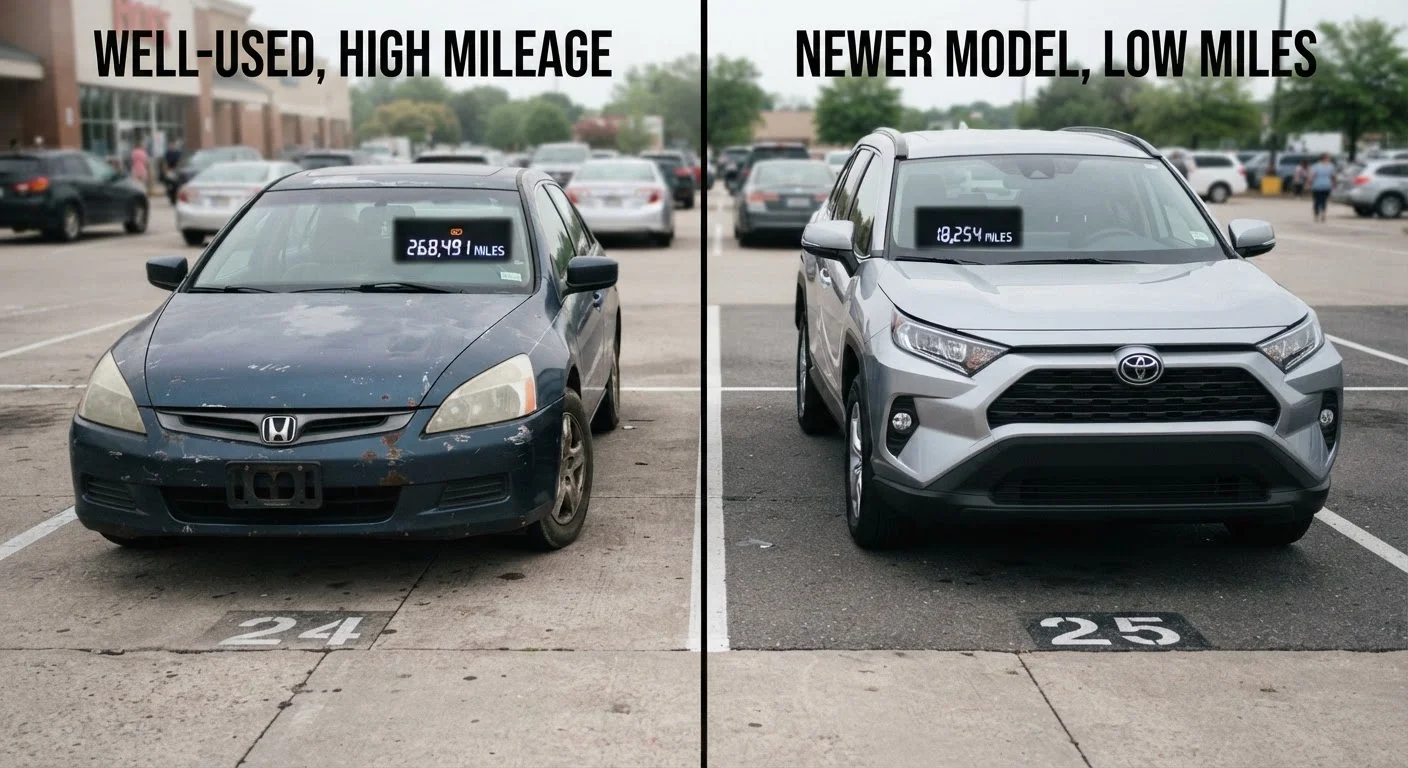
Neither option is universally cheaper - the economics depend heavily on the specific vehicle, your driving volume, and how you weigh predictability against upfront savings. High-mileage vehicles can be cost-effective if they have a strong maintenance history and you carry adequate reserves for repairs. Newer models justify their higher price when depreciation is managed, financing rates are favorable, and reliability matters more than low initial outlay.
| Best for | Recommended |
|---|---|
| Drivers who want minimal monthly exposure and can absorb occasional repair costs | Older high-mileage vehicle |
| Those who prioritize warranty coverage, fuel efficiency, and predictable expenses | Newer model |
| High-mileage commuters where reliability and fuel costs are primary concerns | Newer model |
| Budget-constrained buyers with mechanical knowledge or trusted repair access | Older high-mileage vehicle |
Why the Purchase Price Is Only the Starting Point
Most drivers anchor their vehicle decision on what they pay at signing. But purchase price captures only one slice of total cost of ownership. The AAA framework for calculating vehicle costs includes depreciation, financing, insurance, fuel, maintenance, and repairs - and these ongoing expenses routinely dwarf the initial transaction. Understanding this is essential before comparing an older, high-mileage vehicle against a newer model. See also our overview of common ownership cost myths that cause drivers to consistently underestimate what they actually spend.
The practical question isn't "which car costs less to buy" - it's which vehicle costs less to operate over your expected ownership window, accounting for every line item.
The Real Cost Profile of a High-Mileage Older Vehicle
A vehicle with 100,000+ miles typically sells at a significant discount, which reduces or eliminates financing needs and sidesteps the steepest portion of the depreciation curve. For cash buyers especially, this means avoiding interest charges entirely - a genuine financial advantage covered in more depth in our article on owning a car outright.
However, older vehicles carry compounding risks that erode those savings:
- Repair unpredictability: Wear items - timing components, suspension parts, transmission seals - become failure candidates past certain mileage thresholds. A single major repair can cost $1,500-$4,000 and wipe out months of payment savings.
- Fuel economy degradation: Engine efficiency declines with age and wear. A vehicle averaging 22 mpg instead of 28 mpg costs roughly $500-$700 more annually at typical US driving distances and fuel prices.
- Insurance quirks: Comprehensive and collision coverage on a low-value vehicle may cost nearly as much as on a newer one, reducing the net insurance savings many buyers expect.
- No powertrain warranty: Out-of-pocket exposure on all mechanical failures is total. Budgeting a dedicated repair reserve - commonly suggested at $100-$150 per month - is prudent but often overlooked.
Always Get a Pre-Purchase Inspection
A pre-purchase inspection by an independent mechanic (typically $100-$150) is one of the highest-return investments you can make before buying any high-mileage vehicle. It surfaces costly problems before they become your responsibility and gives you negotiating leverage if issues are found. Never skip this step based on a seller's assurances or a clean visual appearance.
A pre-purchase inspection by an independent mechanic (typically $100-$150) is one of the highest-return investments you can make before buying any high-mileage vehicle. It surfaces costly problems before they become your problem.
The Real Cost Profile of a Newer Vehicle
Newer models carry substantially higher purchase prices and, for most buyers, monthly financing obligations. These payments represent a fixed cash outflow that persists regardless of how much the vehicle is used - a structural cost difference that deserves serious weight. Short-term affordability and long-term value often pull in opposite directions in this scenario.
On the other side of the ledger, newer vehicles offer:
- Depreciation front-loading: New vehicles lose roughly 20-30% of value in the first year and roughly 50% within three years, according to commonly cited industry data. Buying a vehicle that is two to four years old shifts this curve significantly in the buyer's favor.
- Manufacturer warranty: Powertrain coverage of 5 years/60,000 miles is standard across most brands, with some extending to 10 years/100,000 miles. This coverage functions as a form of repair insurance with real economic value.
- Fuel efficiency gains: Regulatory-driven improvements in fuel economy have been meaningful over the past decade. Choosing a vehicle that is six to eight years newer can translate to measurable annual fuel savings.
- Lower financing rates: Certified pre-owned and new vehicles regularly qualify for manufacturer-supported financing rates that are unavailable on older inventory.
For drivers putting on high annual mileage, these advantages compound. Managing costs across a vehicle's full life is easier when the vehicle starts from a lower mechanical-risk baseline.
Side-by-Side: Where Each Option Wins and Loses
The table below summarizes how the two ownership profiles typically compare across key cost dimensions. Individual results vary by make, model, condition, and usage pattern.
| Cost Factor | Older High-Mileage Vehicle | Newer Model (2-4 Years Old) | |
|---|---|---|---|
| Purchase price | Significantly lower | Moderate to high | |
| Financing interest cost | Often none (cash purchase) | Meaningful over loan term | |
| Depreciation exposure | Minimal - curve already steep | Moderate - past steepest drop | |
| Repair unpredictability | High - major failures more likely | Low to moderate | |
| Warranty coverage | None typically | Remaining factory or CPO warranty | |
| Fuel economy | Often lower due to age/wear | Generally higher | |
| Insurance cost | Liability savings; comp/collision similar | Higher premiums overall | |
| Long-term cost predictability | Low - repair variance is wide | Higher - known schedule costs |
As illustrated, neither option dominates across all dimensions. The older vehicle wins on initial outlay and depreciation exposure; the newer model wins on reliability predictability, warranty protection, and often fuel cost. This is also the core tension explored in our piece on why cheap-to-buy cars can be expensive to own.
How to Run the Numbers for Your Situation
Rather than relying on general rules, build a simple 36- or 60-month cost model for each option being considered. Include:
- Total acquisition cost (purchase price + taxes + fees + financing interest)
- Estimated depreciation (use historical resale value data for the specific model)
- Insurance premium difference (get actual quotes for both vehicles before deciding)
- Fuel cost difference (annual miles ÷ mpg × average fuel price)
- Maintenance and anticipated repairs (OEM service schedules plus a repair reserve for the older vehicle)
Divide the total 60-month cost by 60 to get a true monthly cost of ownership - a much more honest number than the monthly payment on a loan. For readers thinking through the broader buy-versus-finance decision, the buying vs. leasing hub provides useful framing. Exploring maintenance savings strategies can also reduce ongoing costs regardless of which vehicle you choose.
This article is for general informational and educational purposes only and does not constitute personalized financial or automotive advice. Consult a qualified mechanic and, where relevant, a licensed financial professional before making vehicle purchase decisions.