

Key Takeaways
Our Verdict
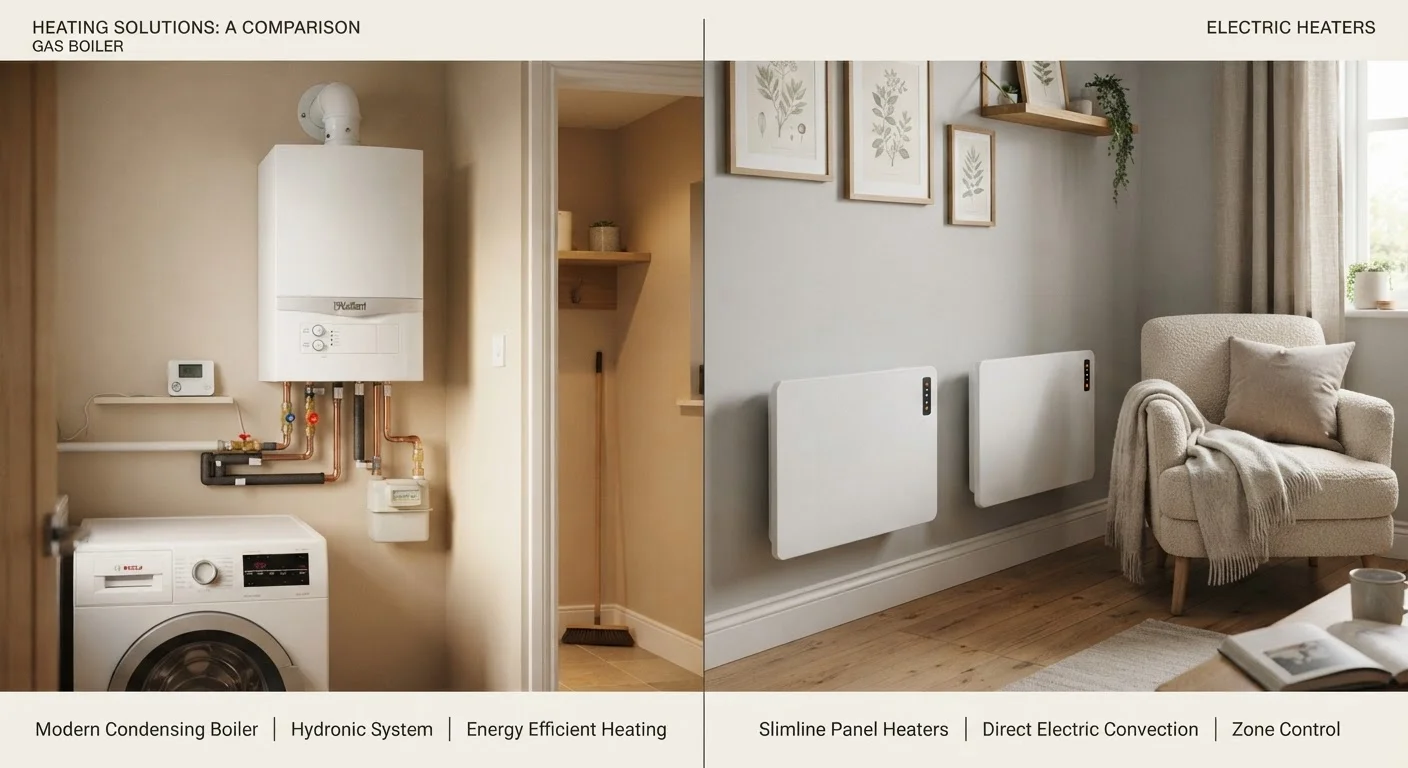
Gas central heating generally offers lower running costs where natural gas supply is available and winters are long or cold. Electric heating wins on simplicity, lower upfront cost, and flexibility for smaller or well-insulated homes. Neither system is universally superior - your local energy prices and home characteristics are the deciding factors.
| Best for | Recommended |
|---|---|
| Homes in cold climates with existing gas infrastructure | Gas Central Heating |
| Smaller homes, apartments, or mild-climate regions | Electric Heating |
| Homeowners prioritizing low installation and maintenance costs | Electric Heating |
| Households focused on long-term energy efficiency and decarbonization | Electric Heating with Heat Pump |
How the Costs Actually Stack Up
The core issue is simple: electricity costs more per unit of energy (measured in BTUs or therms) than natural gas in most US regions. According to the US Energy Information Administration, residential natural gas typically costs roughly one-third to one-half the price of electricity on an equivalent energy basis. For a high-demand household running heat through a cold Midwestern winter, that gap translates to hundreds of dollars annually.
That said, the raw fuel price is only part of the equation. Gas furnaces and boilers lose some energy through combustion and flue exhaust. A standard gas furnace operates at around 80% efficiency (AFUE - Annual Fuel Utilization Efficiency), meaning 20 cents of every dollar burned goes out the flue. High-efficiency condensing furnaces reach 95-98% AFUE, substantially closing the gap. Electric resistance heaters, by contrast, convert virtually 100% of electricity into heat - there's no combustion loss. So while electricity costs more per BTU, you're using all of it.
To understand your bill in full detail, see what each line item on your energy bill means.
| Gas Central Heating | Electric Resistance Heating | Electric Heat Pump | |
|---|---|---|---|
| Typical fuel cost per BTU | Lower (gas is cheaper per unit) | Higher (electricity costs more) | Moderate (high efficiency offsets cost) |
| System efficiency | 80-98% AFUE depending on model | ~100% (no combustion loss) | 200-400% COP in suitable climates |
| Installation complexity | High - boiler, flue, gas line needed | Low - no ductwork or gas line | Moderate - outdoor unit, refrigerant lines |
| Annual maintenance | Required - licensed technician annually | Minimal - few moving parts | Annual check recommended |
| Safety considerations | CO risk; detector required | No combustion risk | No combustion risk |
| Best climate fit | Cold climates, long winters | Mild climates, small spaces | Moderate climates (above ~25°F) |
| Typical upfront cost | Higher - system plus infrastructure | Lower - simpler installation | Higher - equipment and install |
Installation, Maintenance, and Hidden Costs
Gas central heating requires a boiler or furnace, distribution system (ductwork or radiators), a flue or chimney, and a gas line. If your home lacks gas supply, connecting to the utility grid can cost several thousand dollars before the system itself is purchased. Annual servicing by a licensed technician is generally recommended - and in many jurisdictions, legally required - adding $100-$200 or more per year to your operating costs. Carbon monoxide detectors are essential safety equipment with any gas appliance.
Electric heating - whether baseboard heaters, wall units, or radiant panels - typically requires no ductwork, no gas line, and no flue. Installation costs are lower and the systems contain fewer moving parts, meaning less to maintain or repair over time. The trade-off is that electrical panel upgrades may be needed in older homes.
Gas Appliances Require Carbon Monoxide Detectors
Any home with gas heating must have working carbon monoxide detectors installed on every floor. CO is odorless and colorless, and faulty or poorly maintained gas appliances are a recognized hazard. Annual professional servicing of gas boilers and furnaces is strongly recommended and may be required by local code. Never operate a gas heating system without adequate ventilation.
Heat pumps are a separate category worth noting. They use electricity but move heat rather than generate it, achieving efficiencies of 200-400% (expressed as a Coefficient of Performance). In moderate climates, a heat pump can make electric heating cost-competitive with gas. The full trade-off analysis for heat pumps covers their suitability in detail.
What Actually Drives Your Bill Day to Day
Fuel type is important, but behavior and insulation often matter more than the system itself. A drafty house hemorrhages heat regardless of whether it came from gas or electricity. Sealing air leaks, adding attic insulation, and installing weatherstripping are measures that reduce costs for both systems. For a practical rundown, see low-cost changes that genuinely reduce heating bills.
Thermostat control also has an outsized effect. Dropping your thermostat 7-10°F for 8 hours daily can reduce heating costs meaningfully. Both gas and electric systems benefit equally from smart scheduling - something explored in our comparison of smart vs. programmable thermostats.
Hot water heating is a separate but related cost. Many gas central heating systems also heat domestic water, which can make the economics more favorable for gas households. See how to cut hot water costs without sacrificing comfort for targeted strategies. And before assuming your current habits are efficient, check our breakdown of energy-saving myths homeowners still believe.
Making the Decision for Your Home
Several practical questions clarify which direction makes sense:
- Does your home already have gas infrastructure? If yes, switching away involves real cost. If no, adding it involves real cost.
- What are your local utility rates? In states where electricity is unusually affordable (parts of the Pacific Northwest, for example), the cost gap with gas narrows considerably.
- How cold are your winters? Longer, colder heating seasons amplify the per-unit cost difference. In mild climates, the annual savings from gas over electric resistance can be modest.
- How well insulated is your home? A well-sealed, insulated home loses heat slowly - shrinking the total demand and making even a slightly less efficient system viable.
- Are you planning major renovations? Switching systems mid-renovation is far less disruptive and expensive than doing it standalone.
Neither system is the automatic choice. Run the numbers using your actual local rates, factor in realistic installation and maintenance costs, and weigh those against your heating demand. That calculation - not a rule of thumb - produces the honest answer for your household.