

Key Takeaways
Option A
Smart Thermostat
The adaptive, connected option for hands-off energy management.
Best for: Households with unpredictable schedules who want automated, real-time adjustments without manual programming.
Option B
Programmable Thermostat
The straightforward, set-it-and-forget-it scheduling tool.
Best for: Households with consistent daily routines who want simple, reliable temperature scheduling at a lower upfront cost.
If your household runs on a consistent daily schedule
Programmable Thermostat
A well-programmed schedule thermostat performs nearly as well as a smart model at a fraction of the cost. Consistent routines remove the main advantage smart thermostats offer.
If your schedule varies week to week or you travel frequently
Smart Thermostat
Automatic occupancy detection and remote control via smartphone prevent unnecessary heating or cooling when your schedule changes unexpectedly.
If minimising upfront spend is your priority
Programmable Thermostat
Programmable models are widely available at a lower price point and can deliver meaningful savings when set up correctly and used consistently.
If you want energy usage reports and integration with other home systems
Smart Thermostat
Built-in energy dashboards and compatibility with voice assistants or smart home hubs provide visibility and automation that programmable models cannot match.
How Each Thermostat Actually Works
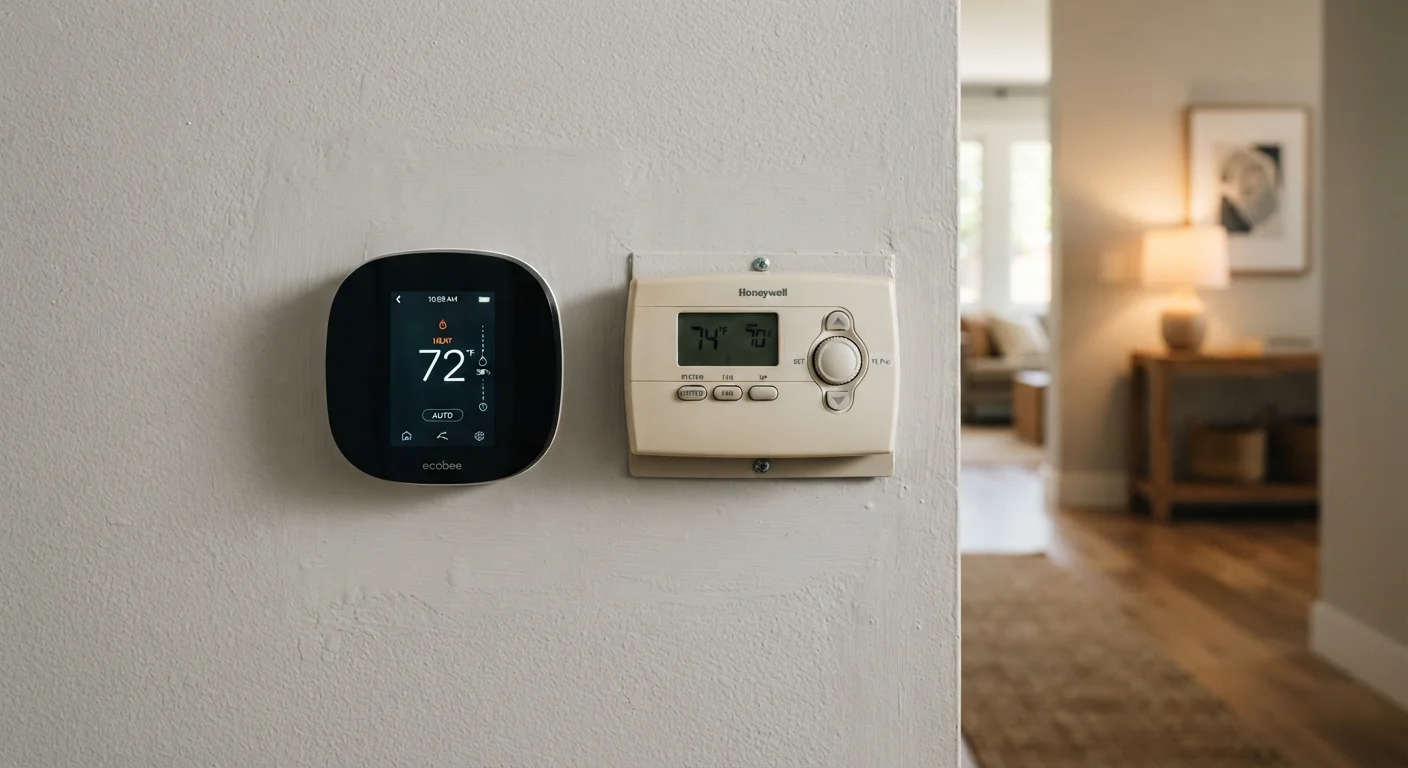
A programmable thermostat lets you set a fixed temperature schedule - for example, lowering heat at 8 a.m. when everyone leaves and raising it at 5 p.m. before people return. Once programmed, it follows that schedule every day unless you manually override it. The logic is simple and reliable, but it assumes your life follows a predictable pattern.
A smart thermostat goes further by using sensors, Wi-Fi connectivity, and - in many models - machine learning to adapt to your actual behaviour. It can detect when the house is empty, respond to your location via a smartphone, and adjust settings in real time. Some models also factor in local weather data to anticipate heating or cooling demand. The result is a system that, in theory, wastes less energy by never conditioning an empty home.
For context on where thermostat control fits within the broader picture of home energy use, see our guide to low-cost heating bill reductions.
| Criterion | Smart Thermostat | Programmable Thermostat |
|---|---|---|
| Typical upfront cost | $100-$250+ | $20-$80 |
| Schedule adjustment | Automatic and adaptive | Manual, user-defined |
| Remote control | Yes, via smartphone app | No |
| Occupancy detection | Yes (most models) | No |
| Energy usage reports | Yes, built-in dashboard | No |
| Utility rebate eligibility | Often eligible | Rarely eligible |
| DIY installation complexity | Moderate (compatibility checks needed) | Low (standard systems) |
| Best-case annual savings potential | Up to ~10-12% on HVAC costs | Up to ~10% on HVAC costs |
What the Savings Evidence Actually Shows
The US Department of Energy has long noted that turning your thermostat back 7-10°F for eight hours a day can reduce heating and cooling costs by around 10% annually. Both thermostat types can achieve this - the difference is in how reliably they do so.
Studies and utility data consistently show that programmable thermostats underperform their potential because many households never fully program them, override them constantly, or set them to hold a single temperature around the clock. Smart thermostats remove some of that friction through automation, which tends to improve real-world performance over simply owning a programmable model.
~10%
Potential annual HVAC savings from setback scheduling
The US Department of Energy estimates this savings range when thermostat temperature is reduced by 7-10°F for 8 hours per day.
~50%
Programmable thermostat owners who never use full programming
Industry surveys and utility studies have consistently found that a significant share of programmable thermostat owners rely on manual override or a single set-point instead of a schedule.
$131-$145
Reported average annual savings with smart thermostat use
Independent studies commissioned by major smart thermostat manufacturers suggest this range, though real-world results vary considerably by home, climate, and prior thermostat behaviour.
That said, a household that programs a basic thermostat correctly and sticks to the schedule may see savings comparable to a smart model. The technology gap matters less than the behaviour gap. Many homeowners would also benefit from reviewing common energy-saving myths before assuming any thermostat upgrade will dramatically cut bills on its own.
Upfront Cost, Installation, and Compatibility
Programmable thermostats typically range from around $20 to $80 and are straightforward to install on most standard HVAC systems. Most homeowners comfortable with basic wiring can handle the swap themselves - though if you have any uncertainty about your system's wiring or if it involves high-voltage or multi-stage equipment, consulting a licensed HVAC technician is the safer route.
Smart thermostats generally start around $100-$150 and can run considerably higher for premium models with advanced features. Installation is still DIY-friendly for standard systems, but compatibility is a more meaningful concern: some older systems, multi-zone setups, or homes without a common (C-wire) require additional components or professional installation to work correctly.
One factor that can narrow the cost gap: many utility companies offer rebates for certified smart thermostat installations. The amounts and eligibility criteria vary by provider and region, so checking directly with your local utility before purchasing is worthwhile. This is consistent with the kind of household saving strategies that make upgrades more financially practical.
Note: Always verify compatibility with your specific HVAC system before purchasing any thermostat. If your system involves gas, high-voltage wiring, or complex multi-zone controls, have a licensed professional assess the installation.
Which Households Benefit Most From Each Option
The honest answer is that the right choice depends more on your household's habits than on the technology itself. Families with regular 9-to-5 schedules, consistent occupancy patterns, and the discipline to set up and maintain a program get strong value from a programmable thermostat without paying the smart-thermostat premium.
Households with variable schedules - shift workers, frequent travellers, or those working from home on irregular hours - tend to see more tangible benefit from a smart model's ability to adapt automatically. Remote control via smartphone also means you can adjust the home's temperature before arriving back unexpectedly, preventing the common habit of cranking the heat up to recover quickly (which doesn't actually warm a home faster but does cost more).
It's also worth remembering that neither thermostat type compensates for underlying heat loss. Poor loft or wall insulation, draughty doors and windows, or an aging boiler will limit savings regardless of which thermostat you choose. For perspective on those trade-offs, see our comparison of loft and cavity wall insulation. Similarly, if your heating system itself is a significant cost driver, the differences between electric and gas central heating are worth understanding before focusing on thermostat upgrades.
Don't Overlook the Human Factor
Research repeatedly shows that the largest variable in thermostat savings is not the device itself but how consistently it is used. A smart thermostat ignored or constantly overridden delivers little more than a manual model. Before upgrading, consider whether your household will actually engage with the features - if not, a correctly programmed basic model may serve you better at lower cost.