

Key Takeaways
Option A
Loft Insulation
The high-impact, low-barrier starting point for most homes.
Best for: Homeowners with an accessible, uninsulated or under-insulated loft who want the fastest return on investment.
Option B
Cavity Wall Insulation
A permanent, invisible upgrade for eligible cavity-walled homes.
Best for: Owners of post-1920s homes with unfilled cavity walls who want to significantly cut year-round heat loss through exterior walls.
If your loft is uninsulated or has less than 100mm of existing material
Loft Insulation
It delivers the largest immediate reduction in heat loss per dollar spent, with installation often achievable in a single day.
If your home was built between the 1920s and 1990s and has unfilled cavity walls
Cavity Wall Insulation
Walls are responsible for a larger share of total heat loss than the loft, and cavity fill lasts decades with virtually no maintenance.
If you're working with a tight budget and want the lowest upfront cost
Loft Insulation
Loft insulation generally costs considerably less to install than cavity wall work, making it the more accessible first step.
If your loft is already adequately insulated and bills remain high
Cavity Wall Insulation
Once the loft is dealt with, walls become the dominant heat-loss pathway - cavity fill addresses that directly.
If you want to maximise long-term energy savings and your home qualifies for both
Loft Insulation
Start with loft insulation for the fastest payback, then add cavity wall insulation - the two measures compound each other's benefit.
What Each Measure Actually Does
Both loft insulation and cavity wall insulation reduce the rate at which your home loses heat - but they target different parts of the building envelope and use different installation methods.
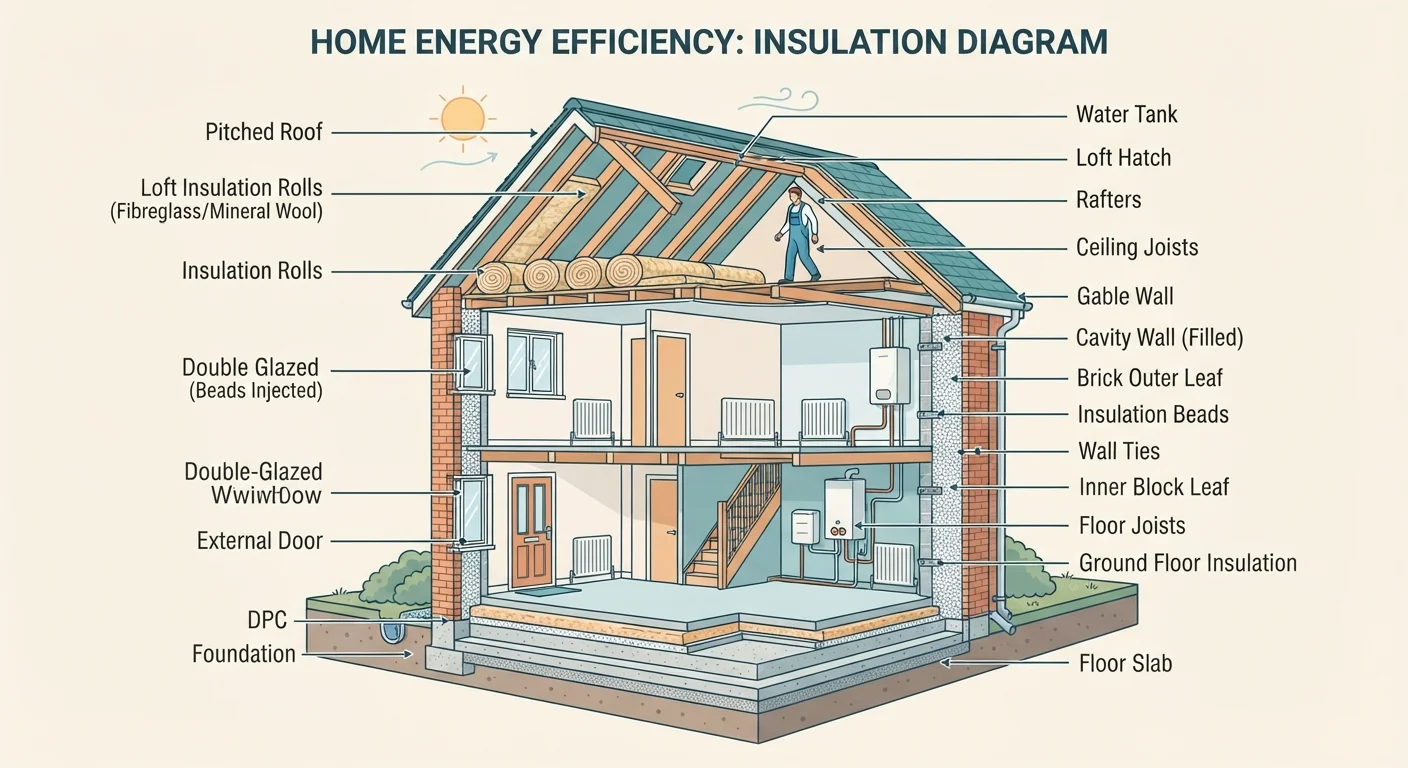
Loft insulation is typically mineral wool (glass or rock fibre) laid between and over the joists of an accessible loft floor, or sprayed/blown into a flat or sloped roof space. It works by trapping air within its fibres, slowing heat transfer from the warm rooms below into the cold loft. Most guidance recommends a total depth of around 270mm for new installations.
Cavity wall insulation involves filling the gap - the cavity - between the inner and outer leaf of a double-skin wall. An installer drills small holes in the exterior brickwork, injects insulating material (commonly mineral wool, polystyrene beads, or foamed polyurethane), then seals the holes. The fill prevents convection currents inside the cavity that would otherwise carry heat outward.
Neither installation involves major disruption to your living space. Loft insulation is a straightforward DIY project for accessible lofts with no complex roof structures; cavity wall installation must always be carried out by a registered professional using appropriate equipment. For homes where draughts are also a concern, see our guide to sealing air leaks - insulation and draught-sealing work best together.
| Criterion | Loft Insulation | Cavity Wall Insulation |
|---|---|---|
| Typical installation cost (professional) | Lower - often under $600 for standard loft | Moderate - generally $400-$1,500+ depending on size |
| DIY possible? | Yes, for accessible lofts | No - requires registered installer |
| Share of heat loss addressed | ~25% of whole-house heat loss | ~35% of whole-house heat loss |
| Suitable for all homes? | Most pitched-roof homes | Cavity-walled homes only (post-1920s) |
| Lifespan | 40+ years with minimal maintenance | 25+ years; some materials degrade faster |
| Disruption during installation | Low - loft access only | Low - exterior drilling, no internal disruption |
| Risk of complications | Low if loft is dry and accessible | Moisture risk in high-exposure locations |
Heat Loss, Savings, and Payback: A Realistic Look
Understanding the relative impact of each measure requires knowing where heat actually escapes. General estimates from energy bodies suggest uninsulated walls account for roughly 35% of a typical home's heat loss, while an uninsulated loft accounts for around 25%. On that basis, cavity wall insulation addresses a larger share of total loss - but that doesn't automatically make it the better first move for every household.
~35%
Heat lost through uninsulated walls
General estimates from UK energy efficiency bodies suggest walls are the single largest source of heat loss in an uninsulated home.
~25%
Heat lost through an uninsulated loft
The Energy Saving Trust has historically cited this figure as a benchmark for homes with no loft insulation at all.
270mm
Recommended loft insulation depth
Current UK guidance recommends a total depth of approximately 270mm of mineral wool for new loft insulation installations.
The practical saving depends on your starting point. A home with no loft insulation at all will see a dramatic reduction in bills after installation. A home that already has 100mm of loft insulation will see only a modest improvement from topping up. Similarly, cavity wall insulation has zero benefit in a solid-walled house (typically pre-1920s construction) because there's no cavity to fill.
Payback period - the time it takes for energy savings to recover the installation cost - tends to favour loft insulation. The combination of lower installation cost and meaningful savings means many households see payback within a few years for loft work. Cavity wall installation costs more, but the savings are also larger on an annual basis, so payback periods are broadly comparable over a longer horizon.
If you're also considering heating controls, comparing smart and programmable thermostats is a useful next step - insulation and better heating control compound each other's effect.
Suitability: Is Your Home a Candidate?
This is the most important question before committing to either measure, because neither works universally.
Loft Insulation Eligibility
Most homes with a pitched roof and an accessible loft can accept mineral wool insulation. Exceptions include rooms in the roof (where different, more complex insulation methods apply), very shallow pitches that prevent access, or lofts used as habitable space. If your loft is used for storage, insulation can still be installed between and over the joists, though boarding over the top requires careful planning to avoid compressing the insulation.
Cavity Wall Insulation Eligibility
Cavity walls became standard in UK construction from roughly the 1920s onward. If your home has solid brick walls - common in Victorian and Edwardian properties - cavity fill isn't applicable, and you'd need to consider internal or external solid wall insulation instead (a more complex and expensive undertaking). Even among cavity-walled homes, some are unsuitable: properties in high-exposure wind-driven rain zones may face moisture penetration risk if cavities are filled with certain materials. A professional survey is essential to assess exposure rating and cavity condition before installation.
For renters, neither measure is typically within your control - energy efficiency options for renters covers what you can realistically do without landlord involvement.
This article provides general educational information about home insulation. Costs, savings, and suitability vary significantly by property. Always obtain a professional survey and, where applicable, verify local permit or building regulations requirements before proceeding with any insulation work.