

| Format origin | Capsule hotel concept launched in Osaka, Japan, 1979 |
| Typical capsule dimensions | Approximately 6.5 ft long × 3.5 ft wide × 3.5 ft high |
| Occupancy | Single occupancy only (most capsule and pod formats) |
| Bathroom facilities | Shared in capsule/pod formats; often private in micro-rooms |
| Strongest market concentration | Japan, South Korea, Singapore; growing in EU and US airport hubs |
| Luggage storage | Locker-based; typically sized for carry-on or small bag |
What Capsule Hotels, Pod Stays, and Micro-Rooms Actually Are
These three formats all share one defining characteristic: they maximize sleep quality while minimizing physical footprint. Despite surface similarities, they differ meaningfully in design, privacy level, and typical price point.
Capsule hotel
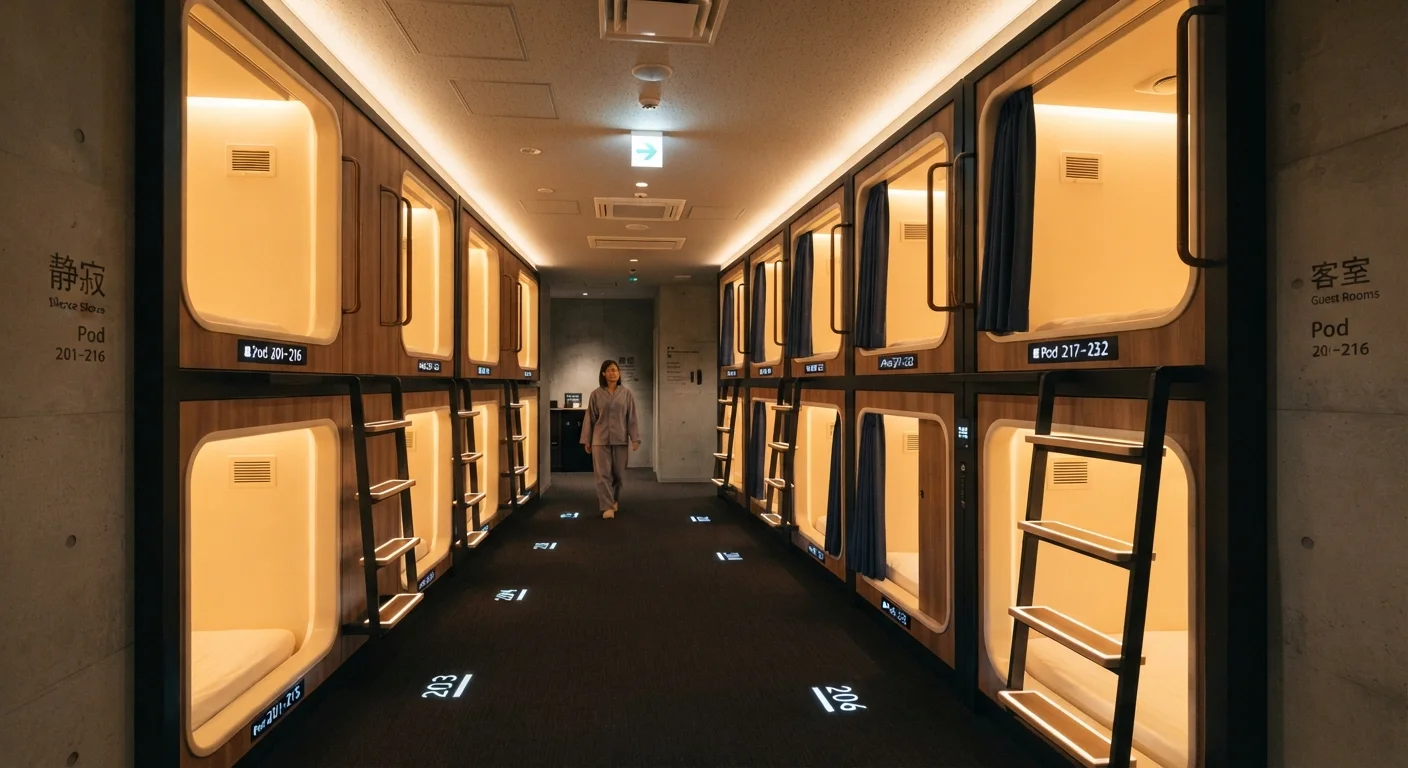
A lodging format originating in Japan that provides individual enclosed sleeping compartments arranged in rows, with shared bathroom and communal facilities. Compartments are compact but typically include bedding, lighting, and ventilation.
Pod stay
A Western adaptation of the capsule concept, featuring individual sleeping pods that may be larger and more enclosed than traditional capsules. Often found in airports, urban hubs, and co-working-adjacent hospitality spaces.
Micro-room
A fully enclosed private hotel room engineered to minimize square footage — sometimes under 100 sq ft — using fold-away furniture and built-in storage. Guests have a locking door and typically private or semi-private bathroom access.
Per-berth pricing
A rate structure where guests pay for a single sleeping space rather than an entire room. Common in capsule hotels, pod properties, and dormitory-style hostels.
Day rate
A discounted rate offered for use of a sleeping space or room during daytime hours only, without an overnight stay. Frequently available at capsule hotels near airports or transit hubs.
A capsule hotel originated in Japan in the late 1970s and consists of individual sleeping compartments — typically around 6.5 ft × 3.5 ft — stacked in rows. Each capsule provides a mattress, controlled lighting, a ventilation system, and usually a small screen or shelf. Bathrooms and common areas are shared. A pod stay is a Western evolution of the capsule format: pods are generally larger, may include a curtain or door for added enclosure, and are increasingly integrated into co-working or lounge environments. Micro-rooms (sometimes called "smart rooms") are fully enclosed private rooms — you have four walls and a locking door — but the square footage is aggressively compressed, sometimes under 100 sq ft, with space engineered through fold-away furniture and vertical storage.
For a broader orientation to lodging categories, see types of budget accommodation worldwide for context on where these formats sit in the global spectrum.
Where These Formats Are Common and How Pricing Generally Works
| Format origin | Capsule hotel concept launched in Osaka, Japan, 1979 |
| Typical capsule dimensions | Approximately 6.5 ft long × 3.5 ft wide × 3.5 ft high |
| Occupancy | Single occupancy only (most capsule and pod formats) |
| Bathroom facilities | Shared in capsule/pod formats; often private in micro-rooms |
| Strongest market concentration | Japan, South Korea, Singapore; growing in EU and US airport hubs |
| Luggage storage | Locker-based; typically sized for carry-on or small bag |
Capsule hotels remain most concentrated in Japan — Tokyo, Osaka, and Kyoto each have hundreds of properties — but the format has spread to South Korea, Singapore, Hong Kong, and select European cities including Amsterdam, London, and Berlin. Pod-style accommodation has expanded most rapidly in US airport hubs (layover-focused properties) and tech-centric cities. Micro-rooms are a growing fixture in high-cost urban markets: New York, San Francisco, and Hong Kong, where land costs make conventional rooms economically impractical at budget price points.
Nightly rates vary significantly by city and property quality, but the general pattern holds: capsule and pod formats often undercut private hostel rooms in the same market, while micro-rooms typically sit between pod stays and standard budget hotel rooms. Rate structures are usually per-berth or per-room, and some capsule properties offer daytime or hourly rates aimed at transit travelers.
For a side-by-side comparison with more traditional lodging categories, what separates hostels, guesthouses, and budget hotels lays out those distinctions clearly.
Who These Formats Suit — and Where They Fall Short
~100 sq ft
Floor area of a typical micro-room
Some urban micro-room properties in high-cost cities like New York and Hong Kong offer rooms at or below this threshold, using convertible furniture to maximize usability.
1979
Year capsule hotels were introduced
The Capsule Inn Osaka is widely credited as the first purpose-built capsule hotel, establishing a format that has since expanded across Asia and into Western markets.
Single occupancy
Typical capsule capacity
The vast majority of capsule and pod formats accommodate one person per berth, making them structurally unsuitable for couples or families sharing a single unit.
These formats work particularly well for solo travelers with light luggage who prioritize location and sleep quality over living space. Transit travelers killing time between flights, commuters using daytime rates, and urban explorers who spend minimal time in their room are the natural audience. Capsule properties designed for business travelers often include lockers sized for carry-on bags, power strips, and reading lights — essentials covered without frills.
They suit less well for travelers carrying large luggage (locker space is finite), couples who want to share a sleep space (most capsules are single-occupancy), anyone sensitive to noise in shared sleeping halls, or travelers who need in-room workspace for extended periods. Light sleepers should check whether the pod format includes a full-panel door or only a curtain — the difference in sound and light blocking is significant.
Privacy expectations also differ by format. Micro-rooms offer the closest experience to a conventional hotel room; capsule formats require comfort with close-quarters communal living. If you're weighing a pod berth against a private room in a hostel, the trade-offs between dorm beds and private hostel rooms covers analogous considerations that apply here.
Travelers new to compact lodging should also review common lodging terms before booking — property listings use terminology inconsistently, and understanding what "en suite," "shared facilities," or "semi-private" actually means prevents unpleasant surprises at check-in.
This article is for general informational purposes only. Prices, availability, and property conditions vary by location and change over time. Always verify current details directly with the property before booking.