

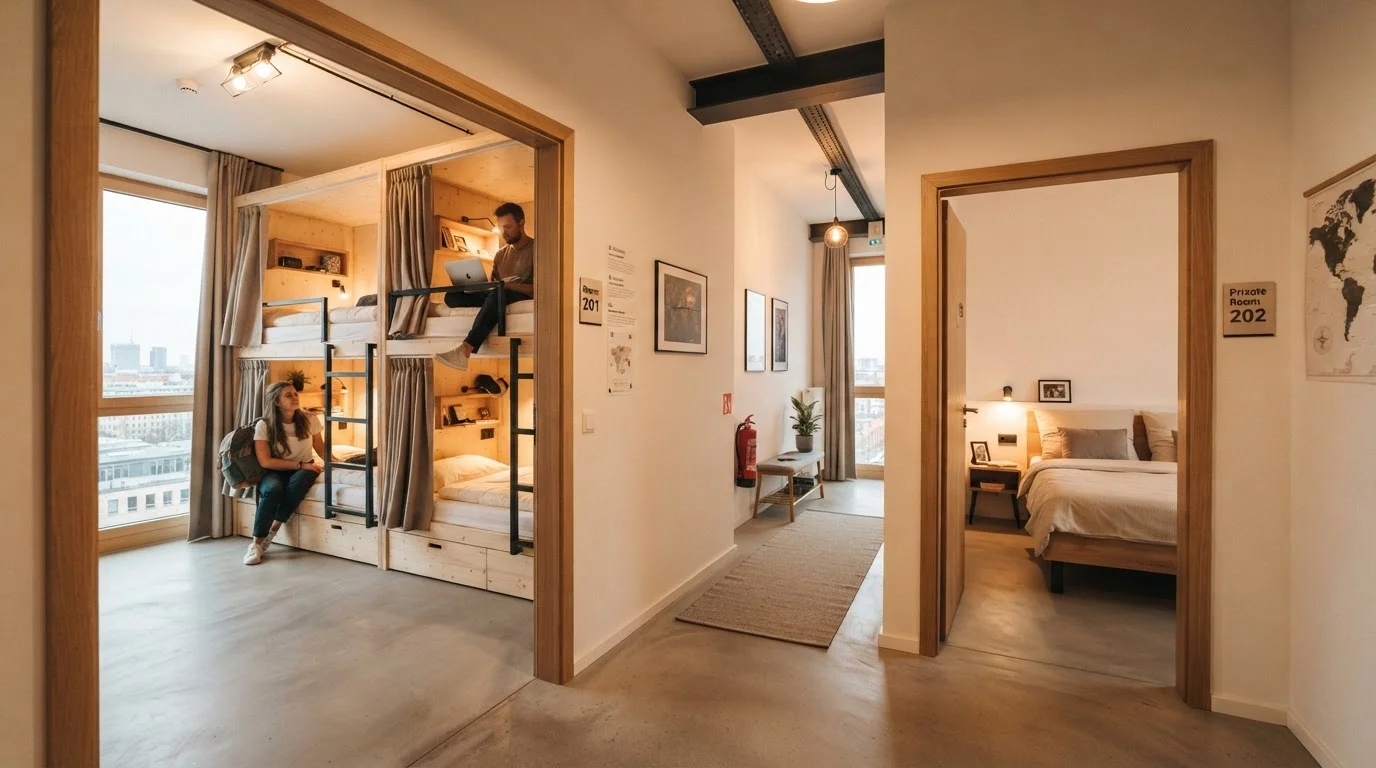
Key Takeaways
Option A
Shared Dorm Bed
The social, stripped-down sleep option.
Best for: Solo travelers and backpackers who prioritize saving money and meeting other travelers over guaranteed privacy and quiet.
Option B
Private Hostel Room
The midpoint between hostel vibe and hotel comfort.
Best for: Couples, light sleepers, or travelers who want hostel amenities and communal spaces without sharing a bedroom.
If you're traveling solo on a tight budget and want to connect with other travelers
Shared Dorm Bed
Dorm beds cut your nightly accommodation cost significantly and place you naturally in a social environment without extra effort.
If you're traveling as a couple or with a friend
Private Hostel Room
A private room at a hostel often costs less than two separate dorm beds while giving you shared space, quiet, and hostel common areas.
If you're a light sleeper or working remotely during your trip
Private Hostel Room
Dorm environments are unpredictable — late arrivals, phone alarms, and snoring are common. A private room protects your sleep and work focus.
If you're doing a long multi-city backpacking trip with many short stays
Shared Dorm Bed
Choosing dorms consistently across a long trip can free up meaningful budget for transportation, activities, or extending your journey.
If privacy and security of belongings are a primary concern
Private Hostel Room
A lockable private room removes the need to rely solely on luggage lockers and reduces exposure to petty theft risk common in open dorms.
The Core Trade-Off: Price vs. Privacy
The decision between a dorm bed and a private room in a hostel comes down to one fundamental exchange: how much comfort and privacy are you willing to trade for a lower nightly rate?
Dorm beds — typically in rooms of 4 to 12 bunks — are the foundation of hostel pricing. In many popular destinations across Europe, Southeast Asia, and Latin America, a dorm bed can run anywhere from $10 to $35 per night, while a private room in the same property might range from $45 to $90. That gap compounds quickly across a week or more of travel.
But price alone doesn't tell the whole story. What you give up in a dorm extends beyond space. You're sharing your sleeping environment with strangers who may keep different hours, use phones at night, or snore. You're managing your belongings in a shared locker rather than a lockable room. And your morning routine — packing, getting ready — happens in proximity to others.
For context on how hostels fit into the broader spectrum of budget lodging, see what separates hostels from guesthouses and budget hotels.
| Criterion | Shared Dorm Bed | Private Hostel Room |
|---|---|---|
| Typical nightly cost | Lower (often 40–70% less) | Higher per night |
| Privacy | None — shared with strangers | Full room privacy |
| Sleep reliability | Unpredictable; noise risk | Controlled environment |
| Social opportunity | High — built-in community | Opt-in via common areas |
| Security of belongings | Locker-dependent | Lockable room |
| Best for couples | Rarely cost-effective | Often lower per-person cost |
| Access to hostel amenities | Full access | Full access |
| Morning routine ease | Requires coordination | Move at your own pace |
What Each Option Actually Delivers Night to Night
Both room types sit within the same hostel ecosystem — meaning guests in dorms and private rooms typically share the same kitchen, common lounge, bathrooms (unless the private room is en suite), and social programming. The hostel experience isn't locked behind one room type.
Where the day-to-day difference shows up:
- Sleep quality: Dorms carry real unpredictability. Even well-run hostels can't control whether a bunkmate returns at 2 a.m. or sets a 5 a.m. alarm. Private rooms give you full control of your sleep environment.
- Social dynamics: Dorms are self-selecting social spaces. If you want to meet people, they're ideal. If you're introverted or simply tired, the social pressure can feel draining. Private rooms let you opt into communal spaces on your terms.
- Security: Most hostels provide lockers in dorms, but they vary in size and reliability. A private room, particularly one with a key lock, adds a meaningful layer of security for valuables and passports.
- Morning logistics: Getting ready in a dorm — especially a full one — requires coordination and patience. A private room lets you move at your own pace without disturbing others.
Solo travelers navigating these trade-offs for the first time will find a more detailed picture in our guide on what to realistically expect staying in a hostel solo.
40–70%
Typical dorm vs. private room price gap
In many hostels across popular backpacker destinations, dorm beds cost significantly less per night than private rooms within the same property.
4–12
Typical bunk count in a hostel dorm room
Smaller dorms (4–6 beds) generally offer quieter conditions and more locker space than larger shared rooms.
2x
Point where two dorm beds may equal one private room
For two travelers, the per-person cost of two dorm beds in a mixed room can approach or match the rate of a shared private room at the same hostel.
When the Math Favors One Over the Other
The financial case for dorms is clearest when you're traveling solo and staying multiple nights. Across a 10-night trip, choosing dorm beds over private rooms could represent $200–$500 in savings — enough to cover additional travel days or meaningful experiences.
The math shifts for couples. Two dorm beds in the same room aren't guaranteed, and even when available, two beds in a mixed dorm often approach or exceed the cost of a private room for two. Running a quick per-person cost comparison before booking is worth the two minutes it takes.
Trip type also matters. A high-movement itinerary — a new city every two or three nights — makes dorm costs add up slowly per stop. A slow-travel approach with a week in one place makes a private room feel more like a genuine home base worth the premium.
Travelers who want a middle-ground format — private sleeping pod with shared facilities — may find value in exploring capsule hotels and pod stays, which occupy a distinct category between dorms and full private rooms.
For a wider view of what budget lodging looks like globally, types of budget accommodation around the world offers a useful reference across different regions and formats.