

| Key anchor dates needed | Last spring frost date and first fall frost date (USDA cooperative extension services) |
| Warm-season crops: minimum soil temp | 60°F for reliable germination (General horticultural guidance) |
| Cool-season crops: max soil temp | 75°F before germination drops sharply (General horticultural guidance) |
| Succession sow interval | Every 2-3 weeks for continuous harvest |
| Fall crop indoor start window | 8-10 weeks before first fall frost |
| Frost date lookup (free) | County cooperative extension service (US nationwide resource) |
Why Timing Is the Most Overlooked Budget Tool in Gardening
Most garden waste isn't caused by bad soil or poor seeds - it's caused by planting at the wrong time. A tomato seedling set out two weeks before the last frost dies. Lettuce sown in midsummer heat bolts before you harvest a single leaf. Each failure costs you money: seeds, starts, water, and time. Getting your timing right is the single highest-leverage habit a budget-minded gardener can build.
The good news is that a seasonal planting calendar doesn't require expensive software or a horticulture degree. It requires knowing two dates - your average last spring frost and your average first fall frost - and working backward and forward from those anchors. Every other planting decision follows from there.
If you're just starting out, see how to grow on a budget from the beginning before committing seed money to a plan. And if wasted spending is already a pattern, these common expensive gardening habits may be compounding the timing problem.
| Key anchor dates needed | Last spring frost date and first fall frost date (USDA cooperative extension services) |
| Warm-season crops: minimum soil temp | 60°F for reliable germination (General horticultural guidance) |
| Cool-season crops: max soil temp | 75°F before germination drops sharply (General horticultural guidance) |
| Succession sow interval | Every 2-3 weeks for continuous harvest |
| Fall crop indoor start window | 8-10 weeks before first fall frost |
| Frost date lookup (free) | County cooperative extension service (US nationwide resource) |
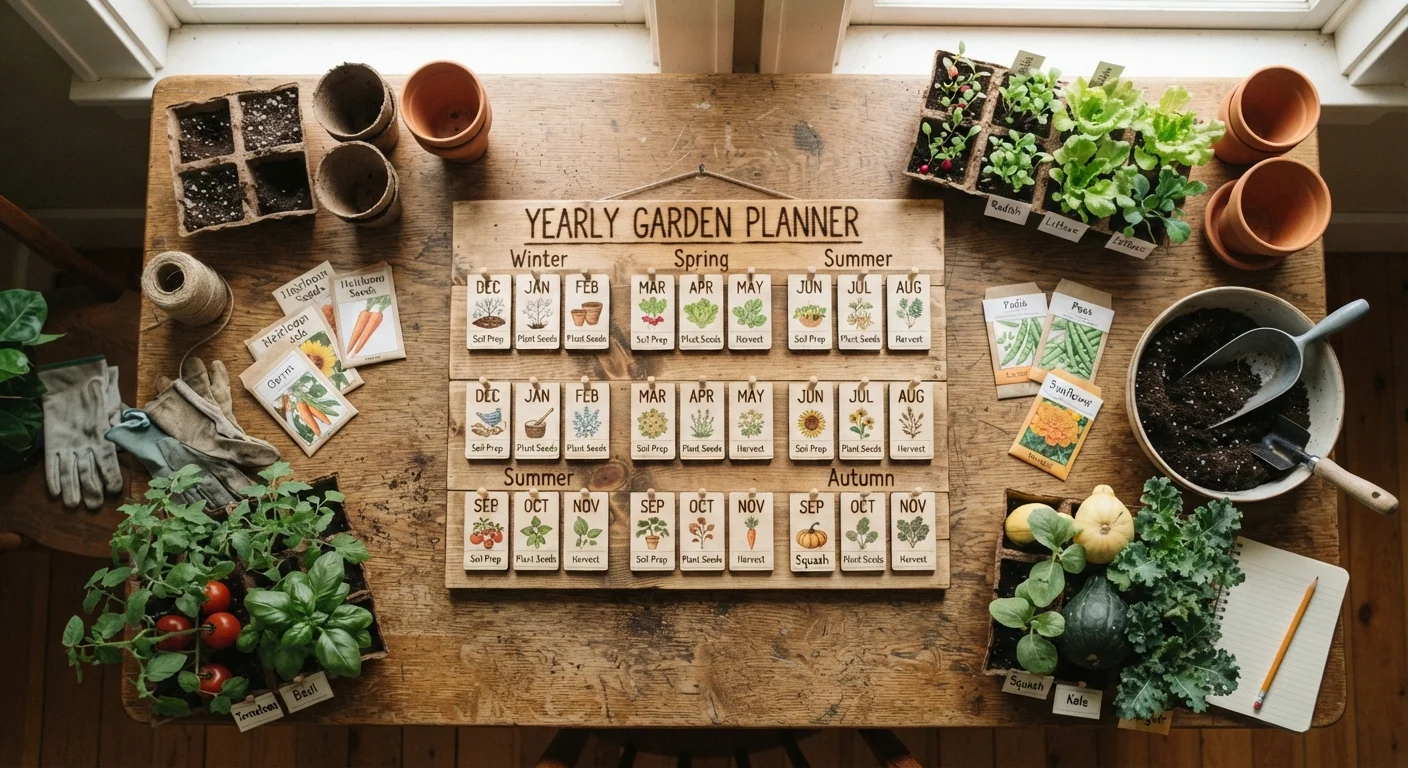
The Seasonal Reference Calendar: What to Plant and When
The windows below apply to temperate US growing zones (roughly USDA Zones 5-8). Adjust by two to three weeks earlier for warmer zones and two to three weeks later for colder ones. Verify your local frost dates through your county's cooperative extension service - these are free, regionally accurate resources.
Late Winter (6-8 Weeks Before Last Frost)
- Start indoors: tomatoes, peppers, eggplant, celery
- Direct sow outdoors (cold-hardy): spinach, kale (in mild zones only)
- Soil prep: turn compost into beds; test pH if not done in fall
Early Spring (2-4 Weeks Before Last Frost)
- Start indoors: basil, squash, cucumbers, melons
- Direct sow outdoors: peas, radishes, carrots, beets, lettuce, onion sets
- Transplant outdoors: broccoli, cabbage, kale started earlier
Late Spring (After Last Frost)
- Transplant outdoors: tomatoes, peppers, eggplant, basil
- Direct sow outdoors: beans, squash, cucumbers, corn, sunflowers
- Note: Do not rush warm-season transplants - cold soil stunts root development even when air temps are acceptable.
Summer
- Succession sow: beans, radishes, salad greens (in partial shade)
- Start fall crops indoors (8-10 weeks before first fall frost): broccoli, cabbage, cauliflower
- Direct sow (mid to late summer): carrots, beets, turnips for fall harvest
Early Fall (6-8 Weeks Before First Fall Frost)
- Transplant outdoors: fall brassicas started in summer
- Direct sow: spinach, arugula, mâche, garlic (for overwintering)
- Cover crops: winter rye, clover to protect and enrich soil
Last Frost Date
The average date of the final freezing temperature in spring for a given location. Warm-season crops should not be planted outdoors before this date. Local cooperative extension services provide regionally accurate estimates.
First Fall Frost Date
The average date when freezing temperatures first return in autumn. Used to count backward to determine when to start or transplant fall crops.
Succession Planting
The practice of staggering sowings of the same crop every two to three weeks to spread out harvests and reduce waste from simultaneous gluts.
Bolting
When a plant prematurely shifts energy to flowering and seed production, usually triggered by heat or long days. Bolted leafy greens become bitter and inedible, representing a complete crop loss.
Open-Pollinated Variety
A plant variety that produces seeds reliably true to the parent plant when self- or cross-pollinated. Seeds can be saved and replanted, making them more cost-effective than hybrid varieties over multiple seasons.
Cover Crop
A crop grown primarily to protect and improve soil during the off-season rather than for food harvest. Common examples include winter rye and clover, which suppress weeds and add organic matter.
At season's end, don't skip the prep work that protects next year's budget. The end-of-season garden checklist walks through soil protection, seed saving, and affordable winterizing steps.
Stretching Seeds Further With Smart Timing Practices
Succession planting is the practice of sowing small batches of the same crop every two to three weeks rather than all at once. This prevents a glut you can't use while keeping a steady harvest flowing. One packet of lettuce seed, properly succession-sown, can supply greens for months rather than one overwhelming harvest.
Soil temperature matters more than air temperature. Cool-season crops like peas and spinach germinate poorly above 75°F soil temp. Warm-season crops like basil and beans stall below 60°F. An inexpensive soil thermometer removes the guesswork and prevents failed germination that wastes seed.
Save and reuse seeds from open-pollinated varieties to eliminate rebuying costs year after year. Time your final harvest to let a few specimens fully mature for seed collection. For free seed sourcing beyond what you save yourself, seed libraries and plant swaps in your community are worth finding.
Feed your timing with free fertility. Compost created from kitchen scraps costs nothing and applied at the right planting windows - early spring bed prep and mid-season side-dressing - reduces or eliminates purchased fertilizer costs. Starting a home compost system is straightforward and pays returns every season. For gardeners working with limited outdoor space, container gardening on a tight budget pairs well with a seasonal calendar to keep potted plants productive.