

Key Takeaways
Significant labor cost savings on simple tasks
Labor is the largest line item on most repair invoices. For straightforward jobs, doing it yourself eliminates that cost entirely, often saving $75-$200 per visit even for minor work.
Immediate response to small problems
A dripping faucet or loose hinge doesn't have to wait for a contractor's schedule. DIY allows you to address minor issues before they escalate - a direct financial benefit.
Builds practical home maintenance knowledge
Each repair you complete successfully reduces dependency on paid services for future similar tasks, compounding savings over time.
Material costs are often very low
For repairs like caulking, patching, or replacing hardware, the supplies frequently cost less than $30 - a fraction of the minimum service call fee for most tradespeople.
Flexible timing and pace
You can work around your own schedule without coordinating with contractors or paying premium rates for urgent call-outs.
Electrical and gas work carries serious safety risk
Mistakes with wiring or gas lines can cause fires, carbon monoxide exposure, or electrocution. In most US jurisdictions, this work requires a licensed electrician or plumber and a permit - doing it unpermitted can affect your homeowner's insurance coverage.
Botched repairs can exceed original professional cost
A DIY repair that fails or creates secondary damage - such as improper pipe joining that leads to a slow leak inside a wall - can result in remediation costs that are multiples of the original job.
Hidden complexity reveals itself once work begins
What looks like a simple tile replacement can expose a rotted subfloor. What looks like a faucet swap can reveal corroded supply lines requiring re-piping. The scope can expand quickly.
Tool investment reduces or eliminates savings
Specialty tools required for a single repair - tile saws, pipe threaders, or concrete drills - can cost more than hiring a professional for that specific job.
Unpermitted work can complicate home sales
Repairs or alterations that required permits and inspections, but didn't get them, can surface during a home inspection and require costly remediation before a sale can close.
Time cost is often underestimated
First-time repairs frequently take two to four times longer than expected. For homeowners with constrained time, the opportunity cost of a long weekend project may outweigh the labor savings.
Our Verdict
DIY home repair genuinely pays off when the task is well-defined, low-risk, and within your skill set. The savings on labor can be substantial for jobs like faucet replacement, drywall patching, or fence repair. However, repairs involving electricity beyond outlets, gas supply, structural elements, or work requiring permits are areas where the cost of getting it wrong - in safety, liability, or remediation - routinely exceeds any labor savings.
Homeowners with basic mechanical aptitude who want to reduce maintenance costs on straightforward, non-hazardous repairs while knowing when to call a licensed professional.
Why the DIY Question Isn't Simply About Money
Labor typically accounts for 40-60% of a home repair bill. That gap is real, and it explains why so many homeowners reach for their own tools first. But the calculation isn't only about hourly rates. It also includes the cost of mistakes, the risk of voiding insurance, permit requirements, and the reality that some repairs are physically dangerous to get wrong.
The goal here isn't to discourage DIY - it's to help you direct your effort where it genuinely pays off. For a broader look at how neglected repairs compound in cost over time, see how deferred maintenance compounds.
Significant labor cost savings on simple tasks
Labor is the largest line item on most repair invoices. For straightforward jobs, doing it yourself eliminates that cost entirely, often saving $75-$200 per visit even for minor work.
Immediate response to small problems
A dripping faucet or loose hinge doesn't have to wait for a contractor's schedule. DIY allows you to address minor issues before they escalate - a direct financial benefit.
Builds practical home maintenance knowledge
Each repair you complete successfully reduces dependency on paid services for future similar tasks, compounding savings over time.
Material costs are often very low
For repairs like caulking, patching, or replacing hardware, the supplies frequently cost less than $30 - a fraction of the minimum service call fee for most tradespeople.
Flexible timing and pace
You can work around your own schedule without coordinating with contractors or paying premium rates for urgent call-outs.
Repairs Where DIY Consistently Delivers Savings
Certain repair categories are well-suited to a capable, informed homeowner. They share a few traits: the scope is predictable, the failure mode is visible, no permit is required, and the materials are readily available.
- Leaky faucets and running toilets. Replacing a flapper, cartridge, or supply line is one of the highest-return DIY tasks. Parts typically cost under $20, and the repair prevents water waste that adds up on utility bills.
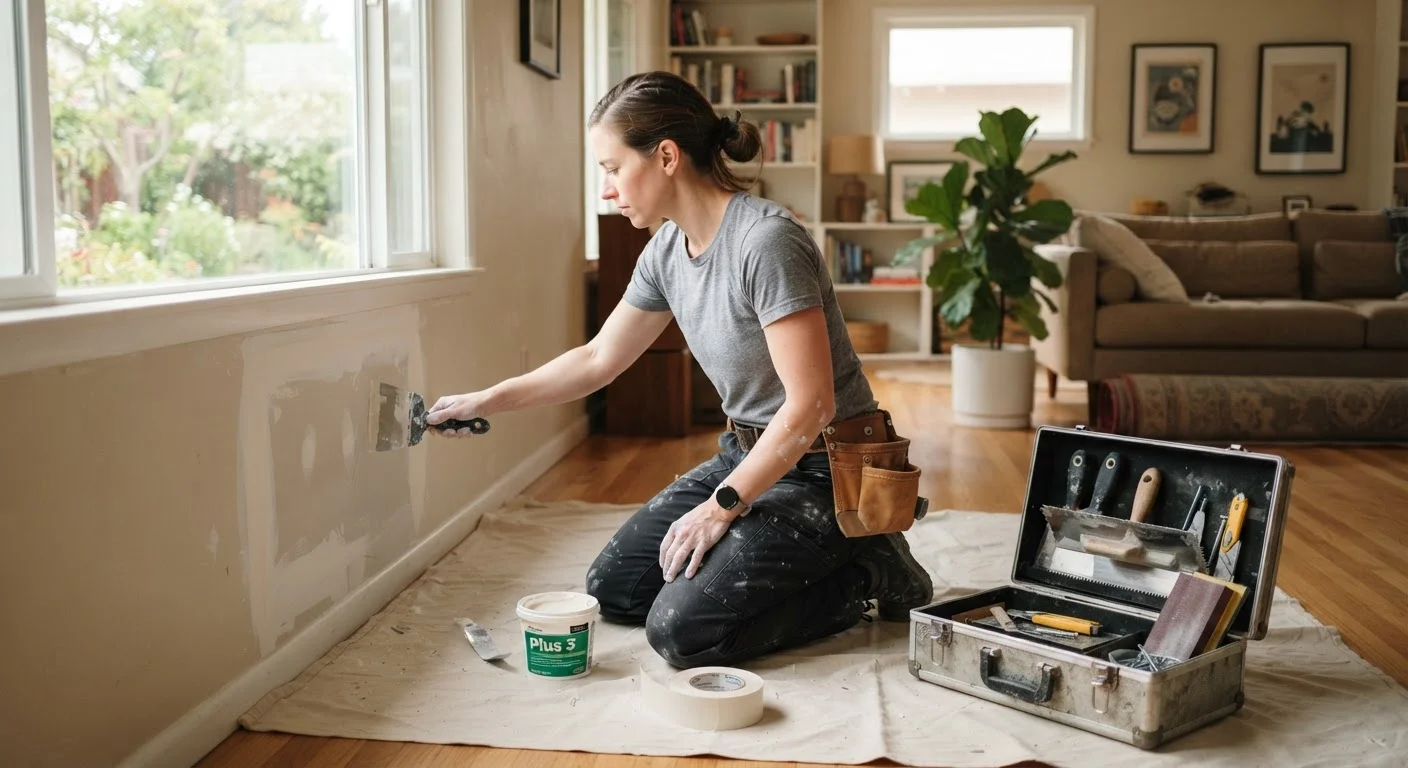
- Drywall patching. Small holes from doorknobs, nails, or anchors are straightforward. Mesh patch kits, joint compound, and a bit of sanding can restore a wall for a few dollars in materials.
- Caulking and weatherstripping. Failing caulk around tubs, windows, and exterior penetrations is a direct path to water damage. Recaulking is low-skill, low-cost, and high-impact - it also contributes to home energy savings by sealing air leaks. For more on when caulk failure becomes serious, see why caulk fails and when it matters.
- Fence panel and post repair. A leaning post or split rail doesn't require a contractor. Targeted fence repairs can extend the life of a fence significantly without full replacement cost.
- Painting interior walls. Properly prepped surfaces, appropriate primer, and patience produce results comparable to a professional at a fraction of the cost - provided cracks are patched first, not painted over.
40-60%
Labor's share of average repair costs
Industry estimates consistently place labor at roughly half of total home repair invoices, making it the primary driver of potential DIY savings.
~$150
Typical minimum service call fee
Many licensed tradespeople charge a minimum visit fee before any work begins, which makes small DIY repairs - completed for under $30 in materials - particularly cost-effective.
35%
DIY repairs that expand in scope unexpectedly
Home improvement surveys have suggested that a significant share of DIY projects encounter unforeseen complications once walls, floors, or ceilings are opened up.
Repairs Where DIY Tends to Cost More in the End
Some repairs look approachable until you open the wall. Others are regulated for safety reasons that exist because the consequences of failure are severe. Recognizing these categories before you start is the most valuable skill a DIYer can develop. For a practical decision framework, see hiring vs. DIY framework.
Electrical and gas work carries serious safety risk
Mistakes with wiring or gas lines can cause fires, carbon monoxide exposure, or electrocution. In most US jurisdictions, this work requires a licensed electrician or plumber and a permit - doing it unpermitted can affect your homeowner's insurance coverage.
Botched repairs can exceed original professional cost
A DIY repair that fails or creates secondary damage - such as improper pipe joining that leads to a slow leak inside a wall - can result in remediation costs that are multiples of the original job.
Hidden complexity reveals itself once work begins
What looks like a simple tile replacement can expose a rotted subfloor. What looks like a faucet swap can reveal corroded supply lines requiring re-piping. The scope can expand quickly.
Tool investment reduces or eliminates savings
Specialty tools required for a single repair - tile saws, pipe threaders, or concrete drills - can cost more than hiring a professional for that specific job.
Unpermitted work can complicate home sales
Repairs or alterations that required permits and inspections, but didn't get them, can surface during a home inspection and require costly remediation before a sale can close.
Time cost is often underestimated
First-time repairs frequently take two to four times longer than expected. For homeowners with constrained time, the opportunity cost of a long weekend project may outweigh the labor savings.
When Permits Are Required - and Why It Matters
In most US jurisdictions, work involving electrical circuits, plumbing beyond fixture replacement, structural changes, HVAC modifications, or additions requires a building permit and inspection. Skipping permits isn't just a legal risk - it can void your homeowner's insurance for related claims and create serious problems when selling the home. Always check with your local building department before starting any project that goes beyond surface-level repairs.
Even repairs that initially seem contained - replacing a light fixture, for example - can reveal knob-and-tube wiring, a junction box that isn't code-compliant, or insulation that needs to be moved. Reading a repair job before you start can prevent you from committing to work that quickly outpaces your ability or tools.
Misidentifying DIY-friendly repairs is also more common than many homeowners expect. Common DIY myths - like the idea that paint conceals cracks - lead to recurring repairs that cost more cumulatively than a single professional fix would have.